
- Catalogs
- OI Analytical
- Aurora 1030W TOC Analyzer


Aurora 1030W TOC Analyzer

Aurora 1030W TOC Analyzer
Catalog excerpts

Aurora 1030W Total Organic Carbon Analyzer
Open the catalog to page 1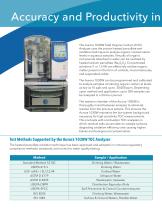
Accuracy and Productivity in The Aurora 1030W Total Organic Carbon (TOC) Analyzer uses the proven heated persulfate wet oxidation technique to analyze organic contamination levels in aqueous samples. Virtually all organic compounds dissolved in water can be oxidized by heated sodium persulfate (Na2S208). Concentrated solutions (1 or 1.5 M) can effectively oxidize organic matter present in the form of colloids, macromolecules, and suspended solids. The Aurora 1030W can be programmed and calibrated to analyze samples containing organic carbon at levels as low as 10 ppb and up to 30,000 ppm. Depending...
Open the catalog to page 2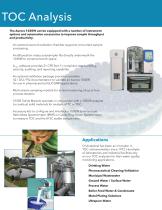
TOC Analysis The Aurora 1030W can be equipped with a number of instrument options and automation accessories to improve sample throughput and productivity. · An optional second oxidation chamber supports concurrent sample processing. · An 88-position rotary autosampler fits directly underneath the 1030W to conserve bench space. · ATOC software provides 21 CFR Part 11 compliant data handling, security, auditing, and reporting capability. · An optional validation package provides complete IQ / OQ / PQ documentation to validate an Aurora 1030W for use in pharmaceutical GLP/GMP applications. · Multi-stream...
Open the catalog to page 3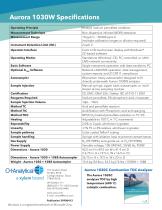
Aurora 1030W Specifications Operating Principle Heated sodium persulfate oxidation Measurement Technique Measurement Range Non-dispersive infrared (NDIR) detection 10 ppb C – 30,000 ppm C (multiple calibration ranges or dilution required) 2 ppb C Instrument Detection Limit (IDL) Operator Interface Operating Modes Basic Software Optional ATOC Software Autosampler Sample Injection Certification Reagents Required Sample Injection Volume Method TC Method TIC Method TOC Heating Repeatability Linearity Sample pathway Sample handling Gas Supply Power Supply Dimensions – Aurora 1030 Dimensions – Aurora...
Open the catalog to page 4All OI Analytical catalogs and technical brochures
 Eclipse 4760
2 Pages
 4551A Water Autosampler
2 Pages
 4450 PID/FID
2 Pages
 1080 TOC Analyzer
8 Pages
 5383 PFPD
2 Pages
 4430 PID
2 Pages
 Aurora 1030D Spec Sheet
2 Pages


Archived catalogs
 5320 ELCD
2 Pages
 5360/5360A XSD™
2 Pages
 Dumatherm Brochure
7 Pages
 Soxtherm Brochure
7 Pages
 CHROM-LINK®
2 Pages
 Hydrotherm Brochure
7 Pages
 Nutrient Pollution Analysis
4 Pages
 Food Safety & Quality
4 Pages
 Series 4000 MINICAMS®
2 Pages


- Analysis software
- Sample preparation system
- Automatic sample processor
- Control software
- Laboratory testing system
- Reporting software
- Laboratory software
- Laboratory sample preparation system
- Benchtop sample preparation system
- Automated software
- Traceability software
- Control analyser
- Analyser for the pharmaceutical industry
- Transparent tubing
- Temperature testing system
- Chromatography system
- Flow testing system
- Environmental analysis tester
- Testing system with touchscreen
- Medical gas tubing