
- Catalogs
- OLIGA MAKINA ELEKTRONIK ITHALAT IHRACAT SANAYI VE TICARET LIMITED SIRKETI
- Navy A/R Femoral Nail

Navy A/R Femoral Nail
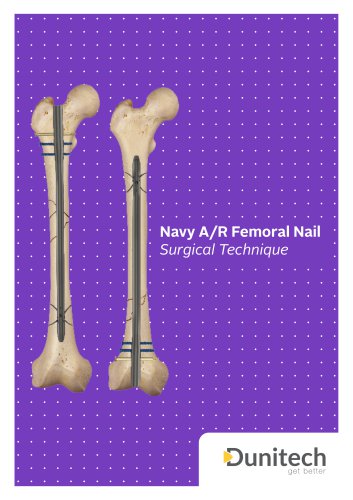
Navy A/R Femoral Nail
The document describes the surgical technique for the Navy A/R Femoral Nail, highlighting the use of innovative claw technology for improved stability in orthopedic procedures. The titanium claws provide superior fixation by anchoring into the cortical bone, reducing surgical time, radiation exposure, and the need for additional incisions.
The nail is available in lengths from 280 mm to 460 mm, with proximal diameters of 13 mm and distal diameters ranging from 10 mm to 13 mm. The distal claw spans up to 38 mm, and the compression range is 10 mm.
The nail is indicated for various femoral fractures, including femoral shaft fractures and osteoporotic fractures. Contraindications include use in legs with total knee implants and certain distal fractures. Precautions are advised for patients with infections, incomplete epiphyseal fusion, or metal sensitivity.
- Patient Positioning and Fracture Reduction: The patient is positioned supine or in lateral decubitus, with traction applied to the affected leg for fracture reduction.
- Incision and Entry Point: A longitudinal incision is made proximal to the greater trochanter, with the entry point aligned with the femoral medullary canal.
- Accessing the Canal: Options include using a trocar tip guide wire or an entry awl with a guide wire to access the canal.
- Proximal Reaming: The proximal femur is reamed to the desired depth using a Navy Entry Reamer, with care taken to avoid displacing the fracture.
- Attaching and Inserting the Nail: The nail is attached and inserted, with alignment checked before deploying the claws for fixation.
- Locking and Compression: Distal and proximal locking screws are inserted, and compression is applied as needed.
- Inserting End Cap: An end cap is inserted to complete the procedure.
The procedure for nail removal involves removing the end cap, cortical screws, retracting the claws, and removing the nail using a flexible shaft.
The Navy A/R Femoral Nail system, with its claw technology, offers a reliable and efficient solution for femoral fracture fixation, minimizing surgical complications and improving patient outcomes.
This document outlines the surgical technique for the insertion of a Navy intramedullary nail, detailing the steps and instruments required for fracture reduction, nail insertion, and fixation.
- Patient Positioning and Fracture Reduction: The patient is positioned supine with the leg flexed to assist in fracture reduction. The fracture is reduced using manual traction or a distraction device, and the entry point is identified.
- Incision and Entry Point: A midline skin incision is made, and the entry point is aligned with the femoral medullary canal.
- Accessing the Canal: Two options are provided for accessing the canal: using a Trocar Tip Guide Wire or an Entry Awl with a Trocar Tip Guide Wire.
- Proximal Reaming: The guide wire is used to guide the Entry Reamer, which reams the distal femur to the desired depth.
- Determining the Nail Length: The appropriate Navy Radiographic Claw Template is used to determine the nail length, considering expected compression.
- Distal Reaming: The canal is reamed to at least 1 mm above the desired nail diameter.
- Attaching the Nail: The nail is attached to the Navy Guide Handle, ensuring alignment with the correct marks for the approach used.
- Checking Alignment: Alignment is checked using the Guide Arm and Drill Sleeve.
- Inserting the Nail: The nail is inserted over the guide wire with steady pressure.
- Deploying Claws: The Claws are deployed using the Navy Claw Deployment Driver and Torque Limiting Handle.
- Proximal Locking: Drilling for the locking screw is performed, and the screw is inserted and secured.
- Compression: Compression is applied using the Navy Compressor, with up to 10 mm of compression possible.
- Inserting End Cap: The final nail head position is checked, and the end cap is inserted and secured.
Various instruments are listed for each step, including guide wires, reamers, drivers, and handles, each with specific part numbers for reference.
This document provides technical specifications and details for the Navy surgical tool set, including various components and their respective catalogue codes. It also outlines the availability of these products based on regional regulatory and medical practices.
The document lists various components of the Navy surgical tool set, including end caps with extensions ranging from 0 to 35 mm, and cortical screws with diameters of 5 mm and lengths ranging from 30 to 120 mm.
- Navy Tray 1: Includes items such as the Navy Guide Arm, Tissue Protector, Handle-Arm Connector Screw, Navy Claw Deployment Driver, and Navy Compressor.
- Navy Tray 2: Contains tools like the 5 mm Hex Driver, Guide Wire Pusher, Reduction Awl, Extractor, and Torque Limiting Handle.
- Navy Tray 3: Features instruments such as the 4.2 mm Drill Bit, 7 mm Hex Driver, Trocar, Screw Sleeve, and Drill Sleeve.
The availability of these products is subject to regional regulatory and medical practices. Users are advised to contact their Dunitech representative for specific information regarding product availability in their area.
Dunitech is a registered brand of Oliga Makina Elektronik Sanayi Ltd. Sti., located in Ankara, Turkey. Contact details and website information are provided for further inquiries.
Catalog excerpts
Navy A/R Femoral Nail Surgical Technique Navy Surgical Technique
Open the catalog to page 1
Special thanks to Contributing Surgeons, Yalkın ÇAMURCU, MD, Department of Orthopedics and Traumatology Medical Faculty of Erzincan University Erzincan, Turkey Mehmet Cenk Cankuş, MD, FEBOT Department of Orthopedics and Traumatology Medical Faculty of Sanko University Gaziantep, Turkey
Open the catalog to page 2
Get Better Expertise and enthusiasm can be perfectly combined into a top-notch medical engineering company! We contribute to the development of health services by providing superior technology products at competitive costs. We envision a socially conscious business environment serving the health industry and patients get better. Dunitech branded products are designed and engineered to keep our promise; Easier Operation Better Fixation
Open the catalog to page 3
Navy A/R Femoral Nail Specifications Navy A/R Femoral Nail Indications TABLE OF CONTENTS Navy A/R Femoral Nail RETROGRADE APPROACH
Open the catalog to page 4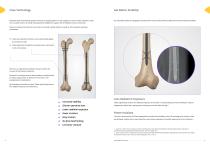
Claw Technology Dunitech leads innovational systems and aims to supply options for the surgeons to excel at their expertise. Claws are a novelty solution on distal locking systems designed to support the orthopedic trauma community. Six retractable Claws are designed to penetrate the cortex and provide exceptional axial and rotational stability. Claws are titanium pins that act as anchors to provide a stable fixation, as well as other superior operative parameters. Claws are made from titanium, and mechanically deploy from within the nail. Claws penetrate through the cancellous bone, and anchor...
Open the catalog to page 5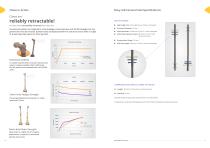
Navy A/R Femoral Nail Specifications reliably retractable! All Claws were successfully retracted after every test. Nail length: 280 mm to 460 mm in 20 mm increment Conventional systems are subjected to screw breakage, screw head wear and drill bit breakage that may prevent the nail to be removed. Dunitech Claws are deployed within the nails from precise holes in a tight fit, preventing empty spaces for bone ingrowth. Distal Diameter: 10 mm to 13 mm in 1 mm increment Distal Claw Maximum Span: 38 mm (11-12-13 mm) 26 mm (10 mm) Cumulative Rotation(deg) Rotational Stability In unstable subtrochanteric...
Open the catalog to page 6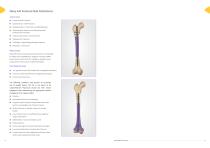
Navy A/R Femoral Nail Indications INDICATIONS ● Femoral Shaft Fractures Ipsilateral hip / shaft fractures Ipsilateral femur / tibia fractures (floating knee) Supracondylar fractures including those with intraarticular extension Fractures proximal to a knee implant Osteoporotic fractures Pathologic / impending pathologic fractures Malunions / nonunions PRECAUTIONS Navy A/R Femoral nails and accessories were not evaluated for safety and compatibility in magnetic resonance (MR) environment and no tests for heating or migration were conducted for this product in MR environment. CONTRAINDICATIONS...
Open the catalog to page 7
Surgical Technique
Open the catalog to page 8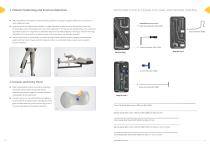
1. Patient Positioning and Fracture Reduction INSTRUMENTS FOR ACCESSING THE CANAL AND PROXIMAL REAMING Place the patient in the supine or lateral decubitus position according to surgeon preference on a fracture or other radiolucent table. Navy Entry Reamer (N03-0030) Apply traction to the affected leg and place it in slight adduction to ease access to the piriformis fossa and intramedullary canal. Alternatively, the torso can be abducted 10-15° towards the unaffected leg. The unaffected leg should be placed in a leg holder or extended away from the affected leg (Fig-1 and Fig-2). Position the...
Open the catalog to page 9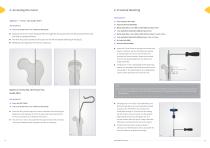
4. Proximal Reaming INSTRUMENTS: Option 1: Trocar Tip Guide Wire Tissue Protector (N01-0150) Navy Entry Reamer (N03-0030) Ball Tip Guide Wire 2 mm x 900 mm (N01-0290), for Navy 10 mm Trocar Tip Guide Wire 3 mm x 600 mm (N01-0250) 2 mm Guide Wire Sheath (N01-0300), for Navy 10 mm ● Advance the 3 mm Trocar Tip Guide Wire through the entry point and into the proximal femur with the help of a powered driver. Ball Tip Guide Wire 3 mm x 900 mm (N01-0270), for Navy 11 mm to 13 mm 3 mm Guide Wire Sheath (N01-0280), for Navy 11 mm to 13 mm ● The wire should be centered in the canal on the AP and lateral...
Open the catalog to page 10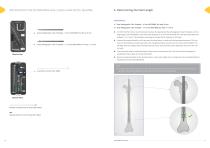
INSTRUMENTS FOR DETERMINING NAIL LENGTH AND DISTAL REAMING 5. Determining the Nail Length INSTRUMENTS: Navy Radiographic Claw Template - 10 mm (N03-0080), for Navy 10 mm Navy Radiographic Claw Template - 11-13 mm (N03-0090), for Navy 11-13 mm Navy Radiographic Claw Template - 10 mm (N03-0080), for Navy 10 mm Confirm that the fracture is well reduced and place the appropriate Navy Radiographic Claw Template over the thigh (Fig-9). Use N03-0080 for nails with distal diameter of 10 mm and N03-0090 for nails with distal diameters between 11 to 13 mm. The template shows approximately the full opening...
Open the catalog to page 11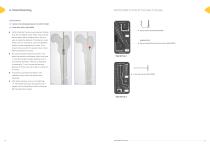
INSTRUMENTS FOR ATTACHING THE NAIL INSTRUMENTS: Dunitech Intramedullary Reamer Set (INST-01-002) Guide Wire Pusher (N01-0060) ● Navy Guide Handle (N03-0060) Confirm that the fracture is well reduced. Starting from 8.5 mm Reamer Cutter Head, ream until the desired depth with a steady pressure. By each pass, increase the diameter of the Reamer Cutter Head in 0.5 mm increments. Use the Guide Wire Navy Handle-Nail Connector Screw (N03-0070) Pusher to keep the guide wire in place. If the sheath comes out with the reamer, insert it back before starting the next pass. ● The canal should be reamed to...
Open the catalog to page 12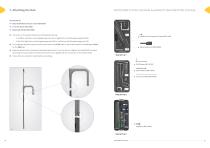
INSTRUMENTS FOR CHECKING ALIGNMENT AND INSERTING THE NAIL INSTRUMENTS: Navy Handle-Nail Connector Screw (N03-0070) 7 mm Hex Driver (N01-0030) Navy Guide Handle (N03-0060) ● The marks on the Guide Handle have the following meaning: Handle-Arm Connector Screw (N01-0140) 3 LA/RR for Left femur and Antegrade approach (LA) or Right femur and Retrograde approach (RR). 3 RA/LR for Right femur and Antegrade approach (RA) or Left femur and Retrograde approach (LR). ● For Antegrade approach, align the mark on the nail to the LA/RR mark on the Guide Handle for the Left leg or RA/LR Navy Guide Arm (N03-0050)...
Open the catalog to page 13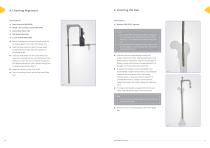
Handle - Arm Connector Screw (N01-0140) Screw Sleeve (N01-0130) 4 If the Guide Wire Sheath has not been removed, it has to be removed in before the insertion of the nail (Fig-11). The Sheath will not pass through the nail. Before inserting the nail check the nail’s holes are correctly aligned to the holes of the Guide Arm. 4 If a traditional ball tip guide wire was used, it must be exchanged for a smooth guide wire. Its tip won’t pass through the nail. Mate the Navy Guide Arm with the Navy Guide Handle and secure them with the Handle-Arm Connector Screw. Insert the Drill Sleeve into the Screw...
Open the catalog to page 14All OLIGA MAKINA ELEKTRONIK ITHALAT IHRACAT SANAYI VE TICARET LIMITED SIRKETI catalogs and technical brochures
 Neon Proximal Femoral Nail
33 Pages
 Nite Tibial Nail
27 Pages