
- Catalogs
- Oniix Group
- BC series

BC series
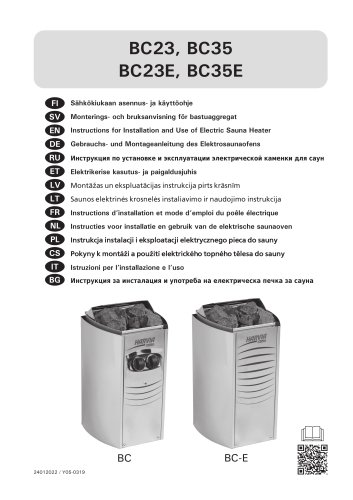
BC series
- Ensure the device is in a warm environment before installation to prevent the overheat protector from activating at temperatures below -5˚C (23˚F). The protector can be reset when the device reaches approximately 18˚C (64˚F).
- Detailed steps are provided for mounting the heater on the wall, making electrical connections, and installing the control unit and sensor.
- Instructions cover the piling of sauna stones, heating the sauna, and using the heater, including immediate activation and pre-set timers.
- Guidance on adjusting temperature and throwing water on the stones for steam is included.
- Warnings and troubleshooting tips are provided to ensure safe operation.
- Regular maintenance is necessary to ensure optimal performance and longevity of the heater.
- Sections on sauna room construction, ventilation, and hygiene are included to support proper installation and use.
- Spare parts and electrical connection details for specific regions (Norway, Belgium) are also provided.
Catalog excerpts

BC23, BC35 BC23E, BC35E Sähkökiukaan asennus- ja käyttöohje Monterings- och bruksanvisning för bastuaggregat Instructions for Installation and Use of Electric Sauna Heater Gebrauchs- und Montageanleitung des Elektrosaunaofens Инструкция по установке и эксплуатации электрической каменки для саун Elektrikerise kasutus- ja paigaldusjuhis Montà¾as un ekspluatàcijas instrukcija pirts kràsnïm Saunos elektrinìs krosnelìs instaliavimo ir naudojimo instrukcija Instructions d’installation et mode d’emploi du poêle électrique Instructies voor installatie en gebruik van de elektrische saunaoven Instrukcja instalacji i eksploatacji elektrycznego pieca do sauny Pokyny k montá¾i a pou¾ití elektrického topného tìlesa do sauny Istruzioni per l’installazione e l’uso Инст
Open the catalog to page 1
! EN: Overheat protector of the device can go off also at temperatures below -5˚C / 23˚F (storage, transport, environment). Before installation take the device to the warm environment. The overheat protector can be reset when the temperature of the device is approx 18˚C / 64˚F. The overheat protector must be reset before using the device. See the user manual > Resetting the Overheat Protector. DE: Der Überhitzungsschutz des Geräts kann auch bei Temperaturen unter -5 °C / 23˚F (Lagerung, Transport, Umgebung) auslösen. Bringen Sie das Gerät vor der Installation in eine warme Umgebung. Der Überhitzungsschutz...
Open the catalog to page 2
do. La protezione da surriscaldamento può essere reimpostata quando la temperatura del dispositivo è di circa 18˚C/64˚F. La protezione da surriscaldamento deve essere reimpostata prima di utilizzare il dispositivo. Vedere il manuale dell’utente > Reimpostazione della protezione da surriscaldamento. PT: O protetor de sobreaquecimento do dispositivo pode também desligar-se a temperaturas inferiores a -5º C / 23º F (armazenamento, transporte, ambiente). Antes da instalação, leve o dispositivo para um ambiente quente. O protetor de sobreaquecimento pode ser reposto quando a temperatura do dispositivo...
Open the catalog to page 3
Tämä asennus- ja käyttöohje on tarkoitettu saunan omistajalle tai saunan hoidosta vastaavalle henkilölle sekä kiukaan sähköasennuksesta vastaavalle sähköasentajalle. Kun kiuas on asennettu, luovutetaan nämä asennus- ja käyttöohjeet saunan omistajalle tai saunan hoidosta vastaavalle henkilölle. Lue käyttöohjeet huolellisesti ennen käyttöönottoa. Kiuas on tarkoitettu lämmittämään saunahuone saunomislämpötilaan. Muuhun tarkoitukseen käyttö on kielletty. Parhaat onnittelut hyvästä kiuasvalinnastanne! Takuu: • Perhekäytössä kiukaiden ja ohjauslaitteiden takuuaika on kaksi (2) vuotta. • Yhteisökäytössä...
Open the catalog to page 4
These instructions for installation and use are intended for the owner or the person in charge of the sauna, as well as for the electrician in charge of the electrical installation of the heater. After completing the installation, the person in charge of the installation should give these instructions to the owner of the sauna or to the person in charge of its operation. Please read the instructions for use carefully before using the heater. Diese Montage- und Gebrauchsanleitung richtet sich an den Besitzer der Sauna oder an die für die Pflege der Sauna verantwortliche Person, sowie an den für...
Open the catalog to page 5
RU Данная инструкциия по установке и эксплуатации предназначена для владельца сауны либо ответственного за нее лица, а также для электрика, осуществляющего подключение каменки. После завершения установки эта инструкция должна быть передана владельцу сауны или лицу, ответственному за ее эксплуатацию. Тщательно изучите инструкцию по эксплуатации перед тем, как пользоваться каменкой. Каменка разработана для нагрева парилки сауны до необходимой для парения температуры. Ее запрещается использовать в любых других целях. Благодарим Вас за выбор нашей каменки! Гарантия: • Гарантийный срок для каменок...
Open the catalog to page 6
©ïs montà¾as un lieto¹anas instrukcijas ir paredzºtas pirts ïpa¹niekam vai atbildïgajam par pirti, kà arï elektrióim, kas veic kràsns uzstàdï¹anu un pievieno¹anu. Pºc uzstàdï¹anas pabeig¹anas instrukcija jànodod pirts ïpa¹niekam vai atbildïgajam par pirti. Lþdzu uzmanïgi izlasiet lieto¹anas insrtrukciju pirms kràsns lieto¹anas. Kràsns ir veidota karsºtavas uzkarsº¹anai lïdz pirts temperatþrai. Kràsni nedrïkst lietot citiem mºróiem. Apsveicam Jþs ar labu izvºli! Garantija: • Garantijas laiks pirts kràsnïm un pultïm, kas tiek lietotas »imenes pirtïs, ir divi (2) gadi. • Garantijas laiks pirts kràsnïm...
Open the catalog to page 7
Ces consignes d’installation et d’utilisation sont destinées au propriétaire du sauna ou à la personne chargée de l’entretien, ainsi qu’à l’électricien responsable de l’installation électrique du poêle. Après l’installation du poêle, ces consignes seront remises au propriétaire du sauna ou à la personne chargée de son entretien. Lire attentivement les consignes d’utilisation avant la mise en service de l’appareil. Ce poêle est prévu pour chauffer la cabine de sauna à la température adéquate. Il est interdit d’utiliser le poêle à d’autres fins. Félicitations pour cet excellent choix ! Deze instructies...
Open the catalog to page 8
Niniejsza instrukcja instalacji i eksploatacji jest przeznaczona dla w³a¶cicieli sauny lub osób odpowiedzialnych za saunê, jak równie¿ dla elektryków odpowiedzialnych za pod³±czenie elektryczne pieca. Po zakoñczeniu instalacji osoba odpowiedzialna powinna przekazaæ niniejsz± instrukcjê w³a¶cicielowi sauny lub osobie odpowiedzialnej za jej eksploatacjê. Przed rozpoczêciem eksploatacji pieca nale¿y dok³adnie zapoznaæ siê z niniejsz± instrukcj±. Piec s³u¿y do ogrzewania kabiny sauny do odpowiedniej temperatury k±pieli. Pieców nie wolno u¿ywaæ do ¿adnych innych celów. Gratulujemy Pañstwu dobrego...
Open the catalog to page 9- 2 doors wardrobe
- 1-door wardrobe
- Gray cabinet
- 1-unit wardrobe
- Cupboard on casters
- Endoscope light source
- Medical suitcase
- Endoscopy video processor
- Digital camera head
- Endoscope camera head
- Cold light source
- Endoscopy column
- Other light sources light source
- Plastic medical suitcase
- Video processor with video monitor
- Equipped medical suitcase
- Laparoscopic column