Overview: The document outlines Onyx Healthcare's advancements in medical technology, focusing on AI integration, certifications, and partnerships. It highlights their role in developing competitive products for the international market, particularly in the medical AI sector.
Embedded Computing Platform: Onyx offers ready-to-use embedded computing solutions, including miniITX motherboards and Computer-on-Module (COM) solutions. These platforms support both X86 and RISC ARM architectures, with complimentary BIOS and driver services.
Certifications and Compliance: Onyx products comply with various international standards, including EMC 4.0 and Safe 3.1. They meet EU directives for electromagnetic compatibility and low voltage, and hold certifications like ISO 9001:2015, ISO 13485:2016, FCC, CE, UL, and CCC. Their quality management system ensures consistent product quality and reliability.
Medical AI Research Center: In collaboration with NTUST, Onyx established a research center focusing on medical AI applications. This partnership aims to advance medical engineering, imaging, big data analytics, and AR/VR training, providing integrated AI solutions for healthcare clients globally.
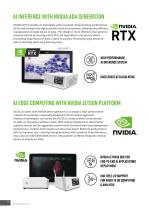
AI and NVIDIA Partnership: Onyx collaborates with NVIDIA to develop AI medical products, leveraging NVIDIA's Holoscan platform for real-time sensor processing. This partnership aims to enhance AI capabilities in medical devices, supporting the development of personalized medicine and next-generation clinics.
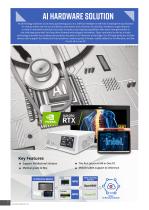
Product Features: Onyx's AI-ready products include medical-grade AI boxes, mobile tablets for AI inference, and the first AI all-in-one PC. These devices support NVIDIA and Intel solutions, emphasizing high-performance AI inference at the edge.
Environmental Commitment: Onyx adheres to ISO 14001:2015 standards, focusing on green manufacturing and sustainable development. Their environmental policy emphasizes continuous improvement and innovation.
AI Edge Computing with NVIDIA Jetson Platform: The ACCEL-JS series is a compact, high-performance medical AI accelerator designed for AI market segments. It supports containerized AI skills and easy deployment for medical devices.
Intel® Arc™ A-Series Graphics: Introduces Intel's new graphics technology with machine learning, graphics acceleration, and ray tracing hardware. The Arc A370M GPU offers significant performance improvements over previous models.
OpenVINO Toolkit: The latest release enhances generative AI accessibility with broader model support and reduced memory usage, powered by Intel's distribution of the OpenVINO toolkit.
Product Specifications: Detailed specifications for various products, including processors, memory, storage, display, I/O, and environmental conditions. Products include the ACCEL-A3210, ACCEL-A2710, and ACCEL-A2401, each with unique features tailored for medical AI applications.
Certifications: Products comply with various international standards, including CE, FCC, UL, and cUL certifications, ensuring safety and compatibility in medical environments.
Critical Information: Products support high-performance AI applications with Intel and NVIDIA technologies. Medical-grade design with features like multi-touch displays, programmable function keys, and medical isolation for LAN/USB/COM ports. Support for advanced graphics and AI processing with PCIe expansion slots and optional NVIDIA RTX modules. Comprehensive connectivity options, including Wi-Fi 6E, Bluetooth, and multiple I/O ports.
Conclusion: The document outlines Onyx Healthcare's advanced AI hardware solutions, emphasizing their application in medical environments. The products are designed to integrate seamlessly into healthcare settings, offering robust performance and compliance with medical standards.
Main Specifications: Processors: Intel 9th and 13th generation Core I/Xeon processors, NVIDIA Jetson AGX Orin platform. Memory: Support for up to 64GB DDR4 memory, with options for LPDDR5. Storage: Options include 2.5" SATA SSDs, M.2 NVMe SSDs, and onboard eMMC storage. Graphics: Integration with NVIDIA RTX 4000, 5000 Ada GPUs, and NVIDIA Ampere architecture GPUs. Operating Systems: Support for Windows 10, Windows 11, and Linux.
Connectivity and I/O: Multiple USB ports (USB 3.1, USB 3.2, USB 2.0), Ethernet ports (Gigabit and 2.5 GigaLAN), and video outputs (HDMI, DisplayPort, VGA). Support for PCIe slots for additional hardware integration, including capture cards and GPU cards. Optional wireless communication modules and 5G/LTE support.
Environmental and Mechanical: Operating temperature range: 0°C to 35°C. Storage temperature range: -20°C to 60°C. Power consumption varies with models, ranging from 500W to 700W. Dimensions and weight vary across models, with compact designs for space-limited environments.
Certifications: The platforms are certified for medical use, complying with CE, FCC, UL, and cUL standards, ensuring safety and reliability in medical environments.
Applications: These platforms are suitable for medical AI applications, video recording, equipment control, and integration into medical environments, supporting advanced AI inference and imaging tasks.
Optional Accessories: Various kits and cards are available for customization, including WLAN kits, capture cards, and additional storage options.
Key Specifications: AI Engine: Utilizes NVIDIA Jetson platforms (Orin Nano, Orin NX, AGX Xavier) with varying CPU cores and memory configurations. Memory: Options include 4GB to 64GB LPDDR5, depending on the model. Graphics: Features NVIDIA Ampere architecture with CUDA and Tensor cores for enhanced AI performance. Storage: Includes NVMe M.2 SSD and eMMC options for storage. OS Support: Primarily supports Linux with Jetpack OS. Connectivity: Offers HDMI 2.0, SDI inputs, USB ports, Ethernet, and optional wireless communication. Certifications: Medical certifications include CE, FCC, UL, and cUL.
Features: Fanless design for silent operation. Support for dual
4K display output and various video input options. Built-in speakers and optional accessories for enhanced functionality. Medical-grade design with IP31 protection and cable management features.
Mechanical and Environmental: Operating temperature ranges from 0°C to 35°C. Dimensions and weight vary by model, with compact designs for space efficiency.
Optional Accessories: Includes WLAN kits, SSD kits, and additional storage options tailored for specific models.
Conclusion: These medical AI edge devices are designed to provide robust AI computing capabilities for medical imaging applications, with a focus on performance, connectivity, and compliance with medical standards.
Specifications: Connectivity: Includes Ethernet GigaLAN, 10G LAN, HDMI 2.0, Display Port 1.4, and various audio and serial ports. Video Input/Output: Supports resolutions up to 4096×2160@60fps via HDMI 2.0 and 12G SDI. Audio: Features mic-in and line-out ports. Wireless Communication: Optional 802.11a/b/g/n/ac/ax with Bluetooth 5.2. Expansion I/O: PCIe Gen 4 [x8].
AI and Management Features: AI Hardware Solution: Includes NVIDIA Jetson AGX Orin for AI inference. Remote Management: ORION software allows for remote monitoring of battery status and other parameters. Security: Trusted Platform Module (TPM) for enhanced security.
Design and Usability: Cleanability: Designed for easy cleaning with hospital solvents, featuring a waterproof and non-gap design. Lightweight Design: Constructed with magnesium alloy for strength and heat dissipation. Battery System: Dual hot-swappable batteries provide extended operation time and quick charging.
Certifications: The devices comply with various international standards, including CE, FCC, and UL certifications, ensuring safety and reliability in medical environments.
Optional Accessories: Includes smart card readers, RFID readers, barcode readers, and various battery kits and chargers.
Key Features: Processor and Performance: Utilizes Intel® Core™ Ultra and Skylake processors, offering robust performance for AI and medical applications. Battery System: Dual swappable batteries allow for 24/7 operation without shutdown, enhancing mobility and uptime. Design and Safety: Fanless design reduces cross-infection risk, and the devices meet high medical safety standards (EMC4.1 / Safety3.2). Mounting and Compatibility: Standard VESA 75/100 mounts ensure compatibility with various medical carts. Security: Equipped with TPM 2.0 for enhanced data security and privacy. Software Support: Compatible with Windows, Ubuntu, and IGEL, supporting a range of medical software applications.
Specifications: Display: Available in sizes ranging from 11.6" to 17", with resolutions up to 1920 x 1080. Memory and Storage: Supports DDR4/DDR5 memory up to 32GB and M.2 SSD storage up to 1TB. Connectivity: Features multiple USB ports, HDMI, isolated LAN, and COM ports for versatile connectivity. Environmental Tolerance: Operates within 0°C to 35°C and can be stored between -20°C to 60°C. Certifications: Complies with CE, FCC, UL, and other international standards for medical equipment.
Models and Options: Venus-154 Plus: 15.6" panel with Intel® Meteor Lake Core™ Ultra 125U processor. Venus-124 Plus: 11.6" panel with similar specifications, offering a more compact solution. Venus-173: 17" panel with Intel® Skylake Dual-Core i5, providing a larger display option. Venus-153: 15.6" panel available with Intel® i7/i5/i3 processors, offering flexibility in performance.
Conclusion: Onyx Healthcare's Medical Power Panel PCs are designed to meet the demanding needs of medical environments, providing reliable, secure, and high-performance computing solutions with continuous power supply and robust safety features.
Specifications and Standards: The document outlines compliance with various international standards for medical and information technology equipment, including EN 60601-1-2:2015 + A1:2021, EN 60601-1:2007 + A1:2013 + A2:2021, EN 55032:2015/A1:2020, EN55035:2017/A11:2020, IEC62368-1:2020+A11:2020, FCC Part 15B/Part 18, UL ANSI AAMI ES60601-1:2005/A1:2012/A2:2021, and cUL CAN/CSA-C22.2 No. 60601-1:14. These standards ensure the highest level of medical safety protection and electromagnetic compatibility (EMC 4.1/Safety 3.2).
Product Features: The
medical panel PC features a hot-swappable design for continuous 24/7 operation, Intel® Skylake Dual-Core i5 processor, remote monitoring/control/update capabilities (ORION compatible), and isolated LAN/COM ports. It is designed for cleanability with hospital solvents.
Ordering Information: The document provides detailed ordering information for various products, including medical adaptors, WLAN modules, mobile computers, chargers, and camera kits. Each product is listed with its part number and specifications.
Battery and Power Management: The UPower system features a dual hot-swappable battery architecture, allowing for continuous power supply even during battery replacement. It includes a voltage selection DC-output, enabling users to select from 12, 19, or 24 volts. The system supports remote monitoring through ORION software, which provides real-time diagnostics and management of battery status.
Environmental and Mechanical Specifications: The document details the mechanical and environmental specifications for various products, including dimensions, weight, operating and storage temperatures, and humidity levels. It also highlights safety features such as protection from over-voltage, over-current, short circuit, and over-charge.
ORION Management System: ORION is a comprehensive software solution for managing Onyx device infrastructure. It allows for remote monitoring, diagnostics, and updates, providing IT managers with tools to manage battery life and system performance efficiently.
Introduction: The document provides an overview of various healthcare technology solutions, focusing on mobile medical devices and IT management software. It highlights successful implementations, key features, and technical specifications of products designed to enhance efficiency in medical settings.
Successful Implementation: NHS UK: The NHS Trust in the UK successfully implemented the e-Care Electronic Patient Record (EPR) system on April 30, 2016, using Parity Medical's mobile computer carts. These carts are lightweight, ergonomic, and powered by hot-swappable batteries, ensuring continuous operation.
ORION IT Management Software: ORION is a comprehensive software solution for managing Onyx device infrastructure. It includes features such as remote updates and installations, automated task scheduling, real-time remote monitoring, customizable dashboards, and battery diagnostics and management. These features help streamline IT operations, allowing managers to focus on critical tasks.
Mobile Medical Tablets: The document details several mobile medical tablets designed for healthcare environments: MD116E: A 12” fanless Intel Pentium tablet with dual hot-swappable batteries, smart card readers, and rugged design for 24/7 operation. MD102N: A 10.1” rugged tablet with Intel Alder Lake processor, long battery life, and IP54 certification for drop resistance. MPAD-800 A1: An 8” Android tablet with ARM Cortex processor, water/drop proof design, and built-in cellular communication. These tablets are designed to streamline data exchange, reduce paperwork, and integrate seamlessly with medical devices.
Technical Specifications: The document provides detailed specifications for each device, including processor type, memory, storage, wireless communication capabilities, and environmental certifications. Key features include high-resolution touchscreens with Gorilla Glass, multiple connectivity options (USB, Ethernet, Wi-Fi, Bluetooth), and compliance with medical and safety standards (e.g., EN 60601, FCC, UL).
Conclusion: The document emphasizes the importance of reliable, efficient technology in healthcare settings. By implementing advanced IT management systems and mobile medical devices, healthcare providers can improve operational efficiency and patient care.
Specifications: The medical tablet features include a DC-In Jack, USB Type C charging, built-in speaker and microphone, nanoSIM and Micro SD card slots, 16 GB eMMC flash storage, and front and rear 8MP cameras. It is equipped with sensors like a light sensor, G-sensor, and vibration motor. The tablet is white, with dimensions of 136.6 x 219 x 21 mm, and weighs 0.67 kg. It operates between 0°C to 40°C and is IP54 water and drop-proof certified.
Certifications: The device complies with IEC/EN60601-1-2, IEC EN60601-1, UL ES60601-1, cUL: IEC 60601-1, FCC Part 18, and TELEC Japan standards.
Power Supply: The tablet uses an AC/DC adapter with an input of 100-240V and output of 12V, 3A. It includes a high-capacity lithium-polymer battery lasting up to 8 hours.
Optional Accessories: Accessories include vehicle and office docks, VESA cradle, battery charger, and desk stand. Each accessory has specific input power, installation options, and dimensions.
Digital OR Solutions: The ACCEL digital OR solution offers AV over IP video solutions with near-zero latency and less cabling. It supports Full HD and 4K video recording, patient data entry, video playback, and editing. The system is certified with UL60601-1, IEC60601-1, and FCC Part 18.
Features: The digital OR solutions include multiple video input interfaces, SDK for integration, and support for multiple storage options. The ACCEL-VM500 medical recorder supports various video formats and provides an API for easy integration.
Conclusion: Onyx Healthcare provides comprehensive solutions for medical tablets and digital operating rooms, focusing on high performance, compliance with medical standards, and ease of integration with existing systems.
Key Features: Support for up to three 4K displays via HDMI and DP ports. Integration capabilities with Nvidia RTX A4000, A5000, and A6000 GPU cards. Optional support for CD/DVD drives and built-in speakers. Medical AI applications and video recording functionalities for operating rooms.
Specifications: Processor options include Intel Atom, Celeron, and 9th Generation Intel Xeon/Core i7 CPUs. Memory support for DDR4 SODIMM up to 32GB, with optional ECC support. Various I/O options including USB 3.2, HDMI, and Gigabit LAN ports. Display options range from 10.1" to 18.5" with resolutions up to 1920x1080. Power consumption is optimized for mobile medical carts with less than 50W usage.
Environmental and Mechanical: Operating temperature range from 0°C to 40°C. Storage temperature range from -20°C to 60°C. VESA mounting compatibility and IP65 front protection.
Certifications: Complies with medical and IT equipment standards such as EN 60601-1 and IEC 62368-1. FCC, UL, and TELEC certifications ensure compliance with international safety and performance standards.
Optional Accessories: WLAN kits with Bluetooth support. Graphics and capture cards for enhanced video capabilities. RFID and smart card readers for security and functionality enhancements.
Applications: These devices are suitable for various hospital applications including mobile nursing stations, wall-mount diagnosis panels, pharmacy automation, and bedside infotainment systems.
Main Specifications: Processors: Options include Intel Celeron N6210, Atom x6211E, Atom x6425E, and 13th Generation Intel Core i9/i7/i5/i3. Memory: Supports DDR4 SODIMM up to 32GB, with optional In-Band ECC support. The MATE2-2412 supports DDR5 up to 64GB. Display: Available in 11.6" and 24" sizes, with resolutions up to 1920x1080. Features capacitive multi-touch screens. Connectivity: Includes USB 3.2 ports, HDMI 2.0b, Gigabit LAN, and optional wireless communication (802.11 a/b/g/n/ac/ax + Bluetooth 5.3). Security: Equipped with TPM 2.0 and optional RFID readers.
Features: Design: Fanless design for quiet operation and easy maintenance. VESA mounting options available. Functionality: Programmable smart function keys, easy cleaning flat screens, and optional cameras with microphones. Power Options: Supports DC 12V input, Power over Ethernet, and AC 100~240V input for different models. Certifications: Complies with various international standards, including CE, FCC, UL, and TELEC.
Optional Accessories: Includes medical power adapters, WLAN kits, smart card readers, and camera kits.
Applications: These
medical PCs are suitable for hospital applications, offering high performance, security features, and efficient data handling capabilities.
Specifications: The main system features a 22" LCD with a resolution of 1920 x 1080, capacitive multi-touch screen, and supports dual-channel DDR5 memory up to 64GB. It includes multiple I/O options such as USB 3.2 ports, HDMI outputs, and Ethernet connections. The system is designed for medical environments with certifications like CE and FCC.
Expansion and Connectivity: The system supports PCI Express expansion, optional RFID reader, and wireless communication options including Wi-Fi and Bluetooth. It also offers security features like a Trusted Platform Module 2.0.
Environmental and Mechanical: The device operates within a temperature range of 0°C to 35°C and has a degree of protection rated at IP65 in the front and IP54 in the back. It is designed for VESA mounting and has a robust build suitable for medical settings.
Display Options: The document also details various display options ranging from 15" to 32" with features like UHD 4K resolution, wide viewing angles, and low power consumption. These displays are designed to meet strict medical safety standards and offer customization options.
Ordering Information: Various configurations are available for different processors (i9, i7, i5, i3) and optional accessories like WLAN kits, PCI Express riser kits, and camera kits are listed for customization.
Certifications: The devices comply with multiple international standards for medical equipment, ensuring safety and reliability in healthcare environments.
Specifications: Display Monitors: The document outlines specifications for several models of medical display monitors, including sizes ranging from 15" to 23.8". All monitors support FHD resolution (1920 x 1080) with varying brightness levels (250 to 500 nits) and contrast ratios (700:1 to 1000:1). They feature projective capacitive touch screens, multiple input options (DVI-D, HDMI, VGA), and built-in speakers. Power Requirements: All devices require an external power adapter with AC input ranging from 100 to 240V and DC output varying by model. Operating Conditions: The monitors operate within temperatures of 0°C to 50°C and storage temperatures of -20°C to 60°C, with humidity levels of 10% to 90% non-condensing. Certifications: The devices are certified under various standards, including CE, FCC, UL, and cUL, ensuring compliance with medical and safety regulations.
Features: Medical Displays: The displays are designed with features like high brightness, compact design, and capacitive touch capabilities. They are suitable for medical environments due to their compliance with medical certifications and their ability to support various operating systems like Windows 10 and 11. Medical Computer (MEDPC Series): The MEDPC series is a fanless design, reducing infection risks, and supports a range of processors from Intel® Quad Core i7 to Atom™ series. It offers flexible function extension, isolated IO interfaces, and a long lifecycle support of 5-7 years.
Ordering Information: The document provides model numbers and configurations for ordering, including optional accessories like power adapters and various cables.
Conclusion: The document highlights the adaptability and compliance of these medical devices, making them suitable for integration into hospital IT systems and medical tasks. The focus on high performance, safety, and flexibility ensures these devices meet the rigorous demands of medical environments.
Specifications: MEDPC-3300: Features Intel Alder Lake-N processors, DDR5 memory up to 32GB, multiple USB and HDMI ports, TPM 2.0 support, and optional components like 4K capture card and external power switch. It supports Windows 11, Ubuntu 24.04 LTS, and IGEL thin client solutions. MEDPC-9200: Utilizes Intel 6th/7th Generation Core processors, supports DDR4 memory up to 32GB, and includes various I/O options like USB, HDMI, and DisplayPort. It is designed for high-performance medical applications. MEDPC-9210: Equipped with Intel 13th Gen Core processors, supports DDR4 memory up to 64GB, and offers extensive I/O options including USB 3.2, HDMI, and DisplayPort. It is suitable for demanding medical environments. MEDPC-9300: Features AMD Ryzen Embedded V1605B processor, supports DDR4 memory up to 32GB, and includes AMD Vega GPU for high-quality graphics. It offers multiple display outputs and is designed for biotech and pharmaceutical applications. MEDPC-2100: A compact, fanless design with Intel Bay Trail SoC, supporting DDR3L memory up to 8GB. It includes basic I/O options and is suitable for environments requiring minimal space.
Mechanical and Environmental: All models are designed to operate within specific temperature ranges and are certified under various international standards such as CE, FCC, and UL for medical and IT equipment.
Accessories: The document lists optional accessories like WLAN kits, power adapters, and various mounting solutions including desktop stands and wall/ceiling mounts with features like gas springs and cable management.
Applications: These medical PCs are suitable for use in hospitals, biotech labs, pharmaceutical industries, and for equipment control and signage.
Specifications: The document outlines the specifications for ceiling and wall mount systems used in healthcare infotainment settings. The ceiling mount features a tile with a 20° up and 35° down display range, and a 20° up and 60° down arm range. It supports VESA 75/100mm mounting options and is made from aluminum alloy and plastic. The pivot angles are 270°, 370°, and 270° for the ceiling, arm, and display respectively, with an extension capacity of 1927mm and weight support ranging from 1 to 12kg.
Procedures and Features: The ergonomic wall mount swivel arm is designed for durability and ease of cleaning, featuring double gas springs for vertical movement and full cable management. It extends Onyx Bedside Services closer to patients and includes a foil keyboard for infection control. The arm has a 180° swivel and an overall reach of 1700mm, supporting weights from 1 to 8kg.
Norms and Recommendations: The document recommends integrating a hall sensor for auto-detection of on and off-hook events and includes a lockable socket for loss prevention. Sample code and API are available for programming key mapping for various applications.
Accessories and Additional Features: The system includes a USB 2.0 interface with an RJ45 socket, a 41cm curly cable, numeric and multimedia keypads, a hall sensor, loudspeaker, microphone, and an optional 2-megapixel camera. A nurse call button is available upon request. The operating temperature range is 0°C to 40°C, with storage conditions from -20°C to 60°C and humidity levels of 10% to 95% at 35°C, non-condensing. The dimensions are 54.6(W) x 160(H) x 34.5(D) mm, with a net weight of approximately 105g.
Conclusion: The document provides comprehensive specifications and features for healthcare infotainment mounting solutions, emphasizing durability, ease of use, and integration capabilities.










 2026 Products update brochure
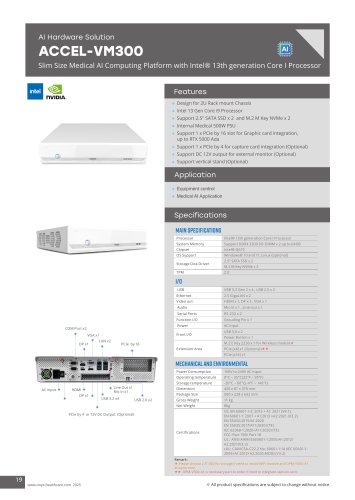 ACCEL-VM300 Datasheet
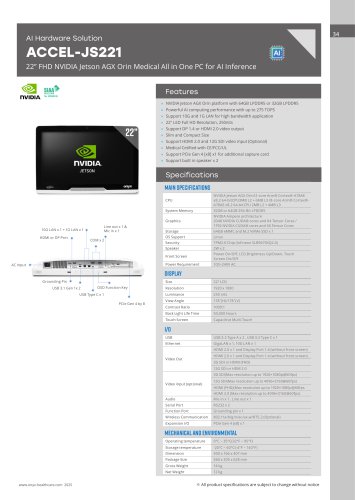 ACCEL-JS221 Datasheet
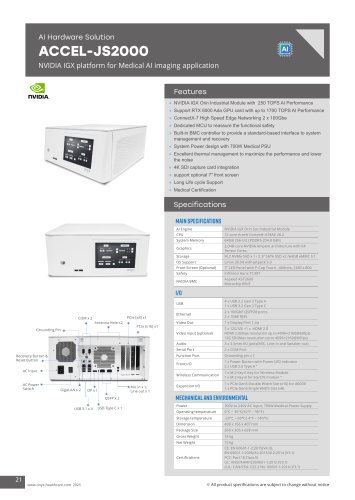 ACCEL-JS2000 Datasheet
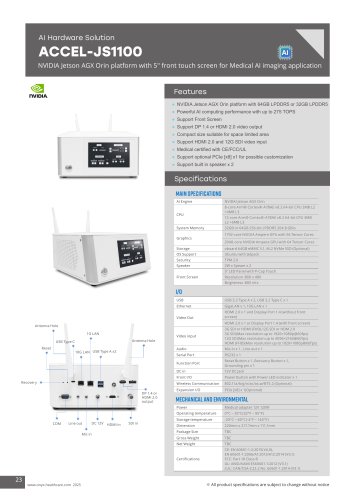 ACCEL-JS1100 Datasheet
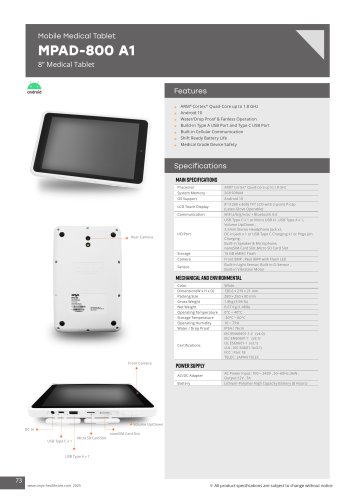 MPAD-800-AI Datasheet
 New Venus Brochure
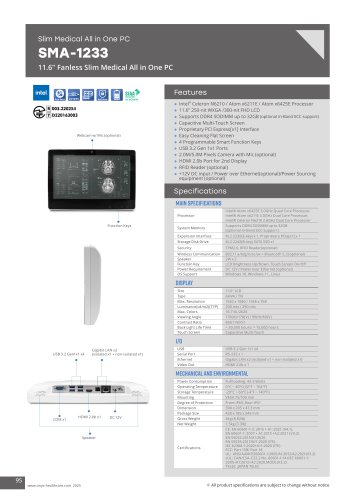 SMA-1233 Datasheet
 ACCEL-VM1000 Datasheet
 ACCEL-VM500 Datasheet
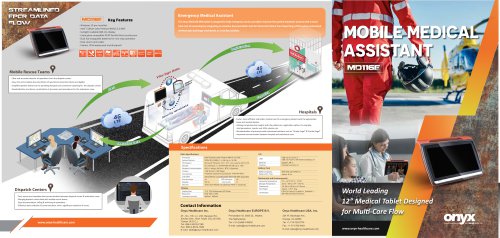 MD116E Brochure
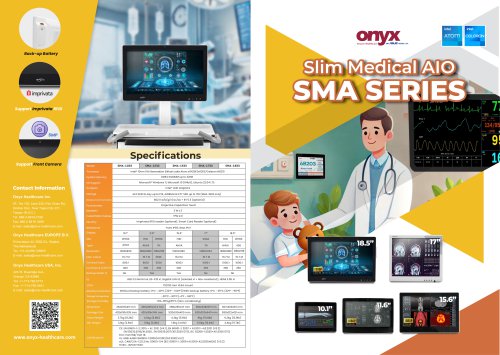 Slim Medical AIO Brochure
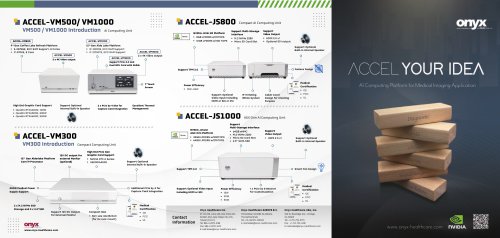 ACCEL AI Brochure
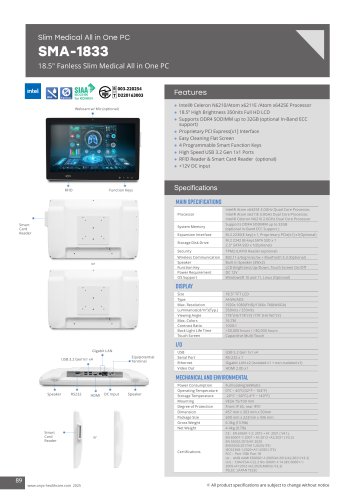 SMA-1833 Datasheet
 SMA-1733 Datasheet
 SMA-1533 Datasheet
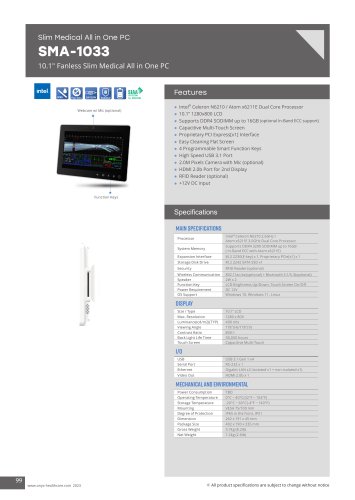 SMA-1033 Datasheet
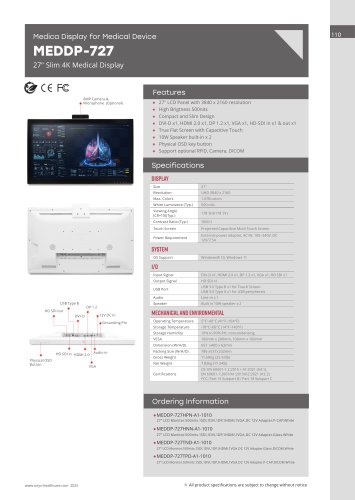 MEDDP-727 Datasheet
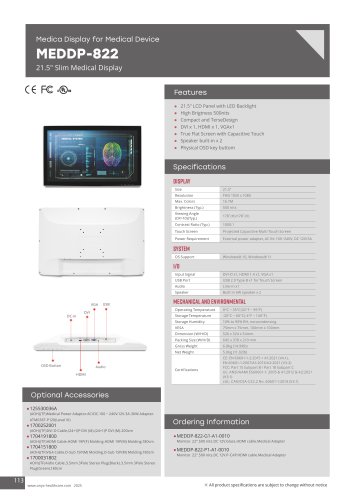 MEDDP-822 Datasheet
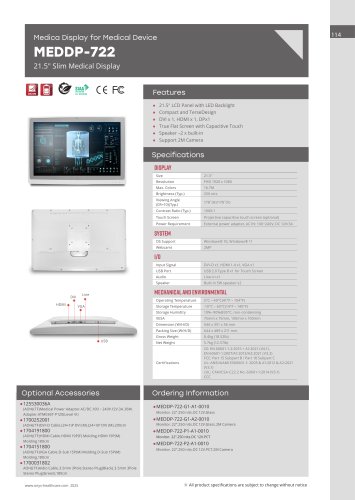
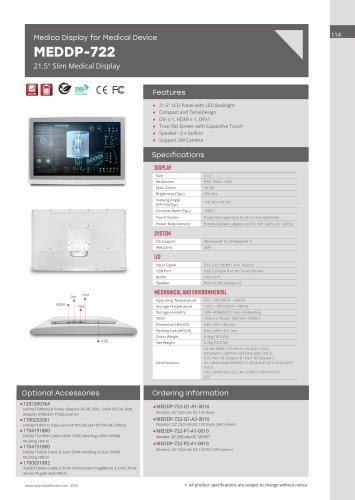 MEDDP-722 Datasheet
 MEDDP-627 Datasheet
 MEDDP-624 Datasheet
 MEDDP-632 Datasheet
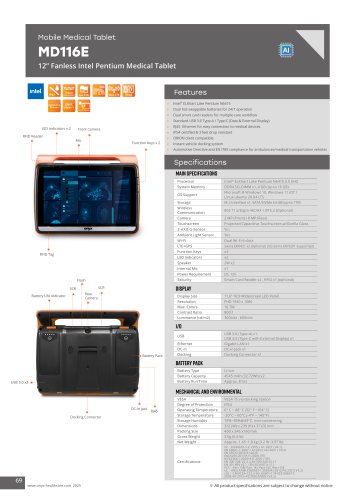 MD116E Datasheet
 MEDDP-622 Datasheet
 MEDDP-615 Datasheet
 MEDDP-415 Datasheet
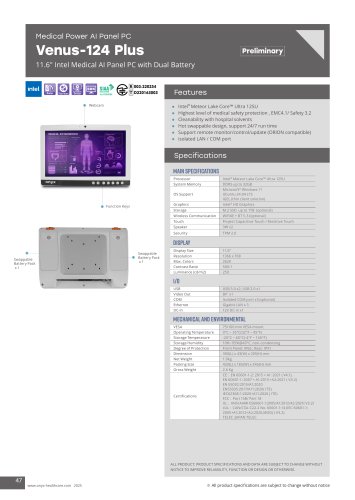 Venus-124P
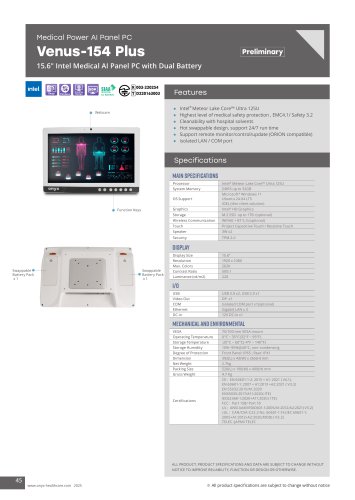 Venus-154P Datasheet
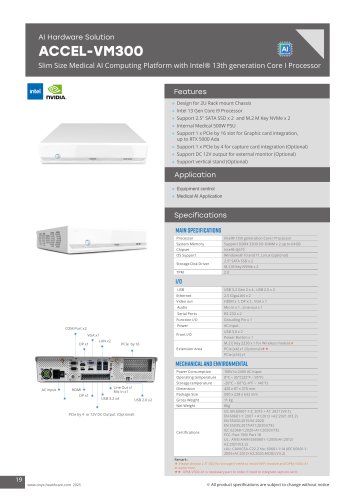 ACCEL-VM300 Datasheet (2025)
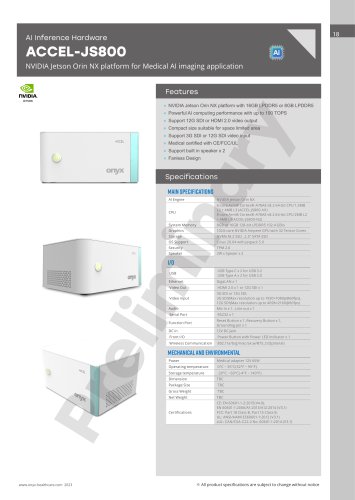 ACCEK-JS800 Datasheet
 ACCEL-JS1000 Datasheet
 ACCEL-A2203 Datasheet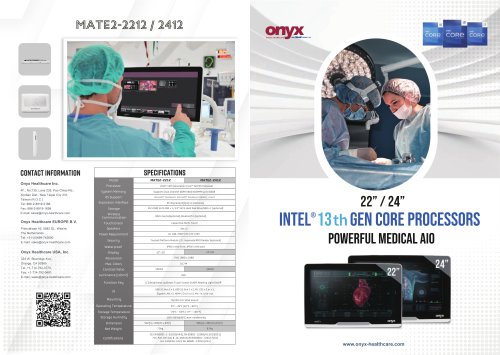
 ACCEL-VM500R Datasheet
 MEDPC-2100 Datasheet
 UPower Pro-43 Datasheet
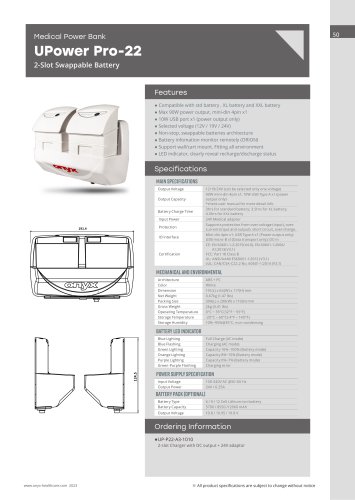 UPower Pro-22 Datasheet
 OPM-P02T Datasheet
 OPM-P03T Datasheet
 ORION Datasheet
 MD101 Datasheet
 ONYX-BE153R Datasheet
 MATE-1903 Datasheet
 MEDPC-9300 Datasheet
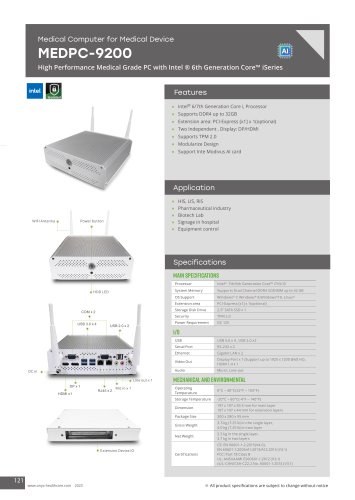 MEDPC-9200 Datasheet
 Venus-123 Datasheet
 MD101 Brochure
 Mini Venus Brochure
 ACCEL-A2401 Datasheet
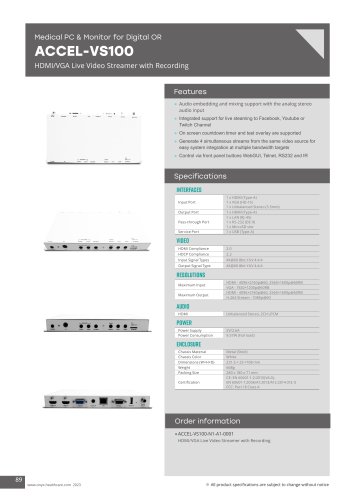 ACCEL-VS100 Datasheet
 ACCEL-VM100 Datasheet
 ACCEL-VM200 Datasheet
 Venus-224/244 Datasheet
 Venus-153 Datasheet
 Venus-173 Datasheet
 Venus-193 Datasheet
 Venus Family Brochure
 Mobility Family Brochure