- Catalogs
- OPELAIII Cx
- Case Study N°2 Effectiveness of OPELAIII in Endocrine Surgery


Case Study N°2 Effectiveness of OPELAIII in Endocrine Surgery

Case Study N°2 Effectiveness of OPELAIII in Endocrine Surgery
This document evaluates the effectiveness of the Wearable Surgical Lighting System OPELAⅢ during open surgeries, specifically focusing on its application in total thyroidectomy and right cervical lymphadenectomy for papillary thyroid carcinoma. Dr. Iwao Sugitani, a professor of endocrine surgery, shares his insights on the challenges of neck surgeries and the potential improvements offered by OPELAⅢ.
The procedure involved a total thyroidectomy for a papillary thyroid carcinoma with a 2.5 cm lesion and lymph node dissection due to metastasis. The surgery required an 8 cm collar incision, exposing the thyroid gland. However, the upper portion of the neck is narrow and deep, making it difficult for traditional OR lights to illuminate effectively. This area is critical as it involves the superior thyroid artery and the external branch of the superior laryngeal nerve.
OPELAⅢ provides deep illumination, crucial for visualizing small blood vessels and nerves, such as the recurrent laryngeal nerves, which are vital to preserve during thyroid surgery. The system's lightweight and cordless design allows for unrestricted movement, addressing the limitations of traditional headlights that can be heavy and cumbersome.
While the document primarily discusses open surgery, it notes that OPELAⅢ is also beneficial in endoscopic procedures, particularly when creating tunnels or flaps. Proper lighting is essential to avoid heavy bleeding during these delicate operations.
OPELAⅢ proves useful in emergency scenarios where immediate treatment is required, such as post-operative hemorrhage, allowing for effective illumination without the need for full OR lighting.
The document concludes that OPELAⅢ significantly enhances surgical visibility, particularly in deep or poorly lit areas, and is expected to see increased demand. It is especially beneficial for surgeons whose vision may deteriorate with age, potentially extending their careers.
Catalog excerpts
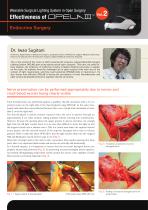
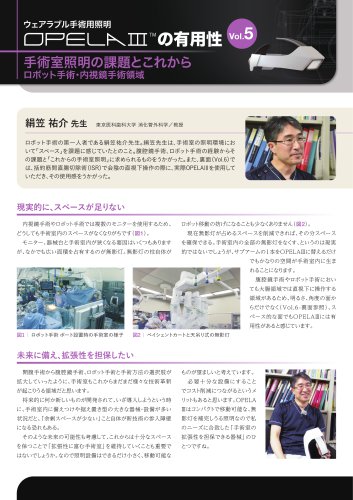
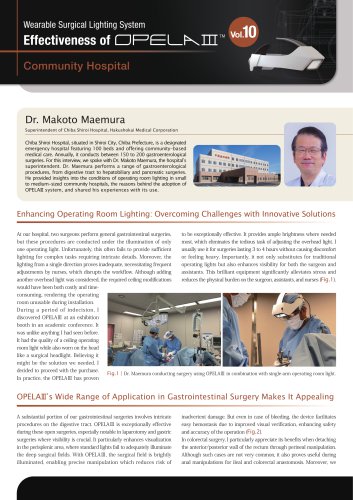
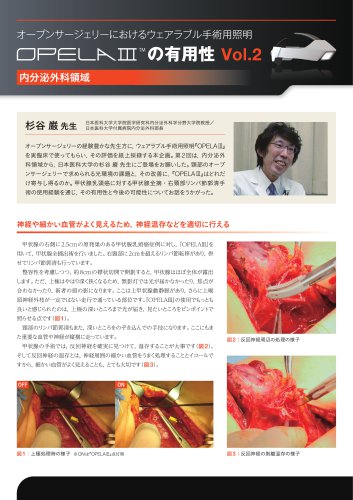
Dr. Iwao Sugitani Professor, Department of Endocrine Surgery, Graduate School of Medicine, Nippon Medical University/ Director for Department of Endocrine Surgery, Nippon Medical University Hospital This is the second of the series in which experienced surgeons evaluate Wearable Surgical Lighting System OPELAⅢ upon using during actual open surgeries. This time, we asked Dr. Iwao Sugitani, the professor of endocrine surgery at Nippon Medical University, to appear on the series. He explains what the challenges are in open surgery of the neck area in the context of light requirement, and how much potential OPELAⅢ holds in improving it. He also shares how effective OPELAⅢ is during the procedures of total thyroidectomy and right cervical lymphadenectomy for papillary thyroid carcinoma. Nerve preservation can be performed appropriately due to nerves and small blood vessels being clearly visible Total thyroidectomy was performed against a papillary thyroid carcinoma with a 2.5 cm primary lesion on the right side of the thyroid gland using OPELAⅢ. At the same time, lymph node dissection was performed because there was a lymph node metastasis of more than 2 cm at the right neck. The thyroid gland is almost entirely exposed when the neck is opened through an approximately 8 cm collar incision, taking minimal esthetic scarring into consideration. However, because the opening above the upper portion is narrow and deep, not enough light from the OR light reaches there. It is an area often difficult to focus the light on and the surgeon’s head casts a shadow over it. This is a critical area where the superior thyroid artery passes, and the external branch of the superior laryngeal nerve runs in various patterns. What I really like about OPELAⅢ is that the light reaches deep into the surgical field and illuminates exactly where I want to see (Fig. 1). Dissection of lymph node in the neck is also a procedure that requires peering into deep parts. Here, too, important blood vessels and nerves run vertically and horizontally. In a thyroid surgery, it is important to ensure that the recurrent laryngeal nerves are properly located and preserved (Fig. 2). As preserving recurrent laryngeal nerves equals to Fig. 2Treatment around the recurrent laryngeal nerve successfully distinguishing small blood vessels around the nerves, clear visibility of small blood vessels is extremely important (Fig. 3). Fig. 1 pper portion of thyroid gland U ON means when OPELAⅢ is lit.
Open the catalog to page 1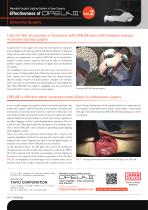
Wearable Surgical Lighting System in Open Surgery I did not feel any burden or heaviness with OPELA1 even with frequent changes in posture during surgery Lymph nodes in the upper neck may not necessarily lie along the internal jugular vein but may also lie behind the pharynx. It happens rarely, but in such cases where lymph node dissection in posterior pharynx or mediastinum is required, OPELAM can be particularly helpful. In other words, surgeons may not be able to confidently perform surgery without the assistance of lights that can illuminate the depths. The headlights I have used in the past...
Open the catalog to page 2All OPELAIII Cx catalogs and technical brochures
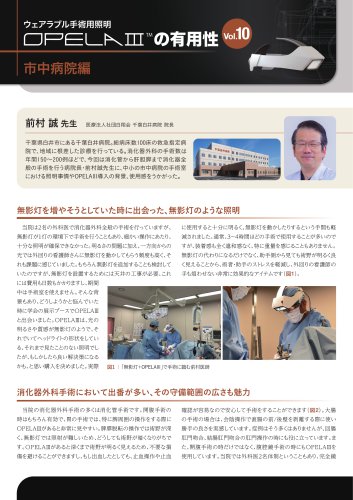 OPELAⅢの有用性vol10市中病院編
2 Pages
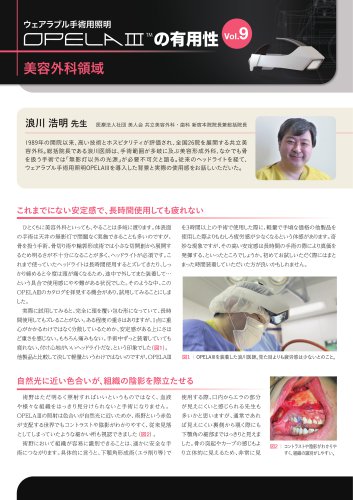 OPELAⅢの有用性vol9美容外科領域
2 Pages
 OPELAⅢの有用性vol8救命救急・災害領域
2 Pages
 OPELAⅢの有用性vol7形成外科領域
2 Pages
 OPELAⅢの有用性vol4呼吸器外科領域
2 Pages
 OPELAⅢの有用性vol3乳腺外科領域
2 Pages
 OPELAⅢの有用性vol2内分泌外科領域
2 Pages
 OPELAⅢの有用性vol1消化器外科領域
2 Pages
 OPELAIII Instructions Manual
32 Pages
 OPELAⅢ_Catalog_EN
2 Pages
 OPELAIII Cx Instructions Manual
48 Pages