- Catalogs
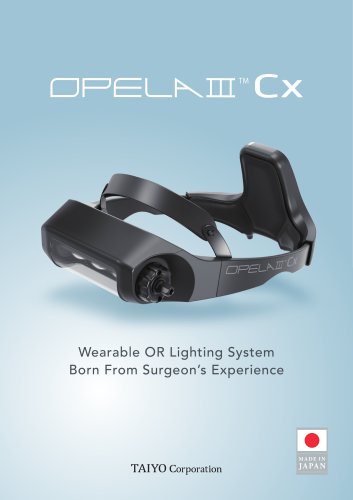
- OPELAIII Cx
- Case study N°7 Effectiveness of OPELAIII in Plastic Surgery


Case study N°7 Effectiveness of OPELAIII in Plastic Surgery

Case study N°7 Effectiveness of OPELAIII in Plastic Surgery
Dr. Tateki Kubo, a professor at the Department of Plastic Surgery, Osaka University, discusses the challenges of achieving adequate lighting during complex surgical procedures. He highlights the benefits of using the OPELAⅢ lighting system, which aligns with the surgeon's line of sight, enhancing visibility and reducing stress during operations.
Surgeons often face difficulties in maintaining sufficient lighting, especially in procedures involving facial fractures, jaw deformities, and breast reconstruction. Traditional operating room (OR) lights and headlights may not adequately illuminate deep or shifting surgical fields, leading to frequent interruptions for light adjustments.
The OPELAⅢ system provides consistent lighting that moves with the surgeon's head, ensuring optimal visibility even in deep and narrow surgical areas. This is particularly beneficial in facial osteoplastic procedures and breast reconstruction, where clear visibility is crucial for precise and safe operations.
In facial fracture surgeries, such as zygomatic fractures, the OPELAⅢ system allows for better visualization of critical structures like the infraorbital nerve. It overcomes the limitations of OR lights, which struggle to penetrate deep into the surgical field, especially when the surgeon's own body casts shadows.
During breast reconstruction, particularly with latissimus dorsi musculocutaneous flap procedures, the OPELAⅢ system provides essential lighting in deep cavities where OR lights are ineffective. This improves the surgeon's ability to perform delicate tasks without excessive retraction, potentially reducing scarring.
Dr. Kubo emphasizes that the enhanced visibility provided by OPELAⅢ leads to safer surgeries with better aesthetic outcomes. The system's ability to illuminate deep and complex surgical fields without the need for additional light adjustments is a significant advancement in surgical technology.
Catalog excerpts

Dr. Tateki Kubo Professor, Department of Plastic Surgery, Osaka University Graduate School of Medicine Department of plastic surgery“endeavors in recovery of functions and repair them back to normal, while improving esthetic appearance.”With this principle in mind, the department of plastic surgery at Osaka University contributes to enhancing patients’QOL using a variety of techniques. In this report, we asked Dr. Tateki Kubo his lighting requirements, and how useful OPELAⅢ is in facial osteoplastic procedure and breast reconstruction. A light that moves consistently with surgeon’ line of sight s Treatments and procedures in plastic surgery can be from a small skin incision or at times in very deep areas. There are instances wherein I struggle to get sufficient light during facial bone surgery such as facial fractures and jaw deformities, head and neck reconstruction after malignant tumor resection, and breast reconstruction after mastectomy. This is especially true when the area I want to focus the light is constantly shifting, then I have to stop and ask for light adjustment every time, which gives me so much stress (Fig. 1). Now that I started using OPELAⅢ, I can perform surgery more efficiently, free from stress because I can brightly illuminate exactly where I want to see. Fig. 1The surgeon is changing position frequently to get a better view of the surgical field A light that can reach deep and narrow confines during facial fracture procedures I decided to use OPELAⅢ this time because I considered it effective in subciliary incision and oral side manipulation of open reduction and internal fixation for zygomatic fracture. In facial fracture surgery, I try to be conscious of making as small an incision as possible in approaching the facial bone, but then the surgical field becomes too constricted. Thus, it is dark. And that is when I require a form of light that can penetrate deep inside. OR light can reach the area just beneath the subciliary incision, but when I try to see the infraorbital nerve and its caudal side, neither OR lights nor conventional headlights can reach there. With OPELA Ⅲ, because the direction of light is consistent with my line of sight even when focus is shifting within the tight confines of the surgical field, it is easier to visually recognize the infraorbital nerve and therefore proceed with the surgery more effectively (Fig. 2). Similarly, when performing procedures from the oral side, the conventional lights have difficulty illuminating the surgical field because often my own shoulder casts a shadow while I work inside Fig. 2 ygomatic fracture (subciliary incision) Z OPELAⅢ illuminates the field at an angle that OR light cannot Fig. 3 ygomatic fracture (oral side) Z OPELAⅢ only (no OR light) OPELAⅢ ensures a bright fie
Open the catalog to page 1
Wearable Surgical Lighting System Vol. Plastic Surgery the mouth. By using OPELAM, I could perform the surgery even with the OR light turned off as it provided ample light deep in the oral cavity (Fig. 3). Orbital floor fracture requires a very deep approach with a small skin or conjunctival incision in an almost-vertical direction. However, this area is surrounded by bones so there is no room to maneuver and the view is often blocked by orbital fats. Surgery in such dark surgical field may result in inadequate treatment with dire consequences, and I cannot compromise safety without sufficient...
Open the catalog to page 2All OPELAIII Cx catalogs and technical brochures
 OPELAⅢの有用性vol10市中病院編
2 Pages
 OPELAⅢの有用性vol9美容外科領域
2 Pages
 OPELAⅢの有用性vol8救命救急・災害領域
2 Pages
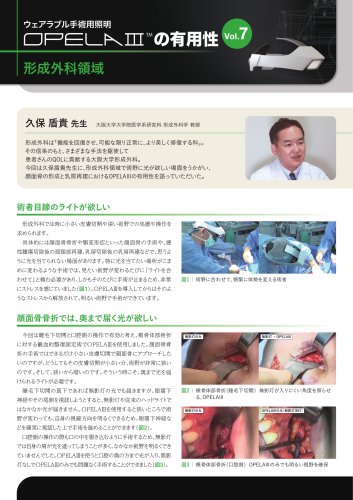 OPELAⅢの有用性vol7形成外科領域
2 Pages
 OPELAⅢの有用性vol4呼吸器外科領域
2 Pages
 OPELAⅢの有用性vol3乳腺外科領域
2 Pages
 OPELAⅢの有用性vol2内分泌外科領域
2 Pages
 OPELAⅢの有用性vol1消化器外科領域
2 Pages
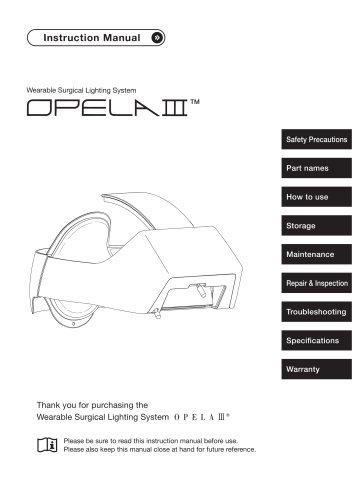 OPELAIII Instructions Manual
32 Pages
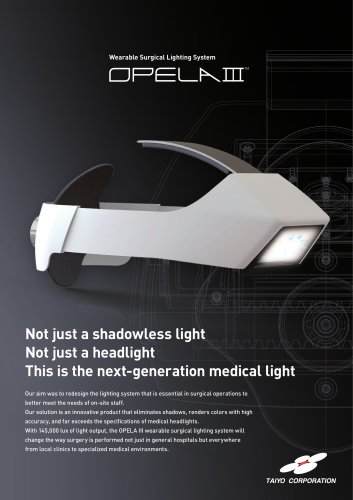 OPELAⅢ_Catalog_EN
2 Pages
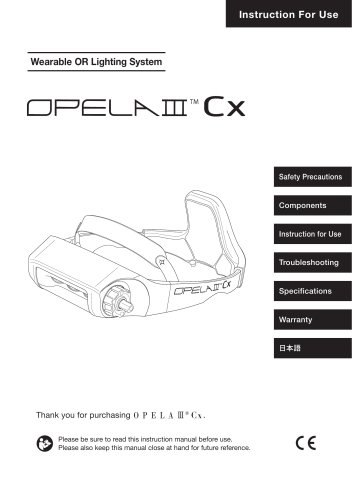 OPELAIII Cx Instructions Manual
48 Pages