- Catalogs
- OPELAIII Cx
- Case study N°8 Effectiveness of OPELAIII in Emergency Critical Care and Trauma


Case study N°8 Effectiveness of OPELAIII in Emergency Critical Care and Trauma

Case study N°8 Effectiveness of OPELAIII in Emergency Critical Care and Trauma
The document discusses the effectiveness of the OPELAⅢ wearable surgical lighting system in emergency and critical care settings. It highlights the challenges faced in surgical lighting during emergency procedures and how OPELAⅢ addresses these issues.
Specifications and Features
OPELAⅢ functions as both an operating room (OR) light and a headlight, providing superior brightness and eliminating shadows in deep surgical fields. It is battery-operated, lightweight, and portable, making it ideal for use in various emergency situations.
Applications in Emergency and Critical Care
In emergency settings, such as the ER, traditional ceiling-mounted lights often fail to adequately illuminate the surgical field, especially in deep cavities. OPELAⅢ allows for precise lighting without the need for adjusting ceiling lights, thus improving visibility and efficiency during procedures like thoracotomy and tracheostomy.
Benefits in ICU and Disaster Situations
In the ICU, OPELAⅢ facilitates procedures like tracheostomy without the need for cumbersome mobile OR lights, reducing preparation time and space constraints. During disasters, its portability and battery power make it invaluable for surgeries outside traditional ORs, such as in field hospitals or special emergency vehicles.
Training and Preparedness
Regular use of OPELAⅢ in training helps surgeons become adept at using it in emergencies. The Acute Care Surgery Center emphasizes its use to prepare for trauma and thoracoabdominal surgeries, enhancing skills and readiness for disaster scenarios.
Conclusion
OPELAⅢ is a critical tool in emergency and disaster preparedness, offering flexibility, ease of use, and effective illumination in challenging environments. Its adoption by organizations like JICA underscores its importance in global emergency response efforts.
Catalog excerpts
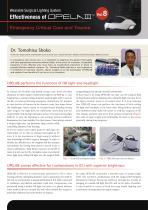
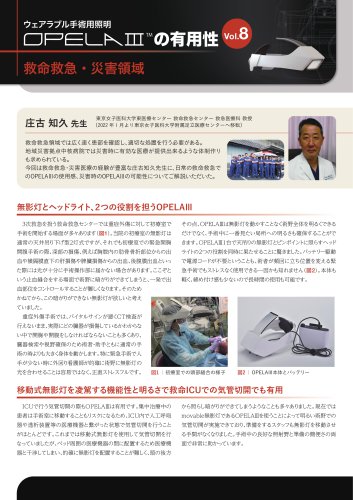
Wearable Surgical Lighting System Effectiveness of Emergency Critical Care and Trauma Professor, Department of Emergency and Critical Care, Tokyo Women’s Medical University Adachi Medical Center In emergency and critical care, it is important to diagnose the patient thoroughly and take appropriate measures without delay. In the event of a disaster, designated hospitals in the affected area must have an established procedure in place to provide effective medical response. Dr. Tomohisa Shoko who has a vast experience in treatment of traumatic injuries, shares insights as to the advantages of OPELAⅢ and explains how beneficial it can be in crisis situations. OPELAⅢ performs the functions of OR light and headlight At critical care facilities that handle tertiary care, there are many situations in which surgery is performed right in the ER Fig.1)Our ( . compounding to the already stressful environment. In that respect, by using OPELAⅢ, not only can the surgical field be illuminated without adjusting the ceiling OR light, but also focus the light precisely where it is needed most. It is truly amazing how OPELAⅢ alone can perform the functions of both ceiling OR light and headlight at the same time. Being battery-operated and untethered help make life easier as well for surgeons at ER who change positions and move their posture frequently (Fig.2). hospital has a normal ceiling-mounted surgical light with 2 arms in the ER, yet when performing emergency thoracotomy for instance in cases such as rib fracture in the thoracic cavity, liver injury below the diaphragm, spleen injury or retroperitoneal bleeding during open surgery, the light does not sufficiently reach deep into the surgical field. And during hemostatic suture, it becomes increasingly difficult to stop the bleeding in one attempt without sufficient Also with its light weight and comfortable fit, there is less stress illumination for clear visibility. For this reason, I have always wanted especially during long surgeries. a surgical light that can illuminate deep cavities while controlling shadows from forming. In severe trauma cases where patient’s vital signs are unfavorable yet no time to examine thoroughly by CT scan, it is not uncommon to begin surgery without clear knowledge of which organ is damaged. In order to identify the affected area, the surgeon and the assistant will examine by moving their posture around to get a visual confirmation. With limited resource in the ER at times, it is not easy for the circulation nurse to accurately direct light from ceiling OR light into the surgical field, Fig. 1︱Scene at ER treating head injury Fig. 2︱OPELAⅢ main unit and battery OPELAⅢ proves effective for tracheostomy in ICU with superior brightness OPELAⅢ is effective in tracheostomy performed in ICU’s. Since moving patients undergoing intensive care to operating room adds to the risk, as tracheostomy is usually performed in ICU while connected to ventilators and dialysis machines. Until now, tracheostomy was performed using a mobile OR light, but since it is placed between other medical devices around the bed, often behind the surgeon’s head thus shadows form and interfere in surgery. By using OPELAⅢ, technically a movable type of surgical light itself, now I perform tracheostomy with the surgical field brightly illuminated without having my staffs go through the trouble of bringing in a mobile OR light into ICU and vie for space. Therefore, I reap benefits in terms of both securing ample lighting and convenience of pr
Open the catalog to page 1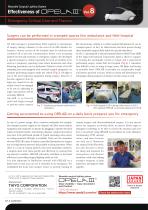
Wearable Surgical Lighting System Vol. Emergency Critical Care and Trauma Surgery can be performed in cramped spaces like ambulance and field hospital We hold emergency preparedness drills regularly in anticipation of surgery during a disaster. In the event of an NBC disaster for instance, various section of the hospital must be sanitized and cordoned off to prevent contamination before even accepting patients for first aid treatment or emergency surgery. We developed a special emergency vehicle especially for such an incident to be used as a temporary operating room where hemostasis and other...
Open the catalog to page 2All OPELAIII Cx catalogs and technical brochures
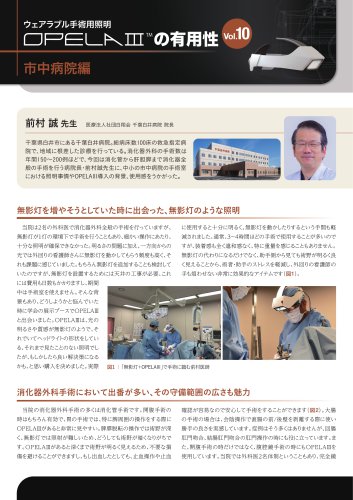 OPELAⅢの有用性vol10市中病院編
2 Pages
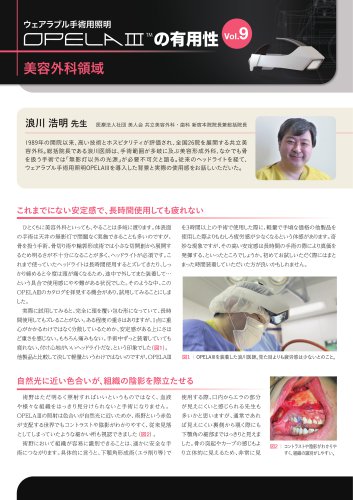 OPELAⅢの有用性vol9美容外科領域
2 Pages
 OPELAⅢの有用性vol8救命救急・災害領域
2 Pages
 OPELAⅢの有用性vol7形成外科領域
2 Pages
 OPELAⅢの有用性vol4呼吸器外科領域
2 Pages
 OPELAⅢの有用性vol3乳腺外科領域
2 Pages
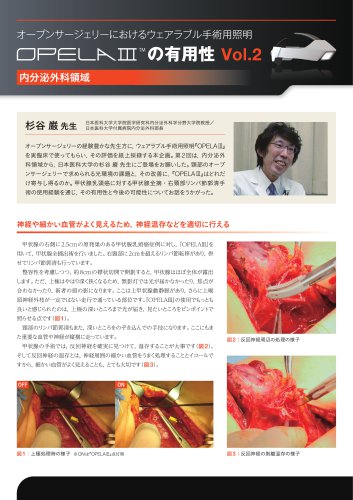 OPELAⅢの有用性vol2内分泌外科領域
2 Pages
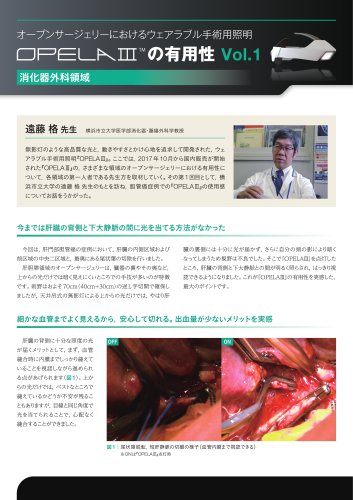 OPELAⅢの有用性vol1消化器外科領域
2 Pages
 OPELAIII Instructions Manual
32 Pages
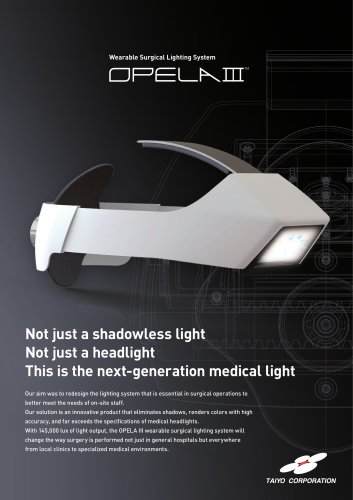 OPELAⅢ_Catalog_EN
2 Pages
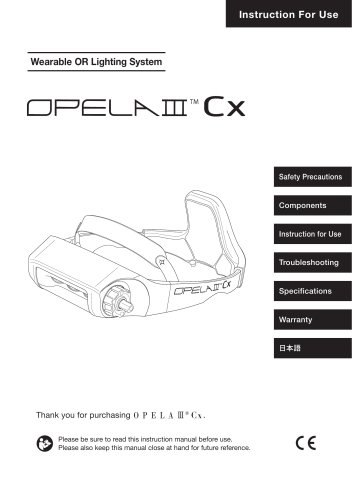 OPELAIII Cx Instructions Manual
48 Pages