- Catalogs
- OPELAIII Cx
- OPELAⅢの有用性vol5_6ロボット内視鏡_大腸外科領域


OPELAⅢの有用性vol5_6ロボット内視鏡_大腸外科領域
OPELAⅢの有用性vol5_6ロボット内視鏡_大腸外科領域
Challenges and Future Directions of Operating Room Lighting
The document discusses the evolving needs and challenges of lighting in operating rooms, particularly in the context of robotic and endoscopic surgeries. It highlights the spatial constraints caused by multiple monitors and large shadowless lamps (無影灯), which occupy significant space and can obstruct robotic equipment movement.
Key Challenges in Current Operating Room Lighting
- Space Limitations: The increasing use of monitors and equipment in robotic and endoscopic surgeries reduces available space, with shadowless lamp columns being a major contributor to spatial congestion.
- Obstruction to Robotic Movement: Large fixed shadowless lamps can interfere with the mobility of robotic surgical systems.
- Lighting Angle and Brightness: Certain surgical areas, such as the anterior rectal wall during transanal procedures, are difficult to illuminate adequately with traditional overhead lighting.
Recommendations for Future Operating Room Design
- Maintain Expandability: To accommodate future technological innovations, operating rooms should preserve sufficient free space to avoid barriers to new equipment integration.
- Compact and Mobile Lighting Solutions: Lighting equipment should be as small and movable as possible to optimize space and flexibility.
- Cost Efficiency: Using only necessary equipment can reduce costs while maintaining functionality.
Introduction of OPELA III Wearable Surgical Lighting
OPELA III is presented as a compact, mobile, wearable shadowless lamp designed to complement existing lighting and address spatial and illumination challenges in robotic and endoscopic surgeries.
- Space Saving: Replacing one of the traditional shadowless lamp arms with OPELA III can free significant space in the operating room.
- Enhanced Illumination: Its wearable design allows surgeons to direct light precisely at desired angles, improving visibility in difficult-to-illuminate areas such as the anterior rectal wall during intersphincteric resection (ISR).
- Compatibility with Robotic Surgery: OPELA III coexists well with robotic systems without hindering their movement.
Clinical Insights from Professor Yusuke Kinugasa
Professor Kinugasa, a leading expert in robotic surgery at Tokyo Medical and Dental University, shares his experience using OPELA III during colorectal surgeries involving robotic and laparoscopic techniques.
- He emphasizes the importance of space in the operating room and notes that OPELA III meets the need for expandable, compact lighting.
- He reports that OPELA III provided bright, adjustable illumination even in challenging areas like the deep anterior rectal wall, where traditional overhead lamps struggle.
- He successfully performed ISR procedures using only OPELA III lighting, confirming its adequacy and practical benefits.
Summary of Visual Data
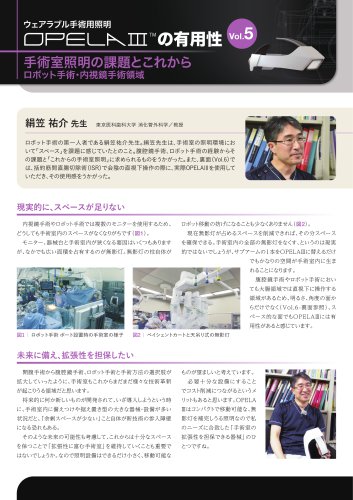
- Figure 1: Shows the crowded operating room during robotic surgery with multiple ports and monitors.
- Figure 2: Illustrates the interference of ceiling-mounted shadowless lamps with patient carts and robotic equipment.
- Additional Figures: Depict the use of OPELA III during ISR and transanal procedures, demonstrating improved illumination and surgical field visibility.
Critical Takeaways
- Operating rooms must evolve to support new surgical technologies by optimizing space and lighting.
- Wearable, mobile lighting like OPELA III offers practical solutions to spatial and illumination challenges.
- Adopting such lighting can improve surgical visibility, reduce equipment footprint, and facilitate robotic surgery workflows.
Catalog excerpts
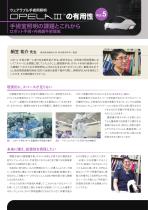
東京医科歯科大学 消化管外科学/教授 ロボット手術の第一人者である絹笠祐介先生。絹笠先生は、手術室の照明環境にお いて 「スペース」 を課題に感じていたとのこと。腹腔鏡手術、 ロボット手術の経験からそ の課題と 「これからの手術室照明」 に求められるものをうかがった。 また、裏面(Vol.6) で は、括約筋間直腸切除術(ISR) で会陰の直視下操作の際に、実際OPELAⅢを使用して いただき、 その使用感をうかがった。 現実的に、 スペースが足りない 内視鏡手術やロボット手術では複数のモニターを使用するため、 どうしても手術室内のスペースがなくなりがちです (図 1)。
Open the catalog to page 1
大腸・肛門外科領域 ロボット手術と共存可能な、 次世代ウェアラブル照明 大腸癌の手術は近年、腹腔鏡下手術やロボット手術が非常に増 えています。 しかし、開腹手術を行う際はもちろん、腹腔鏡手術を行 う際でも腹会陰式直腸切断術における会陰操作、ISRにおける肛 門括約筋の剥離、結腸肛門吻合など、直視下に手術を行い、かつ 明かりが必要な場面は依然存在します 図1。 そんな時に、OPELAⅢは、 「移動可能でウェアラブルな無影灯」 ということでしたので、自分の見たい角 度で明るく照らせると考え、 ロボット併用 のISRで肛門操作直視下 をする際に 使用しました。OPELAⅢは、 コンパクト な無影灯として、大腸・肛門外科領域の ロボット手術と上手く共存できる照明だ と感じました。
Open the catalog to page 2All OPELAIII Cx catalogs and technical brochures
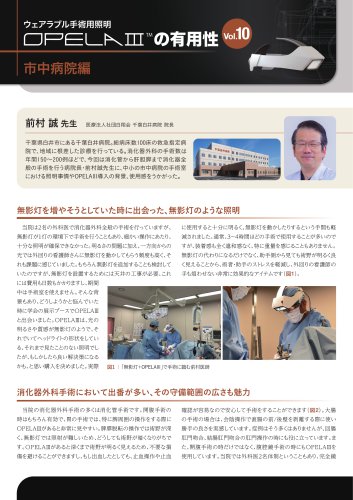 OPELAⅢの有用性vol10市中病院編
2 Pages
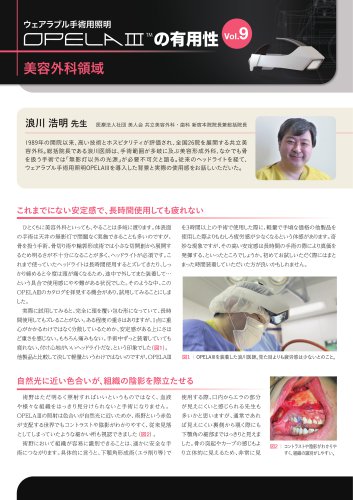 OPELAⅢの有用性vol9美容外科領域
2 Pages
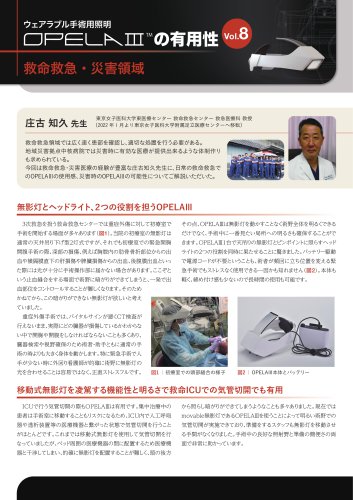 OPELAⅢの有用性vol8救命救急・災害領域
2 Pages
 OPELAⅢの有用性vol7形成外科領域
2 Pages
 OPELAⅢの有用性vol4呼吸器外科領域
2 Pages
 OPELAⅢの有用性vol3乳腺外科領域
2 Pages
 OPELAⅢの有用性vol2内分泌外科領域
2 Pages
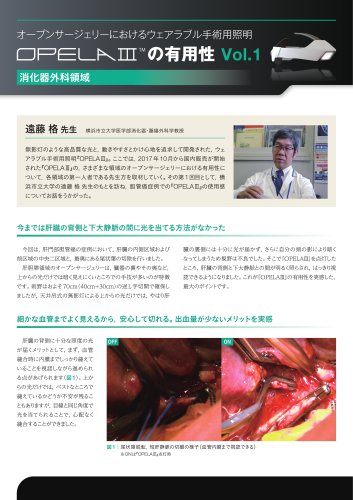 OPELAⅢの有用性vol1消化器外科領域
2 Pages
 OPELAIII Instructions Manual
32 Pages
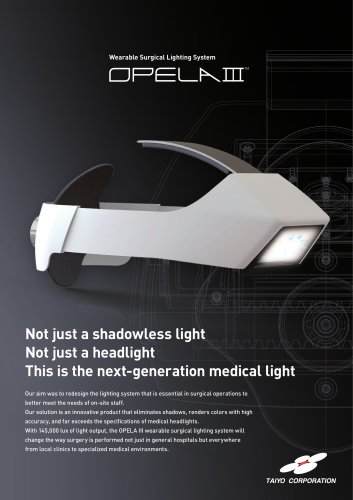 OPELAⅢ_Catalog_EN
2 Pages
 OPELAIII Cx Instructions Manual
48 Pages