- Catalogs
- OPELAIII Cx
- OPELAIII Cx_Case_Report_Vol.10_Community_Hospital


- Company
- Products
- Catalogs
- News & Trends
- Exhibitions
OPELAIII Cx_Case_Report_Vol.10_Community_Hospital
OPELAIII Cx_Case_Report_Vol.10_Community_Hospital
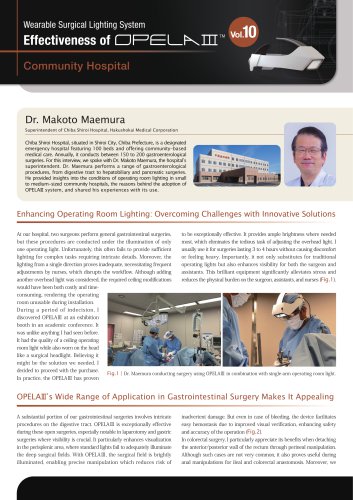
Chiba Shiroi Hospital, led by Dr. Makoto Maemura, is a community-based emergency hospital in Chiba Prefecture, Japan. The hospital performs numerous gastroenterological surgeries annually and has adopted the OPELAⅢ wearable surgical lighting system to enhance operating room conditions.
The hospital faced challenges with insufficient lighting during complex surgeries, as only one overhead light was used. This required frequent adjustments, disrupting workflow. Installing additional overhead lights was deemed costly and impractical.
Dr. Maemura discovered the OPELAⅢ system at a conference. This innovative device combines the quality of ceiling lights with the convenience of a head-mounted system, providing ample brightness and eliminating the need for constant light adjustments.
The OPELAⅢ system significantly enhances visibility during surgeries, particularly in deep surgical fields where traditional lights fall short. It is effective in various procedures, including laparotomy, gastric surgeries, and colorectal surgeries, improving safety and precision.
OPELAⅢ is used in both open and laparoscopic surgeries, proving valuable in anastomosis and reconstruction procedures. Its portability allows use in outpatient surgeries and minor procedures, offering flexibility and adaptability.
OPELAⅢ is a valuable addition to traditional lighting systems, providing superior illumination aligned with the surgeon's line of sight. It is beneficial for small and medium-sized hospitals, enhancing surgical confidence and reducing physical strain on medical staff.
Catalog excerpts
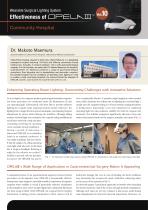
Wearable Surgical Lighting System Effectiveness of Community Hospital Superintendent of Chiba Shiroi Hospital, Hakushokai Medical Corporation Chiba Shiroi Hospital, situated in Shiroi City, Chiba Prefecture, is a designated emergency hospital featuring 100 beds and offering community-based medical care. Annually, it conducts between 150 to 200 gastroenterological surgeries. For this interview, we spoke with Dr. Makoto Maemura, the hospital’ s superintendent. Dr. Maemura performs a range of gastroenterological procedures, from digestive tract to hepatobiliary and pancreatic surgeries. He provided insights into the conditions of operating room lighting in small to medium-sized community hospitals, the reasons behind the adoption of OPELAⅢ system, and shared his experiences with its use. Enhancing Operating Room Lighting: Overcoming Challenges with Innovative Solutions At our hospital, two surgeons perform general gastrointestinal surgeries, to be exceptionally effective. It provides ample brightness where needed but these procedures are conducted under the illumination of only most, which eliminates the tedious task of adjusting the overhead light. I one operating light. Unfortunately, this often fails to provide sufficient usually use it for surgeries lasting 3 to 4 hours without causing discomfort lighting for complex tasks requiring intricate details. Moreover, the or feeling heavy. Importantly, it not only substitutes for traditional lighting from a single direction proves inadequate, necessitating frequent operating lights but also enhances visibility for both the surgeon and adjustments by nurses, which disrupts the workflow. Although adding assistants. This brilliant equipment significantly alleviates stress and another overhead light was considered, the required ceiling modifications reduces the physical burden on the surgeon, assistants, and nurses (Fig.1). would have been both costly and timeconsuming, rendering the operating room unusable during installation. During a period of indecision, I discovered OPELAⅢ at an exhibition booth in an academic conference. It was unlike anything I had seen before. It had the quality of a ceiling operating room light while also worn on the head like a surgical headlight. Believing it might be the solution we needed, I decided to proceed with the purchase. Fig.1︱Dr. Maemura conducting surgery using OPELAⅢ in combination with single-arm operating room light. In practice, the OPELAⅢ has proven OPELAⅢ’ s Wide Range of Application in Gastrointestinal Surgery Makes It Appealing A substantial portion of our gastrointestinal surgeries involves intricate procedures on the digestive tract. OPELAⅢ is exceptionally effective during these open surgeries, especially notable in laparotomy and gastric surgeries where visibility is crucial. It particularly enhances visualization in the perisplenic area, where standard lights fail to adequately illuminate the deep surgical fields. With OPELAⅢ, the surgical field is brightly illuminated, enabling precise manipulation which reduces risk of inadvertent damage. But even in case of bleeding, the device facilitates easy hemostasis due to improved visual verification, enhancing safety and accuracy of the operation (Fig.2). In colorectal surgery, I particularly appreciate its benefits when detaching the anterior/posterior wall of the rectum through perineal manipulation. Although such cases are not very common, it also proves useful during anal manipulations for ileal and colorectal anastomo
Open the catalog to page 1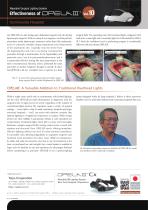
Wearable Surgical Lighting System use OPELAⅢ not only during open abdominal surgeries but also during surgical field.’ The operating room had overhead lights configured with laparoscopic surgeries. With our setup of two surgeons, we often perform dual arms, a main light and a secondary light, but I still wished for OPELA procedures under laparoscopic assistance rather than fully endoscopic, Ⅲ. I think the confidence level in performing surgery is considerably and it is extremely valuable during anastomosis and reinforcement different with and without OPELAⅢ. of the anastomotic site. I typically...
Open the catalog to page 2All OPELAIII Cx catalogs and technical brochures
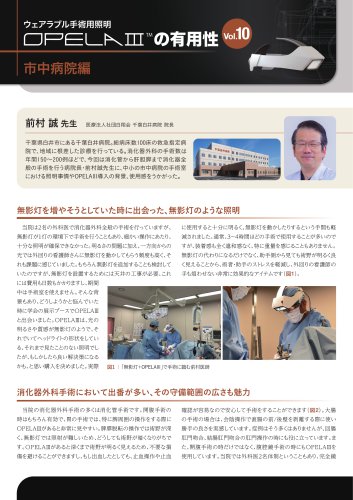 OPELAⅢの有用性vol10市中病院編
2 Pages
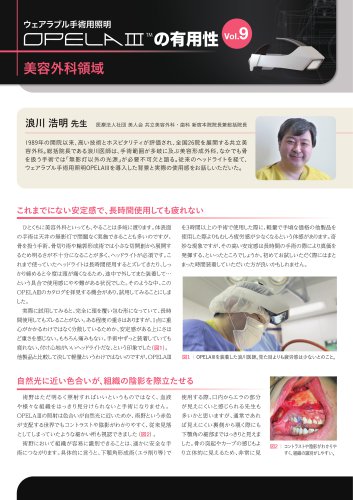 OPELAⅢの有用性vol9美容外科領域
2 Pages
 OPELAⅢの有用性vol8救命救急・災害領域
2 Pages
 OPELAⅢの有用性vol7形成外科領域
2 Pages
 OPELAⅢの有用性vol4呼吸器外科領域
2 Pages
 OPELAⅢの有用性vol3乳腺外科領域
2 Pages
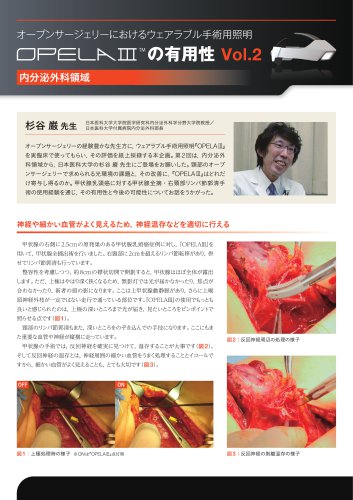 OPELAⅢの有用性vol2内分泌外科領域
2 Pages
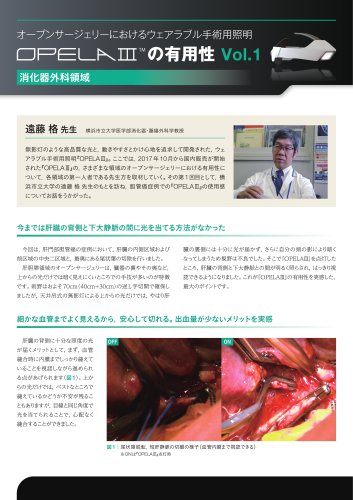 OPELAⅢの有用性vol1消化器外科領域
2 Pages
 OPELAIII Instructions Manual
32 Pages
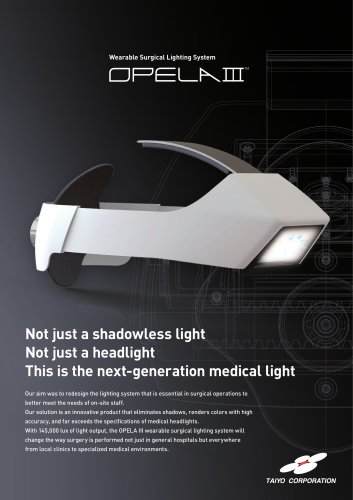 OPELAⅢ_Catalog_EN
2 Pages
 OPELAIII Cx Instructions Manual
48 Pages