

THE CRADLE SPLINT

THE CRADLE SPLINT
The Cradle Splint is designed for the lower limb and should be used according to the instructions provided by the treating physician. It is recommended not to apply the splint directly to bare skin, and all skin wounds or lesions should be dressed prior to application.
The splint is made of nylon and polyurethane, making it light, flexible, and of variable stiffness. It is suitable for first aid support of all levels of lower limb injuries, providing support without the need for rigid immobilization. The splint supports the foot and ankle in a physiological plantigrade position and prevents limb rotation with the use of a stabilizer. It is translucent in radiological images and absorbs shocks during transport.
- Spread out the splint and attach the inflation pump to the valve, inflating to the desired stiffness.
- Click-close the buckles and tighten the cross straps for a snug fit.
- Buckle and tighten the oblique straps for desired foot support.
- Withdraw the stabilizer from its pocket and apply its Velcro surfaces to the splint.
- Use the well-leg strap to secure both legs together if needed for first aid and transport.
- Remove the pump, close the valve, and insert the padding behind the heel pit and along the foot piece.
- Place the leg into the splint, aligning the heel above the heel pit.
The splint can be washed with water, soap, and antiseptics but should not be laundered in a washing machine. Sterilization by gas is recommended when necessary. The splint should be stored at temperatures below 50 degrees Celsius and should not be punctured or opened with sharp instruments.
The air pressure in the splint should not exceed 230 mmHg (30,000 pascal) when inflated without the attached air pump. The splint is intended for personal use, and the company is not responsible for misuse.
Orthoflex Ltd. can be contacted via phone at 972-4-8388778, fax at 972-4-8244558, or email at [email protected].
Catalog excerpts

• Cross straps # Oblique straps # One-way valve # Buckles # Pocket for stabilizer • Well-leg strap Instructions for use • Use of the splint must be according to the instructions given by the treating physician. • We recommend not to apply the splint directly to the bare skin. • Prior to applying the splint all skin wounds or lesions should be dressed. • When the splint is being inflated not with the attached air pump, the air pressure in the splint should not exceed 230 mmHg (30,000 pascal) • The splint can be washed with water, soap, and the usual antiseptics in use in medical institutions. • Do not launder in a washing machine. • Sterilize the splint by gas when necessary. • Do not open the package with a sharp instrument. • Do not puncture the splint. • Store at temperatures below 50 degrees Celsius. • The splint is intended for personal use. The company takes no responsibility if the splint is not used according to the instructions given by the producer.
Open the catalog to page 1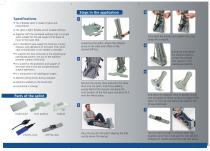
Steps in the application Specifications The inflatable splint is made of nylon and polyurethane. The splint is light, flexible and of variable stiffness. Together with the contained well-leg strap it is single splint suitable for first aid support of all levels of injury to the lower limb. Click-close the buckles and tighten the cross straps for a snug fit Spread out the splint. Attach the inflation pump to the valve and inflate to the desired stiffness. It is intended to give support to fractures, injuries, diseases, and operations of the lower limb, when rigid immobilization is not needed or...
Open the catalog to page 2All Orthoflex catalogs and technical brochures
 THE CRADLE SPLINT
2 Pages
 Next-Generation Limb Support
2 Pages
 inflated splint
2 Pages
