
- Catalogs
- ORUM INTERNATIONAL
- BAG LINE - ORUM INTERNATIONAL

BAG LINE - ORUM INTERNATIONAL
BAG LINE - ORUM INTERNATIONAL
Catalog excerpts

BAG LINE - ORUM INTERNATIONAL © ALL RIGHTS RESERVED
Open the catalog to page 1
INDEX CLEANROOM BAG (code 381) to transport plates and swabs “WCB” WIRE COLLECTING BAG (code 389) to store and transport various samples COLLECTING BAG (code 383) to store and transport various samples BIOHAZARD BAG (code 385) to transfer biological samples and documents BIOHAZARD POCKET SUPER BAG (code 386) to transfer biological samples and documents STERIBAG AUTOCLAVABLE DISPOSAL BAG (code 384) for sterilizing infected materials “SFB” SIDE FILTER BAG (code 408) to use with blender SUPER BAG (code 382) to use with blender
Open the catalog to page 2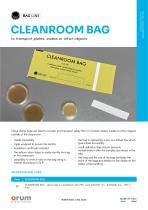
BAG LINE - ORUM INTERNATIONAL © ALL RIGHTS RESERVED CLEANROOM BAG to transport plates, swabs or other objects These sterile bags are ideal to contain and transport safely Petri or Contact plates, swabs or other objects outside of the cleanroom. • • • • sterile traceability triple wrapped to ensure the sterility irradiation certificate included the yellow colour helps to easily identify the bag in the cleanroom • possibility to write a note on the bag using a marker according to GLP • the bag is opened by a pre-cut dotted line which guarantees the sterility • a self-adhesive flap closure prevents...
Open the catalog to page 3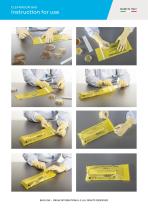
BAG LINE - ORUM INTERNATIONAL © ALL RIGHTS RESERVED
Open the catalog to page 4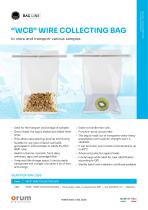
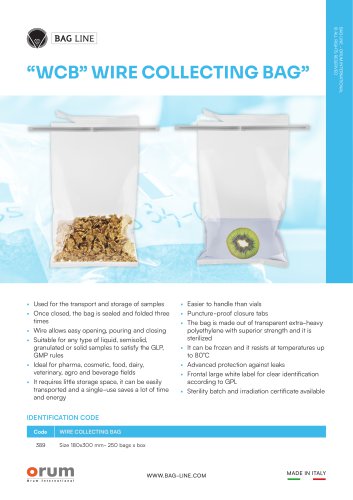
to store and transport various samples • Used for the transport and storage of samples • Once closed, the bag is sealed and folded three times • Wire allows easy opening, pouring and closing • Suitable for any type of liquid, semisolid, granulated or solid samples to satisfy the GLP, GMP rules • Ideal for pharma, cosmetic, food, dairy, veterinary, agro and beverage fields • It requires little storage space, it can be easily transported and a single-use saves a lot of time and energy • Easier to handle than vials • Puncture-proof closure tabs • The bag is made out of transparent extra-heavy polyethylene...
Open the catalog to page 5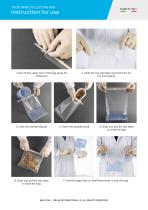
1. Tear off the upper part of the bag along the dotted line 3. Insert the sample (liquid) 6. Grab and pull the two sides to close the bag 2. Grab the two side flaps and fold them for the final sealing 4. Insert the sample (solid) 5. Grab and pull the two sides to close the bag 7. Fold the edge back on itself three times to seal the bag BAG LINE - ORUM INTERNATIONAL © ALL RIGHTS RESERV
Open the catalog to page 6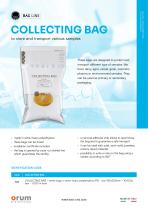
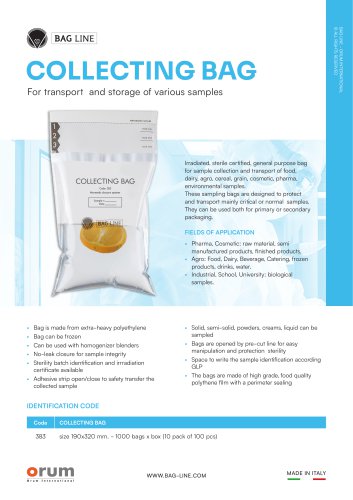
BAG LINE - ORUM INTERNATIONAL © ALL RIGHTS RESERVED COLLECTING BAG to store and transport various samples These bags are designed to protect and transport different type of samples, like food, dairy, agro, cereal, grain, cosmetic, pharma or environmental samples. They can be used as primary or secondary packaging. • a removal adhesive strip allows to open/close the bag and to guarantee a safe transport • made in extra-heavy polyethylene • these bags can be frozen • irradiation certificate included • the bag is opened by a pre-cut dotted line which guarantees the sterility • it can be used with...
Open the catalog to page 7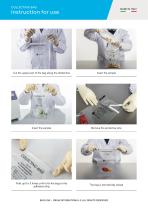
Cut the upper part of the bag along the dotted line Remove the protective strip Fold up for 3 times until to fix the bag to the adhesive strip BAG LINE - ORUM INTERNATIONAL © ALL RIGHTS RESERVED
Open the catalog to page 8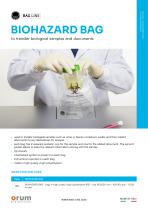
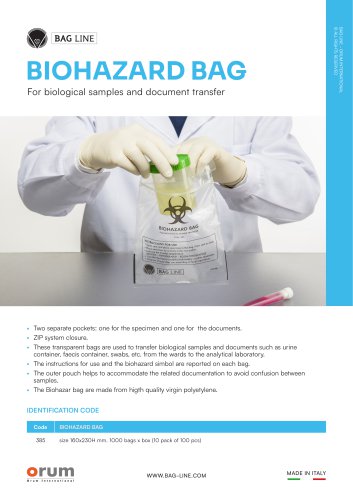
BAG LINE - ORUM INTERNATIONAL © ALL RIGHTS RESERVED BIOHAZARD BAG to transfer biological samples and documents • used to transfer biological samples such as urine or faeces containers, swabs and their related documents to any laboratories for analysis • each bag has 2 separate pockets: one for the sample and one for the related document. The second pocket allows to keep the relevant information among with the sample • zip closure • a biohazard symbol is present on each bag • instructions reported on each bag • made in high quality virgin polyethylene IDENTIFICATION CODE Code 385 BIOHAZARD BAG...
Open the catalog to page 9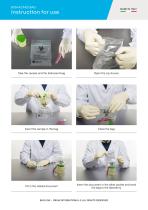
Take the sample and the biohazard bag Fill in the related document Insert the document in the other pocket and send the bag to the laboratory BAG LINE - ORUM INTERNATIONAL © ALL RIGHTS RESERVED
Open the catalog to page 10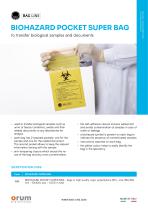
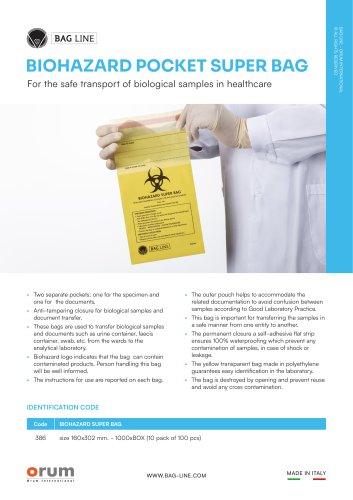
to transfer biological samples and documents • used to transfer biological samples such as urine or faeces containers, swabs and their related documents to any laboratories for analysis • each bag has 2 separate pockets: one for the sample and one for the related document. The second pocket allows to keep the relevant information among with the sample • anti-tampering closure which avoids the reuse of the bag and any cross contamination • the self-adhesive closure ensures waterproof and avoids contamination of samples in case of crash or leakage • a biohazard symbol is present on each bag to...
Open the catalog to page 11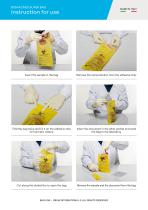
Remove the red protection from the adhesive strip Fold the bag twice and fix it on the adhesive strip for hermetic closure Insert the document in the other pocket and send the bag to the laboratory Cut along the dotted line to open the bag Remove the sample and the document from the bag BAG LINE - ORUM INTERNATIONAL © ALL RIGHTS RESERVED
Open the catalog to page 12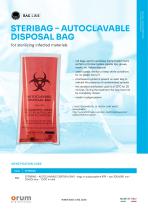
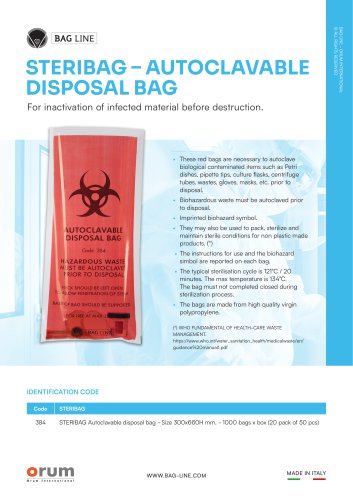
for sterilizing infected materials • red bags used to autoclave contaminated items as Petri or Contact plates, pipette tips, gloves, masks, etc. before disposal • used to pack, sterilize or keep sterile conditions for no plastic items (*) • a biohazard symbol is present on each bag to indicate the presence of contaminated samples • the standard sterilization cycle is at 121°C for 20 minutes. During the treatment, the bag must not be completely closed • made in polypropylene (*) WHO FUNDAMENTAL OF HEALTH-CARE WASTE MANAGEMENT. https://www.who.int/water_sanitation_health/medicalwaste/en/ guidance%20manual1.pdf...
Open the catalog to page 13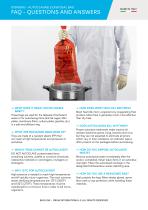
STERIBAG – AUTOCLAVABLE DISPOSAL BAG → WHAT DOES IT MEAN “AUTOCLAVABLE BAGS”? These bags are used for the disposal of biohazard waste or for autoclaving items (animal cages, Petri plates, membrane filters, culture plates, pipettes, etc.) in a safe and efficient way. → WHAT ARE BIOHAZARD BAGS MADE OF? They are made of a resistant plastic (PP) that can resist at high temperatures and pressures of autoclave. → WHICH ITEMS CANNOT BE AUTOCLAVED? DO NOT AUTOCLAVE contaminated items containing solvents, volatile or corrosive chemicals, radioactive materials or carcinogens, mutagens or teratogens. →...
Open the catalog to page 14All ORUM INTERNATIONAL catalogs and technical brochures
 BIOHAZARD BAG - BAG LINE
2 Pages
 COLLECTING BAG - BAG LINE
2 Pages
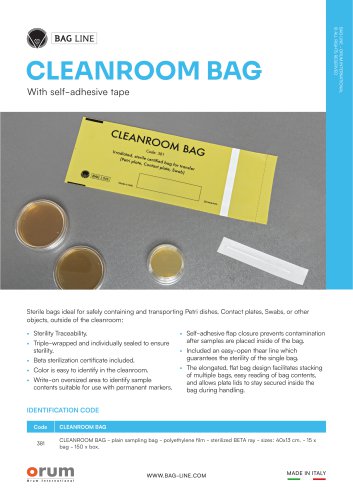 CLEANROOM BAG - BAG LINE
2 Pages
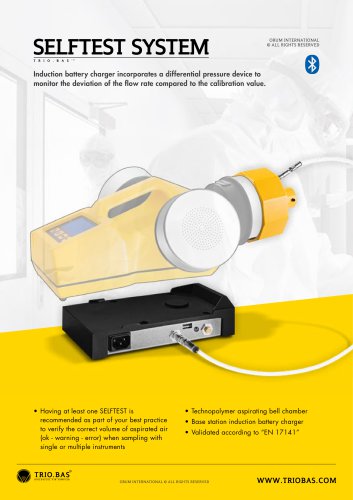 TRIO.BAS™ SELFTEST SYSTEM
2 Pages
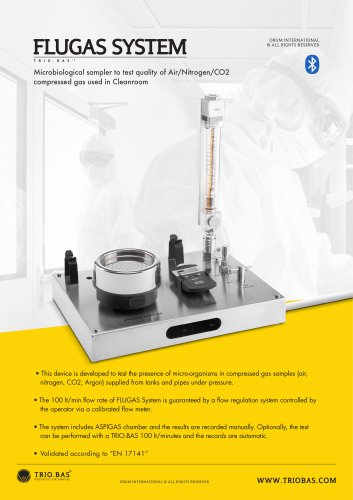 TRIO.BAS™ FLUGAS SYSTEM
2 Pages
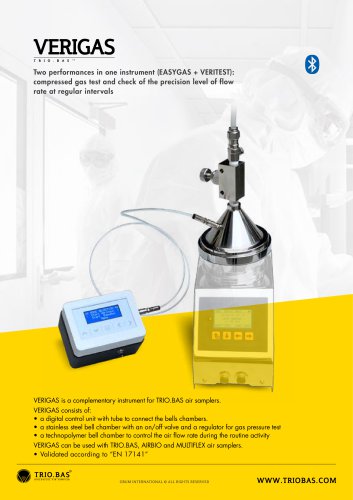 TRIO.BAS™ VERIGAS
2 Pages
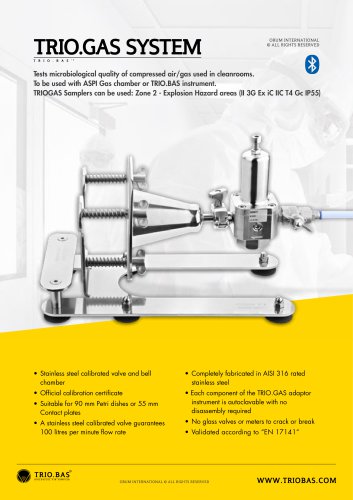 TRIO.BAS™ TRIO.GAS SYSTEM
2 Pages
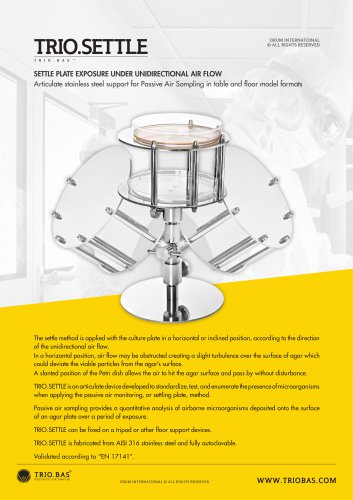 TRIO.BAS™ TRIO SETTLE
2 Pages
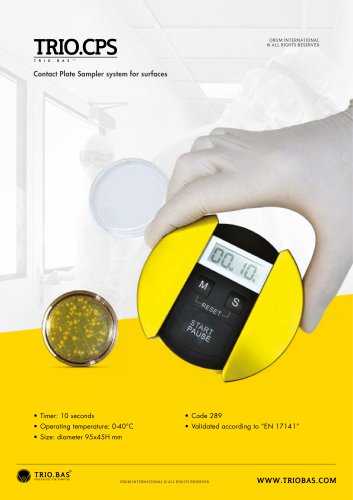 TRIO.BAS™ TRIO.CPS
2 Pages
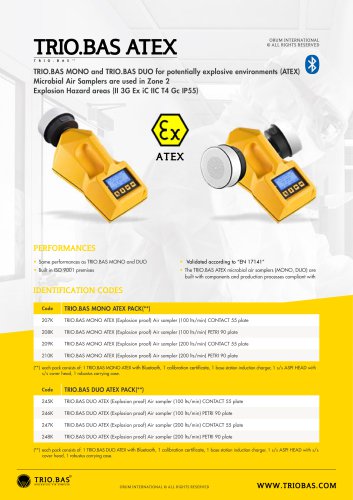 Explosion Proof ATEX
2 Pages
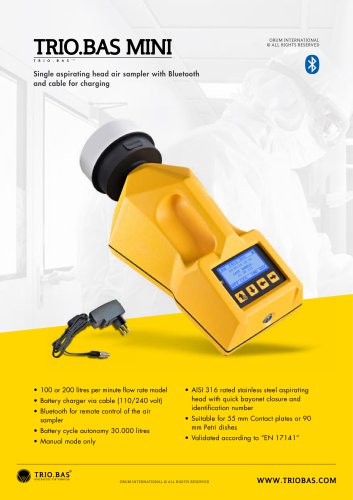 TRIO.BAS™ MINI
2 Pages
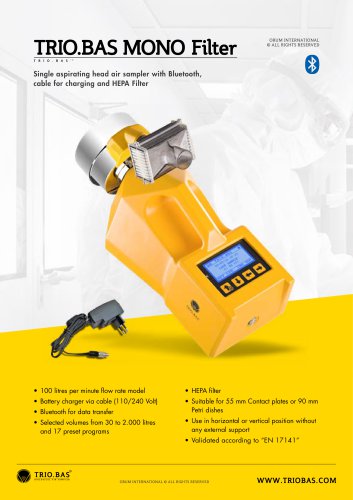 TRIO.BAS™ MONO FILTER
2 Pages
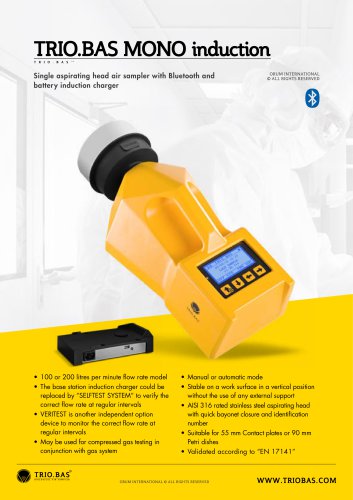 TRIO.BAS™ MONO INDUCTION
2 Pages
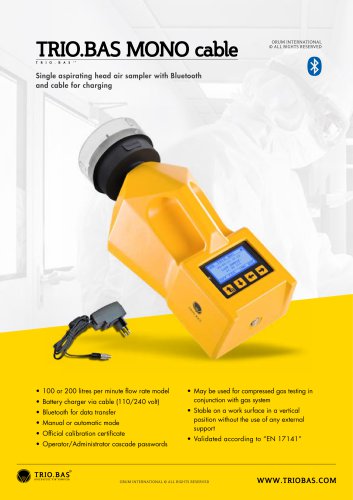 TRIO.BAS™ MONO CABLE
2 Pages
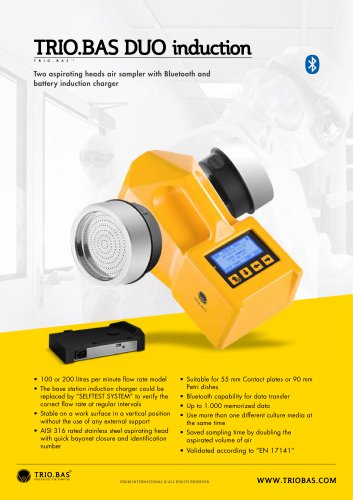 TRIO.BAS™ DUO INDUCTION
2 Pages
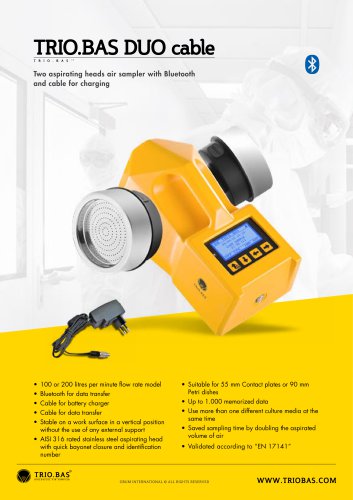 TRIO.BAS™ DUO CABLE
2 Pages
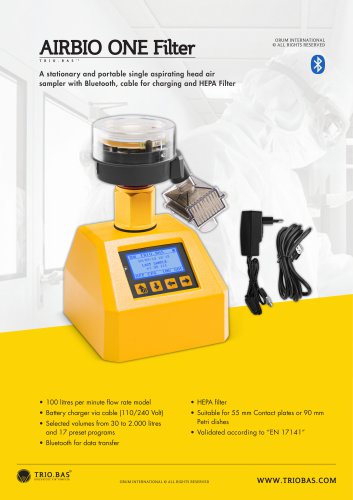 TRIO.BAS™ AIRBIO ONE FILTER
2 Pages
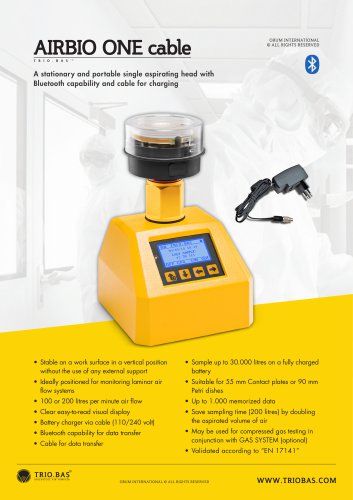 TRIO.BAS™ AIRBIO ONE CABLE
2 Pages
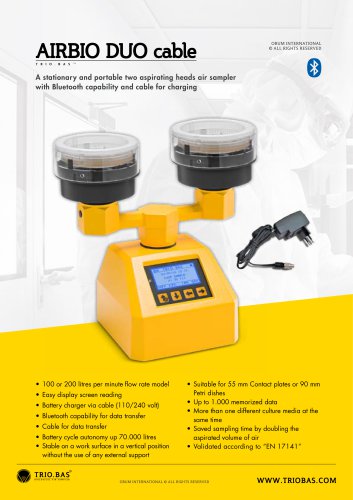 TRIO.BAS™ AIRBIO DUO CABLE
2 Pages
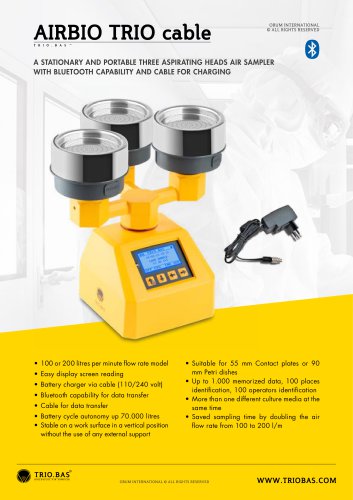 TRIO.BAS™ AIRBIO TRIO CABLE
2 Pages

- Analysis software
- Control software
- Laboratory testing system
- Windows software
- Laboratory software
- Medical packaging
- Stainless steel support
- Traceability software
- Control analyser
- Analyser for the pharmaceutical industry
- Recording software
- Flow testing system
- Packaging pouch
- Server-based software
- Pressure testing system
- Calibration analyser
- Security software
- Carbon dioxide analyzer
- Plastic bag
- Android software