
- Catalogs
- OSSTELL AB
- Osstell ISQ

Osstell ISQ

Osstell ISQ
- Optimal Loading Decisions: The system helps in making informed decisions about when to load implants, considering various clinical parameters and risk factors related to implant stability.
- Early Warnings: By providing early warnings of potential stability issues, the Osstell ISQ system helps prevent treatment failures, especially in high-risk patients.
- Quality Assurance: The system enhances communication between dental professionals and patients, offering a clear understanding of stability measures and increasing patient confidence.
- The Osstell ISQ meter uses a SmartPeg™ to measure resonance frequencies, which are translated into the Implant Stability Quotient (ISQ) scale ranging from 1 to 100.
- ISQ values above 55 are generally considered indicative of sufficient stability for successful treatment outcomes.
- The system includes a hand-held probe, a rechargeable battery, and is compatible with most major implant systems.
- The Osstell ISQ system is easy to use, providing quick and comfortable measurements for patients.
- It facilitates objective comparisons of treatment outcomes across different clinics and enhances the training of dental professionals.
- The system is supported by a global warranty and customer support, ensuring reliability and user satisfaction.
Catalog excerpts

optimal implant loading decisions
Open the catalog to page 1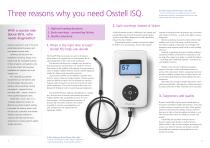
Three reasons why you need Osstell ISQ. With a success rate above 95%, who needs diagnostics? Implant treatment is one of the most predictable dental therapies, with near-perfect success rates. However, the nature of the treatment is evolving. Today, more patients ask for immediate loading of their implants. And patients who in the past might not have been candidates for implants ask to be treated, too. This naturally puts greater requirements on the dentists and the technology. Allowing early loading, and successfully treating risk patients – despite the less favorable odds – create a need for...
Open the catalog to page 2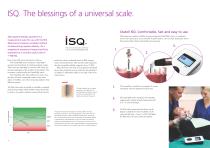
ISQ. The blessings of a universal scale. Osstell ISQ. Comfortable, fast and easy to use. ISQ (Implant Stability Quotient) is a measurement scale for use with the RFA (Resonance Frequency Analysis) method of determining implant stability. It’s a mapping of resonance frequencies (kHz), presented as a clinically useful scale of 1-100 ISQ. Here is how ISQ works and what it achieves. The Osstell ISQ meter stimulates a SmartPeg™ mounted on the implant, by emitting magnetic pulses. These cause the SmartPeg to resonate with certain frequencies depending of the stability of the implant. The resonance...
Open the catalog to page 3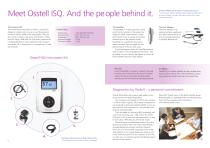
Meet Osstell ISQ. And the pe ople behind it. The instrument kit The actual Osstell instrument (1 below) is attractively designed, compact and very easy to use. Measurement results are clearly visible on the large display. They are also stored in memory and can be transferred to a Windows PC using a USB cable (4). The meter is powered by a rechargeable battery and is delivered with a measurement probe (2), a mains plug (3), a testing device (5) and user manuals. Technical data Rated power: Instrument size: Package size: Instrument weight: Total gross weight: The SmartPeg The SmartPeg is a...
Open the catalog to page 4
Scientific references. More than 300 scientific reports and papers on the measurement of dental implant stability have been published around the world. Some of these are listed below. More can be found on Osstell’s website, www.osstell.com Bornstein M, Hart C, Halbritter S, Morton D, Buser D. Early Loading of Nonsubmerged Titanium Implants with a Chemically Modified Sand-Blasted and AcidEtched Surface: 6-Month Results of a Prospective Case Series Study in the Posterior Mandible Focusing on Peri-Implant Crestal Bone Changes and Implant Stability Quotient (ISQ) Values. Clin Implant Dent Relat Res...
Open the catalog to page 5All OSSTELL AB catalogs and technical brochures
 Osstell IDx
6 Pages