


Prosthetics. Lower limb.
1 /454Pages
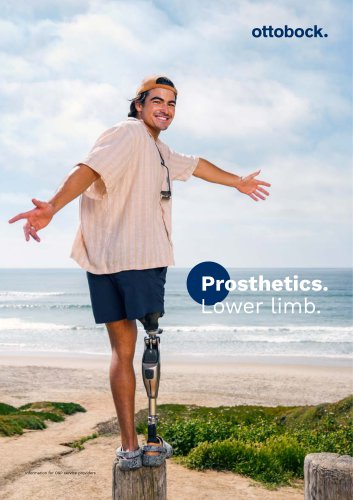
Prosthetics. Lower limb.
1 /454Pages
Catalog excerpts
Information for O&P service providers
Open the catalog to page 1
Prosthetics. Lower limb. This is a global catalogue. The product selection is exemplary and may vary depending on local conditions. If you have any questions, please get in touch with your local Ottobock contact. Please visit www.ottobock.com to obtain up-to-date product information at any time.
Open the catalog to page 2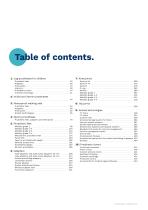
2 | Initial and interim prostheses 3 | Waterproof walking aids • Accessories/spare parts for socket technology in general 403
Open the catalog to page 4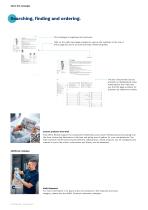
About this catalogue Searching, finding and ordering. This catalogue is organised into sections. Knee joints · Kenevo 3C60 Kenevo The Ottobock Kenevo is a microprocessor knee that meets the needs of moderately active users. In addition, it is also suitable as a knee joint for rehabilitation after an amputation. It features various basic functions that provide support in typical everyday situations. Moreover, activity modes A, B, B+ and C provide high adaptability to changing mobility. Tabs on the right-hand page margins as well as the subtitles at the top of every page also serve as quick and...
Open the catalog to page 5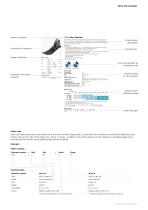
About this catalogue Prosthetic feet · Mobility grade 3–4 1C68 Triton side flex Brief product description The 1C68 Triton side flex was designed for highly active individuals who navigate varied indoor and outdoor environments and place a high value on uncompromised response. It is the first prosthetic foot to provide such extraordinary lateral adaptability and adjusts to the current situation immediately. Triton side flex Connection cover with normal footshell Connection cover with slim 1 Piece(s) footshell Heel wedges for Triton Spectra protective sock black Available information material Key...
Open the catalog to page 6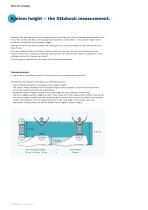
About this catalogue System height – the Ottobock measurement. Ottobock has defined an auxiliary measurement that helps you fill the available space between the end of the socket and floor with appropriate prosthetic components – the system height. Every prosthetic component has a system height. Adding the individual values quickly and easily gives you the build height of the components you have chosen. The values determined by Ottobock take into account the fact that the pyramid and pyramid receiver interlock in modular prosthesis construction. You will find the values in table form in the catalogue...
Open the catalog to page 7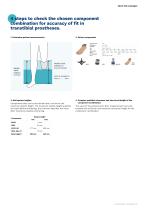
About this catalogue 4 steps to check the chosen component combination for accuracy of fit in transtibial prostheses. 1. Determine patient measurements 2. Select components Reference number Mobility grade Heel height Medial tibial plateau to end of socket Medial tibial plateau to floor Components that can be shortened have a minimum and maximum system height. The maximum system height specifies the value before shortening, the minimum specifies the value after maximum possible shortening. beige (4), light brown (15) 4. Compare available clearance and structural height of the component combination...
Open the catalog to page 8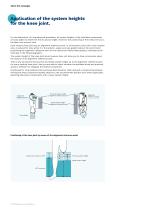
About this catalogue Application of the system heights for the knee joint. For the fabrication of a transfemoral prosthesis, all system heights of the individual components are also added to determine the structural height. However, the positioning of the knee joint has to be taken into account here. Each modular knee joint has an alignment reference point. In monocentric joints this is the rotation axis, in polycentric knee joints it is the anterior, upper axis (see graphic below). We recommend positioning the alignment reference point 20 mm above the medial tibial plateau, illustrated schematically...
Open the catalog to page 9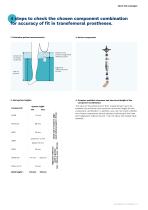
About this catalogue 4 steps to check the chosen component combination for accuracy of fit in transfemoral prostheses. 1. Determine patient measurements Distal end of socket to alignment reference point Distal end of socket to ground Alignment reference point to floor 3. Add system heights System height max. Distal end of socket to alignment reference point = 87 mm The value of the socket end to floor measurement has to be between the minimum and maximum structural height for the component combination. In addition, you can now check whether the chosen components permit optimal positioning of...
Open the catalog to page 10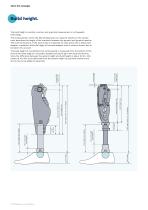
About this catalogue Build height. The build height is another common and practical measurement in orthopaedic technology. This measurement, which the O&P professional can measure directly on the component, describes the length of the transition between the pyramid and pyramid receiver. The outer termination of the tube clamp is measured on knee joints with a distal tube adapter. In addition, the build height of the tube adapter with or without torsion has to be taken into account. Build height knee incl. tube adapter Build height knee Proximal build height knee Distal build height knee Build...
Open the catalog to page 11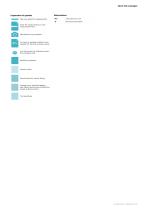
About this catalogue Explanation of symbols Take your patient’s measurements Technical information Enter the measurements on the measurement form Take photos of your patient You have an existing modified, unencrypted STL file from another source You will receive the finished product from Ottobock iFab Definitive prosthesis Version, inside Check socket for interim fitting Casting forms, positive/negative, well-fitting check socket or definitive socket as base product Trial prosthesis
Open the catalog to page 12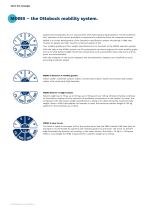
About this catalogue MOBIS – the Ottobock mobility system. Quality and individuality are our top priorities when fabricating a leg prosthesis. The OP professional’s selection of the correct prosthetic components is a decisive factor for treatment success. MOBIS is a further development of the Ottobock classification system introduced in 1994 that focuses on people and their need for enhanced quality of life. Four mobility grades and four weight classifications form the basis of the MOBIS selection system. With the help of the MOBIS symbol, the OP professional can see at a glance for what mobility...
Open the catalog to page 13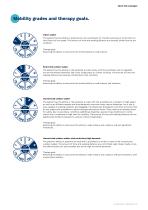
About this catalogue Mobility grades and therapy goals. Indoor walker The patient has the ability or potential to use a prosthesis for transfer purposes or locomotion on level floors at low speed. The amount of time and walking distance are severely limited due to the condition. Therapy goal: Restoring the ability to stand and the limited ability to walk indoors. Restricted outdoor walker The patient has the ability or the potential to walk slowly with the prosthesis and to negotiate low environmental obstacles like curbs, single steps or uneven surfaces. The amount of time and walking distance...
Open the catalog to page 14All Ottobock catalogs and technical brochures
 Orthotics Product Catalog
30 Pages
 The Spine Line
21 Pages
 New Products & Proven Classics
60 Pages
 Prosthetics 2024
244 Pages
- Ottobock orthopedic immobilization
- Wheelchair
- Outdoor wheelchair
- L orthopedic immobilization
- S orthopedic immobilization
- Indoor wheelchair
- M orthopedic immobilization
- Ottobock orthosis
- Black wheelchair
- Electric wheelchair
- Articulated orthopedic immobilization
- Knee orthosis
- Wheelchair with armrests
- XS orthopedic immobilization
- Pediatric orthopedic immobilization
- Mobile disinfection system
- Ottobock lower extremity prosthesis
- Ottobock ankle and foot orthosis
- Extension orthopedic immobilization
- Orthopedic tape