
- Catalogs
- OÜ InterVacTechnology
- InterVactechnology 2026 Catalogue

InterVactechnology 2026 Catalogue
InterVactechnology 2026 Catalogue
- Basic Tubes: Red, no additive, for clinical chemistry, serology, and immunology. Clotting time: 60 minutes, centrifugation: 1300 g for 10 minutes.
- Clot Activator Tubes: Red, silica as clot activator, clotting time: 10-30 minutes, same centrifugation.
- Clot Activator & Gel Tubes: Yellow, silica dioxide and gel, clotting time: 5-30 minutes, centrifugation: 1800-2200 g for 10 minutes.
- Thrombin Tubes: Orange, thrombin with silica, clotting time: 3-5 minutes, centrifugation: 1300 g for 10 minutes.
- Thrombin & Gel Tubes: Orange, similar additives, higher serum volume, centrifugation: 1800-2200 g for 10 minutes.
- EDTA Tubes: Purple, potassium EDTA, for whole blood or plasma, requires mixing 6-8 times.
- Citrate Tubes: Blue, trisodium citrate, for hemostatic system research, requires mixing 5 times, centrifugation: 2000-2500 g for 10-15 minutes.
- Heparin Tubes: Green, lithium or sodium heparin, for chemical, immunology, and toxicology tests, requires mixing 8-10 times.
- Fluoride Tubes: Grey, contain anticoagulant and glucose stabilizer, for glucose level determination, requires mixing 6-8 times.
- Extracellular DNA Tubes: Light lilac, for DNA fragment analysis, stabilization for 7-14 days.
- ACD Tubes: Lemon yellow, for blood group analysis and storage, no centrifugation required.
- Boric Acid Tubes: Yellow, for urine collection and analysis, preserves sample quality.
- Needles and Holders: Essential components manufactured by partner factories, used to secure multi-sample needles.
- Safety Holder: Features special needle protection for enhanced safety.
- Luer Adapter: Connects intravenous catheters, perfusion devices, and needles with Luer connectors to vacuum systems.
- Label tubes with patient information.
- Ensure hand hygiene and wear gloves.
- Select appropriate tubes and prepare equipment.
- Apply a tourniquet above the venipuncture site for no more than one minute.
- Choose the venipuncture site based on vein characteristics.
- Disinfect the site and wait for the antiseptic to dry.
- Insert the needle at a 15-30° angle and ensure proper blood flow.
- Mix the sample by gently inverting the tube as specified.
- Apply a pressure bandage or plaster after collection.
- Tubes are packed in foamed styrene racks and protective film, with specific dimensions and quantities per package.
Catalog excerpts
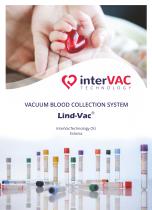
VACUUM BLOOD COLLECTION SYSTEM
Open the catalog to page 1
InterVacTechnology OÜ is the unique high-technology manufacturer of the vacuum blood collection system Lind-Vac® in the Baltic states. The Lind-Vac® vacuum blood collection system was introduced into market in 2011. The system has been designed for quick, safe, correct and hygenic blood collection. We offer a complete range of blood collection tubes available in different sizes and with appropriate additives. Also we provide a wide range of Lind-Vac® needles and holders to perform a total safety of vacuum blood collection. The Lind-Vac® vacuum blood collection systems are used in medical institutions...
Open the catalog to page 2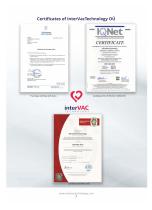
interVACTECHNOLOGY BUREAU VERITAS OU IrtervacTechnology Buniiu Veritas Certification certify that the Manage the above organisation has been audited and found <i villi the requirements of the management system slam :o he in accordance idard detailed behn ISO 9001:2015 MANUFACTURE. QUALITY CONTWX AND STORAGE OF VACUUM BtOOD AND URINE C0HECT10N TUBES, SPECIMEN TUBES WITH VIRAL TRANSPORT MEDIUM (WITWWIWOUT SWABS)
Open the catalog to page 3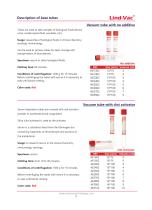
Description of base tubes Lind-Vac® Tubes are used to take samples of biological fluids (blood, urine, cerebrospinal fluid, exudates, etc.). Usage: researches of biological fluids in clinical chemistry, serology, immunology. Can be used as primary tubes for tests, storage and transportation of biomaterials. Specimen: serum or other biological fluids. Clotting time: 60 minutes. Conditions of centrifugation: 1300 g for 10 minutes. Before centrifuging the tubes with serum it is necessary to wait until blood clotting. Vacuum tube with clot activator Clot activator Serum Separation tubes are covered...
Open the catalog to page 5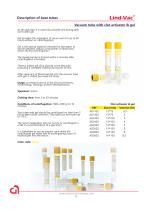
Description of base tubes Lind-Vac As the activator it is used silica dioxide and biologically inert olefin gel. Gel provides the separation of serum and clot up to 48 hours without re- centrifugation. Gel is the special material intended for formation of barrier between cellular components of blood and serum during centrifugation. The steady barrier is formed within 5 minutes after centrifugation is finished. There is added gel silica dioxide in the test tube providing a complete clotting during the 30 min. After capturing of blood sample into the vacuum tube with gel, it should be mixed 5.6...
Open the catalog to page 6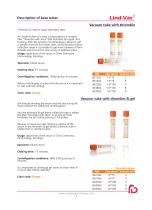
Description of base tubes Lind-Vac* Thrombin is used for rapid laboratory tests. An inside surface of a tube is processed by a complex filler "thrombin with silica" that facilitates the rapid clots forming. After the process of centrifuging it allows to get a sample of serum for further tests. Using thrombin blood collection tubes it is possible to get more cleaned of fibrin threads and clots serum than using no additive tubes. Usage: rapid tests of the serum in Clinic Chemistry, Immunology, Serology. Specimen: blood serum. Clotting time: 3-5 minutes. Thrombin Centrifugation conditions: 1300g...
Open the catalog to page 7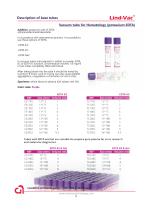
Description of base tubes Vacuum tube for Hematology (potassium EDTA) Additive: potassium salt of EDTA (ethylenediaminetetraacetate). In accordance with international practice, it is possible to use three options of EDTA: -EDTA K3; -EDTA K2; -EDTA Na2 In vacuum tubes anticoagulant is added in powder EDTA K2 or EDTA K3 solution, concentration reaches 1.8 mg/ml in test tubes completely filled with blood. After taking blood into the tube it should be mixed by turning 6-8 times. Lack of mixing can also cause platelet aggregation, coagulation or formation of micro clots. Specimen: whole blood or plasma...
Open the catalog to page 8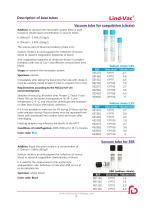
Description of base tubes Lind-Vac® Additive: to research the hemostatic system there is used trisodium citrate liquid concentration in vacuum tubes: The volume ratio of blood and sodium citrate is 9:1. Sodium citrate is an anticoagulant for collection of venous blood to research coagulation properties of blood. Anti-coagulative properties of citrate are shown in complex formation with ions of Ca2+ and effective removal them from blood. Usage: to research the hemostatic system. Specimen: plasma. Immediately after taking the blood into the tube with citrate it must be carefully mixed at least...
Open the catalog to page 9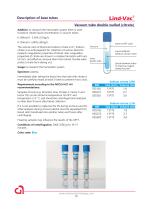
Description of base tubes Lind-Vac® Additive: to research the hemostatic system there is used trisodium citrate liquid concentration in vacuum tubes: The volume ratio of blood and sodium citrate is 9:1. Sodium citrate is an anticoagulant for collection of venous blood to research coagulation properties of blood. Anti-coagulative properties of citrate are shown in complex formation with ions of Ca2+ and effective removal them from blood. Double walls protect citrate from drying out. Usage: to research the hemostatic system. Specimen: plasma. Immediately after taking the blood into the tube with...
Open the catalog to page 10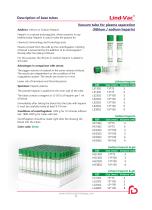
Description of base tubes Lind-Vac® Additive: Lithium or Sodium Heparin Vacuum tube for plasma separation(lithium / sodium heparin) Heparin is a natural anticoagulant, which presents in any healthy body. Heparin is used to take the plasma for chemical, immunology and toxicology tests. Plasma is freed from the cells by the centrifugation. Clotting of blood is prevented by the addition of an anticoagulant directly after the taking of blood. For this purpose, the lithium or sodium heparin is added in this tube. Advantages in comparison with serum: The bigger volume of material in the same volume...
Open the catalog to page 11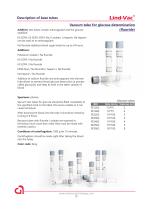
Description of base tubes Lind-Vac® Additive: test tubes contain anticoagulant and the glucose (fluoride) K3-EDTA, K2-EDTA, EDTA-Na, K oxalate, Li heparin, Na heparin can be used as an anticoagulant. Na fluoride stabilizes blood sugar levels for up to 24 hours. Potassium oxalate / Na fluoride K3-EDTA / Na fluoride K2-EDTA / Na fluoride EDTA-Na2 / Na fluoride Li heparin / Na fluoride Na heparin / Na fluoride Addition of sodium fluoride and anticoagulant into the test tube allows to prevent blood glucose destruction (a process called glycolysis) and keep its level in the taken sample of blood....
Open the catalog to page 12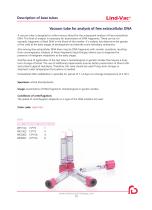
Description of base tubes Vacuum tube for analysis of free extracellular DNA A vacuum tube is designed to collect venous blood for the subsequent analysis of free extracellular DNA. This kind of analysis is necessary for examination of DNA fragments. These can be, for example, fragments of fetal DNA in the blood of the mother. It's analysis lets determine the gender of the child at the early stages of development and identify some hereditary multations. Also among free extracellular DNA there may be DNA fragments with somatic mutations resulting from carcinogenesis. Analysis of these fragments...
Open the catalog to page 13All OÜ InterVacTechnology catalogs and technical brochures
 PRP/PRF
4 Pages
- Laboratory test tube
- Needle holder
- Surgical needle holder
- Cylindrical collection tube
- Puncture needle
- Collection kit
- V-bottom test tube
- Collection tube with anticoagulant
- Sterile test tube
- Laboratory collection tube
- Graduated test tube
- Venipuncture needle
- Sample storage test tube
- Hematological analysis collection tube
- Blood test tube
- Blood collection kit
- Collection tube with coagulation activator