
- Catalogs
- Oxford Optronix Ltd.
- Advancing the frontiers of cancer research

Advancing the frontiers of cancer research

Advancing the frontiers of cancer research
The Colony Forming Unit (CFU) assay is the standard for evaluating treatment effects on cell viability. Manual counting is labor-intensive and error-prone, whereas automated systems improve accuracy, speed, and data management, facilitating large-scale studies and collaborative research.
Introduction
Due to financial constraints in cancer research funding, efficient research methods are necessary. Automated colony counting systems are vital for maximizing output and adhering to strict reporting standards.
Challenges of Manual Colony Counting
Manual counting is prone to errors, resource-intensive, and affected by observer variability. The complexity of 3D assays necessitates more accurate and less labor-intensive methods.
Automated Colony Counting and Image Analysis
Automated systems reduce turnaround time and improve accuracy by minimizing observer variability. They enable detailed data capture, including colony size and distribution, enhancing assay sensitivity.
GelCount™: An Integrated Approach
GelCount™ automates colony detection and analysis, offering a comprehensive solution for data archiving and retrieval. It supports large-scale and collaborative projects, providing a cost-effective alternative to manual counting.
Conclusion
Automated colony counting systems like GelCount™ are crucial for advancing cancer research, allowing for more accurate, efficient, and collaborative studies.
Overview of GelCount Technology
GelCount is an advanced platform for automated colony counting and analysis, offering significant improvements over manual methods. It is compatible with various formats and can detect colonies as small as 30 µm in diameter.
Key Features
- Performance: GelCount enhances throughput and accuracy, reducing human error and subjectivity.
- Compatibility: Supports both adherent and non-adherent colonies with high-resolution imaging capabilities.
- Data Management: Offers extensive data export options and supports offline image processing.
- User-Friendly: Features an intuitive interface with customizable detection parameters and real-time adjustments.
Applications and Benefits
GelCount is beneficial for cancer research, enabling precise and reproducible analysis of drug effects on colony size and number. It supports large-scale studies and complex combinational research, making it accessible to smaller laboratories.
Future Opportunities
The technology addresses operational challenges in cancer research by automating labor-intensive processes, maximizing resource utilization. Future advancements may include robotic sample loading and enhanced data sensitivity, expanding research capabilities.
About Oxford Optronix
Oxford Optronix is a leader in developing sophisticated instrumentation for clinical and life sciences, offering products like bio-sensing devices and automated imaging systems.
Catalog excerpts

Advancing the frontiers of cancer research Automated colony counting for cancer biologists Today’s intelligence-based imaging systems for automated mammalian cell colony counting deliver dramatic accuracy, productivity and throughput enhancements for cancer biologists involved in drug discovery, radiobiology or toxicology research. Automated colony counting opens the way for ambitious new projects that will advance the frontiers of research – including large-scale combinational studies
Open the catalog to page 1
Executive Summary The Colony Forming Unit (CFU) or Colony Forming Cell (CFC) assay is universally recognised as the gold standard method for measuring the effect of radiation, chemotherapeutic drugs and other agents on cell viability. However, manually counting the resulting cell colonies is a laborious task in which consistent objectivity is difficult to achieve. Commercial and funding pressures, resource limitations and the growing complexity of CFC assays means cancer biologists need to maximise colony sample processing capabilities while maintaining the rigour of standardised and accurate...
Open the catalog to page 3
Introduction The financial crisis of the past few years has led to deep cuts in public and non-government funding in the field of cancer research, resulting in hiring freezes across academic institutes. In 2012 Cancer Research UK, one of the largest charities in the UK, announced a 10% cut in basic research funding until 2015 because of a dip in income, which has had an impact on the pace of research and discovery. It’s a similar story in the life sciences industry and the world of ‘big pharma’, where burgeoning development costs and increased regulatory scrutiny have caused R&D costs to spiral....
Open the catalog to page 4
Colony forming assays - the drawbacks The introduction of new advanced assays has highlighted a number of drawbacks relating to the application of colony counting: • Assays require manual enumeration and are therefore highly subjective • The assay is operator intensive, time consuming and expensive to perform • High coefficients of variation (CV) can result • The assay lacks external standards and controls that do not allow assay calibration or standardisation, making validation difficult OXFORD OPTRONIX 1. Counting the cost: the issues and challenges of the colony formation assay technique The...
Open the catalog to page 5
2. The way forward: automated colony counting and image analysis Today’s modern automated colony counting and image analysis systems offer an efficient and costeffective alternative to manual counting, delivering a significant reduction in turnaround time resulting from high sample throughput. The automated image acquisition and analysis approach to colony counting has been validated and found to provide superior accuracy and precision compared to manual observer counting, reducing both intraand inter-observer variation. Using high depth of field imaging combined with powerful algorithms, unsurpassed...
Open the catalog to page 6
for presentations or print output into lab documentation, or in a digital raw image format that supports the future processing or reprocessing of samples. Now research laboratories can visually document findings quickly or submit captured images to multiple research teams or external agents for independent validation and/or processing and assessment. This ability to capture, process, export and data on or off line gives laboratories a cost effective and fast method of undertaking objective and rigorous double blind tests and extends the ability of laboratories to participate in global or large...
Open the catalog to page 7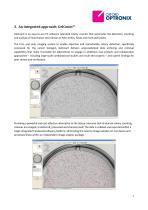
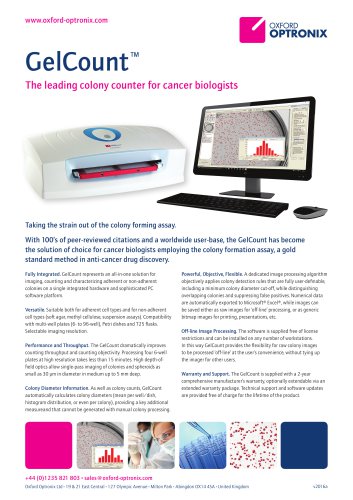
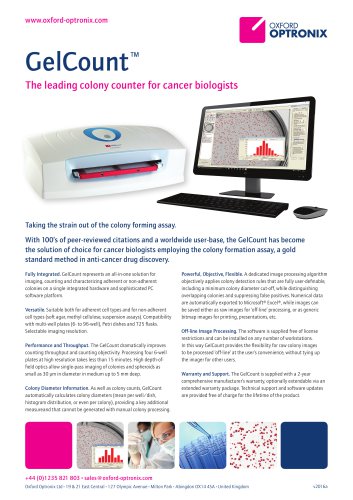
3. An integrated approach: GelCount™ GelCount is an easy-to-use PC software operated colony counter that automates the detection, counting and analysis of mammalian cell colonies in Petri dishes, flasks and multi-well plates. The first, and only, imaging system to enable objective and reproducible colony detection, specifically conceived for the cancer biologist, GelCount delivers unprecedented data archiving and retrieval capabilities that make it possible for laboratories to engage in ambitious new projects and collaborative approaches – including large-scale combinational studies and multi-site...
Open the catalog to page 8
This integrated approach enables: Images to be captured and processed within a single integrated hardware/software platform Instant archiving and output of raw colony images Off-line processing/reprocessing – even when original samples are no longer available Detection parameters (colony size/shape) can be previewed in real-time and stored for reuse Data findings can be captured and submitted for independent review on workstations where GelCount software is installed Data can be analysed and exported in a variety of formats. Impressive performance GelCount provides an effective and...
Open the catalog to page 9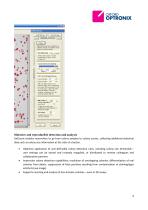
Objective and reproducible detection and analysis GelCount enables researchers to go from colony samples to colony counts, collecting additional statistical data such as colony size information at the click of a button. Objective application of user-definable colony detection rules, including colony size thresholds – user settings can be stored and instantly reapplied, or distributed to remote colleagues and collaboration partners Impressive colony detection capabilities; resolution of overlapping colonies, differentiation of real colonies from debris, suppression of false positives resulting...
Open the catalog to page 10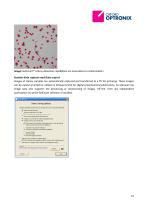
Image: GelCount™ colony detection capabilities are insensitive to contamination Instant data capture and data export Images of colony samples are automatically captured and transferred to a PC for archiving. These images can be output (printed) or utilised in bitmap format for digital presentations/submissions. An optional raw image type also supports the processing or reprocessing of images ‘off-line’ from any independent workstation on which GelCount software is installed.
Open the catalog to page 11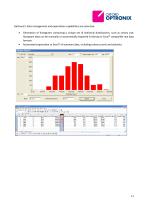
GelCount’s data management and exportation capabilities are extensive: Generation of histograms containing a unique set of statistical distributions, such as colony size; histogram data can be manually or automatically exported in bitmap or Excel® compatible raw data formats Automated exportation to Excel® of summary data, including colony counts and statistic
Open the catalog to page 12All Oxford Optronix Ltd. catalogs and technical brochures
 OxyLite™
2 Pages
 OxyFlo™
2 Pages
 GelCount™
1 Page
 HypoxyLab™
2 Pages
 OxyFlo Pro
2 Pages
 OxyLite Pro
2 Pages
 HypoxyLab ™
2 Pages
 GelCount ™
1 Page
- Laboratory testing system
- Laboratory workstation
- Temperature testing system
- O2 analyzer
- Flow testing system
- Testing system with touchscreen
- Continuous testing system
- Benchtop laboratory workstation
- Fully automated laboratory workstation
- Medical research testing system
- Benchtop colony counter
- Flowability tester
- Automatic colony counter
- Dissolved oxygen tester
- Digital colony counter
- Laboratory workstation with HEPA filter
- Scientific research laboratory workstation
- Anaerobic laboratory workstation
- Cellular biology laboratory workstation