FreeO2-COPD-Exacerb-ERS-2015

FreeO2-COPD-Exacerb-ERS-2015
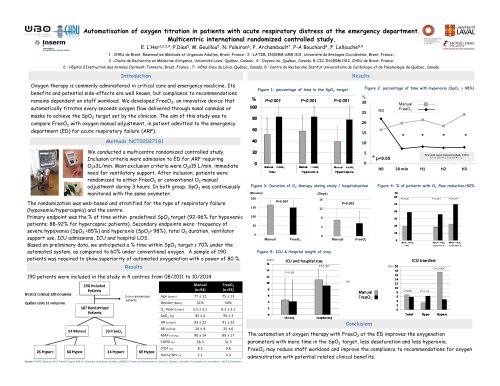
Oxygen therapy is a common treatment for patients with respiratory issues, but adherence to guidelines is often suboptimal. The FreeO2 device was developed to automatically adjust oxygen flow, aiming to reduce hyperoxia and hypoxemia in COPD patients. This study evaluates the feasibility and acceptance of FreeO2 in a clinical setting.
Methods
This randomized controlled pilot study involved COPD patients hospitalized for exacerbations. Participants were divided into two groups: one receiving usual oxygen care and the other using the FreeO2 device. The primary outcome was the acceptance of FreeO2 by caregivers, measured using a visual analogue scale. Secondary outcomes included time spent within SpO2 target range, duration of hyperoxia and desaturation, oxygen therapy duration, and hospital length of stay.
Results
FreeO2 was well accepted by nurses and physicians, with no significant difference in acceptance scores between the groups. The device improved the ability to maintain SpO2 within the target range and reduced the duration of hyperoxia and desaturation. There was a trend towards reduced oxygen therapy duration and hospital stay, although these were not statistically significant.
Conclusions
The study demonstrates that FreeO2 is feasible and well accepted in clinical practice for COPD exacerbations. It shows potential for better SpO2 management and reduced hospital stays, though further improvements in the device are needed for better patient acceptance.
Key Data
- FreeO2 maintained SpO2 within target range 81.2% of the time compared to 51.3% in the control group.
- Time with SpO2 > target +5% was significantly lower in the FreeO2 group (1.5%) compared to control (10.4%).
- Hospital length of stay was shorter for FreeO2 (5.8 days) compared to control (8.4 days).
Catalog excerpts

INSTITUr UNIVERSITAIRE DC CARDO.OGIF ET D6 PNEUMOLOGIE DC OUfBEC Francois Lellouche1-2, Pierre-Alexandre Bouchard1, Maude Roberge1, Guillaume Babin1, Erwan L'Her1-2, Francois Maltais1, Yves Lacasse1 'Centre de recherche de I'Institut Universitaire de Cardiologie et de Pneumologie de Quebec, Universite Laval, Quebec, Canada, 2Oxynov. Inc, Quebec, Canada Oxygen therapy is one of the most frequently used treatments on the respiratory ward. Compliance to practices guidelines is sub-optimal and time consuming. Clinicians are more concerned by desaturation than by hyperoxia, leading to the maintenance of higher than required oxygen flows. We have developed an innovative device (FreeO2) that automatically adjusts the oxygen flow to reduce hyperoxia and hypoxemia and to automatically wean the oxygen. With FreeO2, oxygen flows are titrated every second to maintain a constant SpO2 at a target set by the physicians. We tested the feasibility of using such device in patients hospitalized for COPD exacerbations. Methods NCT01393015 We have conducted a pilot randomized controlled study comparing usual O2 administration and automated O2 adjustment with FreeO2 at the respirology department of our institution. The study was conducted in patients hospitalized with COPD exacerbation and requiring oxygen therapy. Inclusion criterion were the following: age > 40 years, smoker > 10 pack/year, acute exacerbation (<15 days), O2 < 8L/min for SpO2 > 92%; Exclusion criterion were: admission > 48h, infection/colonisation with MDR bacteria, patient on NIV, cognitive impairment, lack of available FreeO2 prototype. Patients were randomized to recieve usual care for oxygen administration or automated titration by FreeO2 with remote monitoring at the nursing station of SpO2 and oxygen flow rate. The setting of the study with Free02 prototypes can be viewed at naan http://www.voutube.com/watch?v=JmGv8~gRtO bUsI Table 1: Patient's characteristics (at inclusion) Respiratory rate (c/min) 22±3 ED admission to inclusion (days) 0.6±0.7 Table 3: Clinical outcome Duration of O2 administration (days) Hospital length of stay Table 2: Primary outcome O2 monitoring NURSES (0 to 10 scale) O2 adjustment PHYSICIANS (0 to 10 scale) Inclusion to hosp. discharge 5.8±4.4 8.4±6.0 0.05 (days) Admission to hosp. discharge 6.7±4.3 9.5±6.0 0.05 (days) Complications Number of patients who completed the study (n, %) 20 (80) 20 (80) Table 4: Oxygenation and capillary blood gases Mean O2 flow (L/min) % of time with SpO, signal available pH Readmissions (within 30 days) (n) 6 ‘Specified by the physician in charge at inclusion The main objective of the study was to evaluate if FreeO2 could be used in daily practice and if it was accepted by the caregivers (primary outcome). Daily, we evaluated the perception of oxygen management in both groups by nurses and physicians with a visual analogue scale Lickert type (0 to 10 scale). Patients in both groups had continuous monitoring of SpO2, respiratory and heart rate and EtCO2. The secondary outcomes were (i) the time in the SpO2 target as defined by the physician in charge of each patient ± 2% (ii) the time with severe desaturation (SpO2 below 85%) (iii) the time with hyperoxia (SpO2 > 5% above the target) (iv) oxygen therapy duration (v) hospital length of stay. Grants: Fonds de Recherche en Sante du Quebec, Canadian Foundation for Innovation, IUCPQ foundation Conclusions -This pilot study demonstrates that automated oxygen titration and weaning by FreeO2 is feasible in patients hospitalized with acute COPD exacerbations. - Automated oxygen adjustment and remote monitoring was well accepted by nurses and by physicians. However, 20% of the patients did not complete the study in both groups. Improvement of the device will allow better acceptance by the patients. - FreeO2 provided a better ability to maintain SpO2 in the target range, a reduction in duration of hyperoxia and desaturation. We also observed a trend towards reduction of oxygen therapy duration, and a trend for PaCO2 reduction at Day 7. - These data demonstrate a potential to reduce the hospitalization length of stay, although the study was not designe
Open the catalog to page 1All OxyNov catalogs and technical brochures
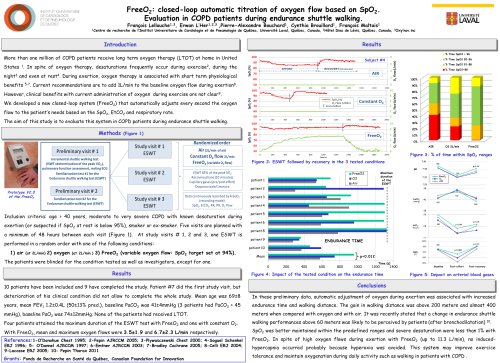 FreeO2-Rehab-CRC-2011
2 Pages