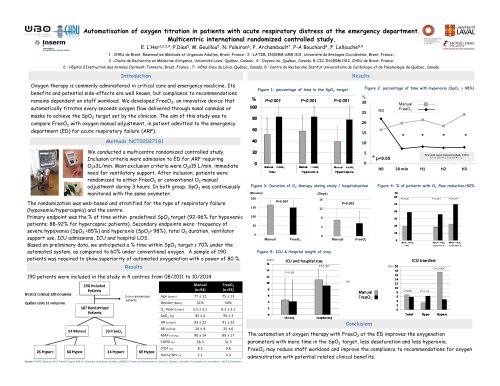
FreeO2-Rehab-CRC-2011
FreeO2-Rehab-CRC-2011
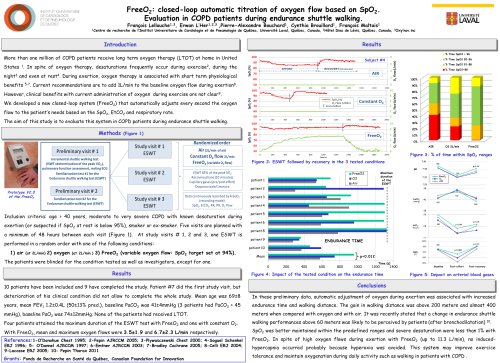
The study evaluates the FreeO2 system, a closed-loop automatic titration device for oxygen flow based on SpO2, in COPD patients during endurance shuttle walking. The aim is to improve exercise tolerance and maintain oxygenation.
Methods
Participants included were over 40 years old with moderate to very severe COPD and known desaturation during exertion. The study involved five visits with a minimum of 48 hours between each. During visits, patients performed endurance shuttle walking tests (ESWT) under three conditions: air at 2L/min, oxygen at 2L/min, and FreeO2 with variable oxygen flow targeting SpO2 at 94%.
Results
Preliminary data showed that automatic oxygen adjustment with FreeO2 increased endurance time and walking distance by over 200 meters compared to oxygen and almost 400 meters compared to air. SpO2 was better maintained within predefined ranges, with severe desaturation occurring less than 1% of the time. No induced-hypercapnia was observed despite high oxygen flows during exertion. The study included 10 patients, with 9 completing it. The mean age was 69 years, and none had received long-term oxygen therapy (LTOT).
Conclusions
The FreeO2 system may enhance exercise tolerance and maintain oxygenation during daily activities in COPD patients. The study was supported by the Fonds de Recherche en Santé du Québec and the Canadian Foundation for Innovation.
Catalog excerpts

FreeO2: closed-loop automatic titration of oxygen flow based on SpO2. Evaluation in COPD patients during endurance shuttle walking. Francois Lellouche1-3, Erwan L'Her1-2-3 ,Pierre-Alexandre Bouchard1, Cynthia Brouillard1, Francois Maltais1 Centre de recherche de I’Institut Universitaire de Cardiologie et de Pneumologie de Quebec, Universite Laval, Quebec, Canada, 2H8tel Dieu de Levis, Quebec, Canada, 3Oxy’nov.inc Introduction More than one million of COPD patients receive long term oxygen therapy (LTOT) at home in United States L In spite of oxygen therapy, desaturations frequently occur during exercise2, during the night3 and even at rest4. During exertion, oxygen therapy is associated with short term physiological benefits 5-7. Current recommendations are to add lL/min to the baseline oxygen flow during exertion8. However, clinical benefits with current administration of oxygen during exercise are not clear9. We developed a new closed-loop system (FreeO2) that automatically adjusts every second the oxygen flow to the patient's needs based on the SpO2, EtCO2 and respiratory rate. The aim of this study is to evaluate this system in COPD patients during endurance shuttle walking. Study visit# 1 ESWT Study visit# 2 ESWT Randomizedorder Air (2L/min of air) Constant O2 flow 2L/min FreeO2 (variable O2 flow) ESWT 85% of the peakVO2 Recoveryphase (10 minutes) Capillary gases (pre/post effort) Dyspneascale/1minute Familiarization test #2 for the Endurance shuttlewalkingtest (ESWT) Study visit# 3 ESWT Data continuously recorded by FreeO2 (recordingmode): SpO2, EtCO2, RR, PR, O2 flow Inclusion criteria: age > 40 years, moderate to very severe COPD with known desaturation during exertion (or suspected if SpO2 at rest is below 95%), smoker or ex-smoker. Five visits are planned with a minimum of 48 hours between each visit (Figure l). At study visits # l, 2 and 3, one ESWT is performed in a random order with one of the following conditions: 1) air (at 2L/min) 2) oxygen (at 2L/min ) 3) FreeO2 (variable oxygen flow: SpO2 target set at 94%). The patients were blinded for the condition tested as well as investigators, except for one. Results Conclusions 10 patients have been included and 9 have completed the study. Patient #7 did the first study visit, but deterioration of his clinical condition did not allow to complete the whole study. Mean age was 69±8 years, mean FEVj 1.2±0.4L (50±13% pred.), baseline PaC02 was 41±4mmHg (3 patients had PaC02 > 45 In these preliminary data, automatic adjustment of oxygen during exertion was associated with increased endurance time and walking distance. The gain in walking distance was above 200 meters and almost 400 mmHg), baseline Pa02 was 74±12mmHg. None of the patients had received LTOT. meters when compared with oxygen and with air. It was recently stated that a change in endurance shuttle Four patients attained the maximum duration of the ESWT test with FreeO2 and one with constant O2. walking performances above 60 meters was likely to be perceived by patients (after bronchodilatation) 10. With FreeO2, mean and maximum oxygen flows were 3.5±1.9 and 6.7±2.3 L/min respectively. References:1-O'Donohue Chest 1995; 2-Pepin AJRCCM 2005; 3-Plywasczewski Chest 2000; 4-Soguel Schenkel ERJ 1996; 5- O'Donnel AJRCCM 1997; 6-Emtner AJRCCM 2003; 7-Bradley Cochrane 2005; 8-Celli ERJ 2004; 9-Lacasse ERJ 2005; 10- Pepin Thorax 2011 Grants: Fonds de Recherche en Sante du Quebec, Canadian Foundation for Innovation SpO2 was better maintained within the predefined ranges and severe desaturation were less than 1% with FreeO2. In spite of high oxygen flows during exertion with FreeO2 (up to 11.3 L/min), no induced-hypercapnia occurred probably because hyperoxia was avoided. This system may improve exercice tolerance and maintain oxygenation during daily activity such as walking in patients with COPD .
Open the catalog to page 1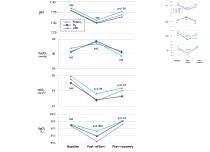
Baseline Post- Posteffort recovery
Open the catalog to page 2