
- Catalogs
- PakuMed Medical Products
- RISK FREE PORT PUNCTURE


RISK FREE PORT PUNCTURE
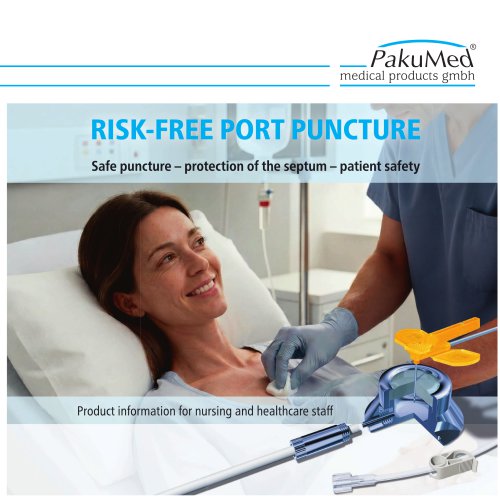
RISK FREE PORT PUNCTURE
Safe port care is essential for patient safety and involves using the correct technique and non-coring port needles. Proper handling and the right choice of port cannula can prevent septum damage and enhance patient safety.
Significance of Safe Port Care
Implanted port catheter systems are crucial in modern therapy, especially in oncology and long-term treatments. Regular access requires high standards in materials, technique, and user competence. Professional port care is vital for maintaining long-term functionality, preventing complications, and ensuring patient safety.
Dual Safety Features
The punching effect, caused by unfavorable cannula geometry or incorrect type, can lead to silicone particles being cut from the port's membrane, potentially causing blockages, leaks, infections, or premature system replacement. Avoiding this effect involves using suitable port cannulas, correct puncture techniques, and regular training.
PakuMed's Non-Coring Port Needles
PakuMed's SFN® port needles are designed for safe, septum-friendly port care. They feature a sturdy cannula tip, prevent silicone particles from being punched out, and ensure smooth insertion without a cutting effect. These needles comply with safety standards and are suitable for everyday clinical practice.
Benefits in Clinical Practice
Using PakuMed's port needles reduces the risk of septum damage, maintains long-term port functionality, reduces complications, and enhances safety and efficiency for patients and healthcare staff.
Port Puncture Procedure
The document outlines a step-by-step procedure for port puncture, emphasizing sterile conditions, correct insertion techniques, and post-therapy flushing to ensure safety and functionality.
Choosing the Right Port Needle
Selecting the appropriate port needle involves considering length, gauge, and design to suit specific clinical requirements. This choice supports safe puncture, enhances user comfort, and contributes to the port's long-term functionality.
Product Variants
The document lists various PakuMed port needle variants, detailing their specifications and suitable applications.
Contact Information
PakuMed medical products gmbh provides further information and test samples upon request. Contact details are provided for inquiries.
Catalog excerpts
RISK-FREE PORT PUNCTURE Safe puncture – protection of the septum – patient safety Product information for nursing and healthcare sta
Open the catalog to page 1
Safe port care starts with the right technique. Proper puncture technique and non coring port needles increase patient safety. Safe port care begins with an awareness of potential risks – and with the right choice of port cannula. The combination of a professional puncture technique and non-coring port cannulas can help to prevent septum damage and improve patient safety in the long term. PakuMed’s SFN® port needles help nursing staff to reliably meet these requirements – andthat is precisely why SFN® stands for “StanzFreie Nadeln” Nadeln .(puncture-fre
Open the catalog to page 3
Significance of a safe port care Why correct handling is crucial for safety and functionality. Implanted port catheter systems are an indispensable part of modern therapy, particularly in oncology and for long-term treatments. Regular access requires high standards in terms of materials, technique and user competence. Professional port care plays a key role in maintaining the port’s longterm functionality, preventing complications and ensuring patient safety. In addition to the correct puncture technique, the choice of port cannula plays a key role in this regard.
Open the catalog to page 4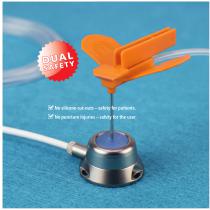
No silicone cut-outs – safety for patients. No puncture injuries – safety for the user
Open the catalog to page 5
During port puncture, the so-called „punching effect" can occur. This involves the cannula tip cutting tiny silicone particles out of the port's silicone membrane. Causes of the punching effect: ■ unfavourable cannula geometry or incorrect cannula type ■ „Anchor-effect"- bent tip following puncture due to an unstable or fragile cannula tip Possible consequences: ■ Particles dislodged during the procedure may block blood vessels. ■ Leaks or malfunctions in the system ■ Increased risk of infection ■ Premature replacement of the port system
Open the catalog to page 6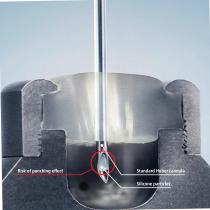
Risk of punching effect Standard Huber cannula Silicone particles
Open the catalog to page 7
How can the punching effect be avoided? Minimising risks – through precise technique and regular training. Avoiding the punching effect depends on three key factors: Suitable port cannula Use of cannulas with a puncture-free design, an atraumatic tip that protects the septum, and certified material and manufacturing quality Correct puncture technique Vertical puncture of the port septum down to the base plate; calm, controlled technique; avoid making multiple puncture attempts Regular training Raising awareness of risks and causes; safe handling in day-to-day clinical practice; knowledge transfer...
Open the catalog to page 8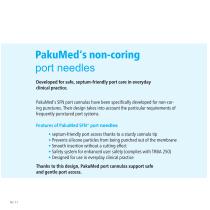
PakuMed's SFN port cannulas have been specifically developed for non-coring punctures. Their design takes into account the particular requirements of frequently punctured port systems. • septum-friendly port access thanks to a sturdy cannula tip • Prevents silicone particles from being punched out of the membrane • Smooth insertion without a cutting effect • Safety system for enhanced user safety (complies with TRBA 250) • Designed for use in everyday clinical practice Thanks to this design, PakuMed port cannulas support safe and gentle port access.
Open the catalog to page 10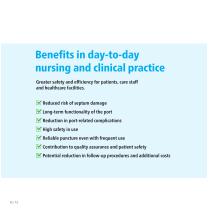
Benefits in day-to-day nursing and clinical practice Greater safety and efficiency for patients, care staff and healthcare facilities. Reduced risk of septum damage Long-term functionality of the port Reduction in port-related complications High safety in use Reliable puncture even with frequent use Contribution to quality assurance and patient safety Potential reduction in follow-up procedures and additional costs
Open the catalog to page 12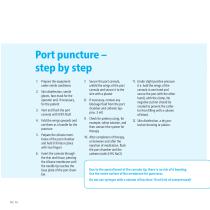
1. Prepare the equipment under sterile conditions 2. Skin disinfection, sterile gloves, face mask for the operator and, if necessary, for the patient 3. Vent and flush the port cannula with 0.9% NaCl 4. Fold the wings upwards and use them as a handle for the puncture 5. Palpate the silicone membrane of the port chamber and hold it firmly in place with two fingers 6. Insert the cannula through the skin and tissue, piercing the silicone membrane until the needle tip reaches the base plate of the port chamber. 7. Secure the port cannula, unfold the wings of the port cannula and secure it to the...
Open the catalog to page 14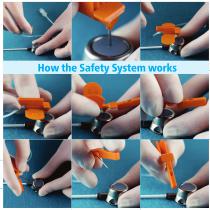
How the Safety System works
Open the catalog to page 15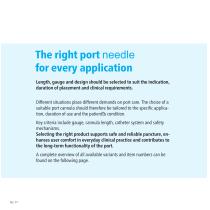
The right port needle for every application Length, gauge and design should be selected to suit the indication, duration of placement and clinical requirements. Different situations place different demands on port care. The choice of a suitable port cannula should therefore be tailored to the specific applicaKey criteria include gauge, cannula length, catheter system and safety mechanisms. Selecting the right product supports safe and reliable puncture, enhances user comfort in everyday clinical practice and contributes to the long-term functionality of the port. A complete overview of all available...
Open the catalog to page 16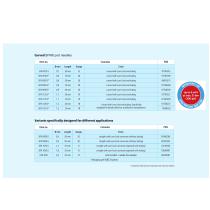
Curved SFN® port needles Variants specifically designed for different applications Item no. suitable for high-pressure injections with contrast medium
Open the catalog to page 17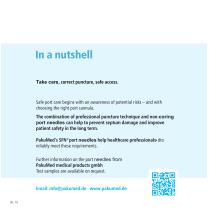
In a nutshell correct puncture, safe access. Safe port care begins with an awareness of potential risks – and with choosing the right port cannula. The combination of professional puncture technique and non-coring port needles can help to prevent septum damage and improve patient safety in the long term. PakuMed’s SFN®port needles help healthcare professionalsedto reliably meet these requirements. Further information on the port needles from PakuMed medical products gmbh Test samples are available on request. Email: [email protected] ·
Open the catalog to page 18All PakuMed Medical Products catalogs and technical brochures
 Anokryo_Folder
2 Pages
 TITAN-PORT G
2 Pages
 TITAN-PORT APH
2 Pages
 SFN-PORTKANÜLE
2 Pages
 TITAN-PORT AS/PT
2 Pages
Archived catalogs
 TITAN-PORT PRENATAL / FETAL
2 Pages