
- Catalogs
- PakuMed Medical Products
- TITAN-PORTcatheter systems


TITAN-PORTcatheter systems

TITAN-PORTcatheter systems
The document serves as a patient care guide for the TITAN-PORT catheter systems by PakuMed, intended for long-term medication, dialysis, and parenteral nutrition. It highlights the significance of ensuring proper functionality and patient comfort.
What is a Port?
The TITAN-PORT is a fully implantable catheter system that provides continuous venous access. It features a titanium port chamber with a silicone membrane and a catheter made of silicone or polyurethane, designed for long-term use and capable of being punctured up to 3000 times with non-coring SFN® port needles.
Advantages of a Port
- Promotes long-term vascular health by preserving smaller veins.
- Offers comfort and ease of use, enabling normal activities such as showering and swimming.
- Enhances privacy as the port is implanted under the skin and not visible.
Uses of a Port
The port is utilized for systemic chemotherapy, regular medication administration, blood collection, long-term infusion therapy, pain therapy, and parenteral nutrition.
How is the Port Used?
The port supports bolus injections, continuous infusion, and blood collection. Proper care and saline flushing are crucial for maintaining functionality.
Puncturing the Port
Puncturing requires sterile conditions and non-coring needles. The area must be disinfected, and the needle should be inserted vertically to prevent damage.
SFN® Safety Port Needles
SFN® needles include a safety system to prevent accidental needle sticks, involving a three-step process: puncture, remove, and activate the safety system.
Care Instructions
Proper care involves ensuring the correct port position, using non-coring needles, and regular flushing. Pulsating rinsing is recommended to avoid blockages.
Potential Complications
Possible complications include resistance during puncture, inflammation, or leakage. Patients should watch for redness, swelling, or pain and notify their doctor of any changes.
FAQs
- Insurance generally covers the port cost.
- The port can remain indefinitely and is removable via a minor procedure.
- The port is unlikely to trigger security alarms.
- Clothing considerations depend on port location.
- A patch is only necessary during wound healing or treatment.
Implant Card
Patients receive an implant card with essential port information, which should be carried at all times.
Further Information
Additional resources and instructional videos are available on the PakuMed website and YouTube channel.
Catalog excerpts

PakuMed. For treatment. And for everyday life. We offer implantable port catheter systems for medication, dialysis and parenteral nutrition amongst other indications. Once inserted, they must function properly for weeks, months or possibly even for years. Port-catheter systems concern not only the illness, but also the life of the patient. Every system from PakuMed stands for three aspects: they are tailored to the indications and requirements, they are simple and safe in operation and during the treatment and offer a high degree of wearing comfort. Patient care guide
Open the catalog to page 1
Dear patient your doctor has recommended a PakuMed port catheter system because your treatment requires the frequent administration of medication or fluids into your bloodstream. The nursing staff may also need blood samples. A port catheter system provides a permanent and long-term access to a vessel. This, fully implanted, may give you quality of life and comfort, as well as protecting your smaller blood vessels. This guide will help you to understand more about the "port" and clarifies possible questions and care instructions for your TITAN-PORT catheter system. This booklet is only a point...
Open the catalog to page 2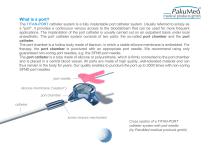
What is a port? The TITAN-PORT catheter system is a fully implantable port catheter system. Usually referred to simply as a "port", it provides a continuous venous access to the bloodstream that can be used for more frequent applications. The implantation of the port catheter is usually carried out on an outpatient basis under local anaesthetic. The port catheter system consists of two parts: the so-called port chamber and the port catheter. The port chamber is a hollow body made of titanium, in which a stable silicone membrane is embedded. For therapy, the port chamber is punctured with an appropriate...
Open the catalog to page 4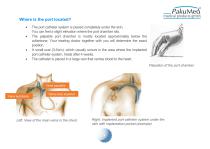
medical products gmbh • The port catheter system is placed completely under the skin. You can feel a slight elevation where the port chamber sits. • The palpable port chamber is mostly located approximately below the collarbone. Your treating doctor together with you will determine the exact position. • A small scar (3-5cm), which usually occurs in the area where the implanted port catheter system, heals after 4 weeks. • The catheter is placed in a large vein that carries blood to the heart. Palpation of the port chamber Vena cava superior Left: View of the main veins in the chest Right: Implanted...
Open the catalog to page 5
medical products gmbh ✓ A port allows your blood vessels to be spared, as smaller veins in arms or hands do not need to be punctured. By puncturing the silicone membrane in the port chamber with a special port needle, access to the bloodstream is established. This is especially important for treatment with chemotherapy. ✓ Once implanted, a port can remain in place as long as your doctor makes sure it works and you still need it. ✓ There is no need for a potentially unpleasant "search" for veins to take blood samples. ✓ X-rays and CT (computer tomography) are possible at any time. MRI (magnetic...
Open the catalog to page 6
What is a port used for? The TITAN-PORT catheter systems allow repeated access to the vascular system, e.g. for: • long-term permanent access to the central vascular system • systemic chemotherapy • regular administration of medication • regional chemotherapy • blood collection for poor peripheral vascular status • long-term infusion therapy • pain therapy • before, during and after operations, especially for malignant diseases • parenteral nutrition (artificial feeding)
Open the catalog to page 7
medical products gmbh The port can be used in several ways, incl. • bolus injections The drug is administered in a single injection and the needle is then immediately removed from the port. • continuous infusion The port needle can remain in the port for up to 48 hours (recommended). The port needle can be used to administer medicines and fluids, such as artificial food that takes a bit more time. • blood collection The port can be used to take blood samples for further testing. Afterwards, care should be taken to ensure that the system is rinsed sufficiently with saline solution.
Open the catalog to page 8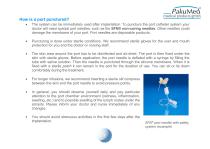
medical products gmbh • The system can be immediately used after implantation. To puncture the port catheter system your doctor will need special port needles, such as the SFN® non-coring needles. Other needles could damage the membrane of your port. Port needles are disposable products. • Puncturing is done under sterile conditions. We recommend sterile gloves for the user and mouth protection for you and the doctor or nursing staff. • The skin area around the port has to be disinfected and air-dried. The port is then fixed under the skin with sterile gloves. Before application, the port needle...
Open the catalog to page 9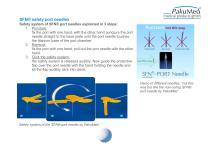
Safety system of SFN® port needles explained in 3 steps: fix the port with one hand, with the other hand puncture the port needle straight to the base plate until the port needle touches the titanium base of the port chamber. fix the port with one hand, pull out the port needle with the other hand. 3. Click the safety system: the safety system is released audibly. Now guide the protective flap over the port needle with the hand holding the needle and let the flap audibly click into place. SFN®- PORT Needle Demo of different needles: “not this way but like the non-coring SFN® port needle by PakuMed”...
Open the catalog to page 10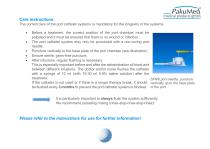
medical products gmbh The correct care of the port catheter systems is mandatory for the longevity of the systems. • Before a treatment, the correct position of the port chamber must be palpated and it must be ensured that there is no wound or infection. • The port catheter system may only be punctured with a non-coring port needle. SFN® port needle: puncture vertically up to the base plate of the port • Puncture vertically to the base plate of the port chamber (see illustration) • Ensure sterile, germ-free puncture. • After infusions, regular flushing is necessary. This is especially important...
Open the catalog to page 11All PakuMed Medical Products catalogs and technical brochures
 Anokryo_Folder
2 Pages
 RISK FREE PORT PUNCTURE
20 Pages
 TITAN-PORT G
2 Pages
 TITAN-PORT APH
2 Pages
 SFN-PORTKANÜLE
2 Pages
 TITAN-PORT AS/PT
2 Pages
Archived catalogs
 TITAN-PORT PRENATAL / FETAL
2 Pages