Overview: BTX has been a leader in electroporation technology since 1983, focusing on electroporation and electrofusion to provide innovative tools for in vivo and in vitro research. Their products cater to a wide range of applications, including mammalian cell transfections, CRISPR gene editing, and vaccine delivery.
Electroporation: This technique involves applying controlled electrical pulses to cells to permeabilize their membranes, allowing molecules like DNA and proteins to enter. Key variables include field strength, pulse length, and pulse shape. Electroporation is favored for its efficiency and low toxicity across various cell types.
Electrofusion: Similar to electroporation, electrofusion involves fusing two cell membranes using electrical pulses. This method is particularly useful for hybridoma work and requires cells to be in contact before fusion, often achieved through dielectrophoresis.
Protocols: The document includes detailed protocols for various applications, such as:
- Protocol 1014: Electroporation of rat hippocampal neurons using GEMINI™ X2 & ECM® 830 HT systems.
- Protocol 0858: Electroporation of skin cells in mice and rats, enhancing plasmid delivery.
- Protocol 0906: Electroporation of Saccharomyces cerevisiae using ECM 630 HT system.
- Protocol 0832: Electrofusion of buffalo oocytes using ECM 2001 system.
- Protocol 0527: Electroporation of Candida oleophila using ECM 399 system.
Key Features: BTX offers a comprehensive library of protocols and publications, along with technical support to assist researchers. Their systems are designed for high throughput and cover a wide range of applications, ensuring reproducibility and success in research.
Conclusion: BTX provides a robust platform for electroporation and electrofusion, supported by extensive resources and expertise, making it a valuable partner for researchers in biotechnology.
Overview of Electroporation Systems: The document provides a comprehensive overview of various electroporation systems and their applications. It includes detailed descriptions of different models such as the ECM™ 630, ECM™ 830, Gemini Twin Wave, and AgilePulse™ systems, highlighting their specific uses in electroporation and electrofusion processes.
Specifications and Systems: The document lists several electroporation systems, each designed for specific applications. The ECM™ 630 and ECM™ 830 systems are noted for their exponential decay and square wave capabilities, respectively, suitable for different cell types. The Gemini Twin Wave system offers dual waveform options for enhanced flexibility.
Electrodes and Chambers: A variety of electrodes and chambers are detailed, including Genetrodes®, Tweezertrodes™, and Petri Dish Electrodes. These components are essential for conducting electroporation experiments across different cell types and applications.
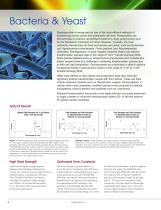
Applications: The document emphasizes the versatility of electroporation in transforming bacteria, yeast, plant, and insect cells. It highlights the efficiency of electroporation in gene expression studies and therapeutic applications, particularly in prokaryotic and eukaryotic cells.
Field Strengths and Time Constants: Key parameters such as field strengths and time constants are discussed, with specific values provided for different cell types. The ECM 630 and Gemini systems offer adjustable settings to optimize these parameters for various applications.
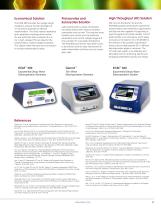
High Throughput Solutions: The document describes high throughput capabilities, particularly with the Gemini X2 and ECM 630 systems, which can be paired with plate handlers for rapid processing of multiple samples.
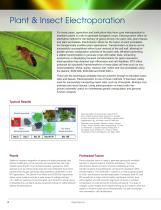
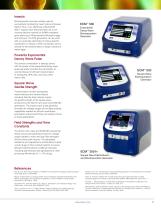
Plant and Insect Electroporation: Electroporation is highlighted as a powerful tool for genetic manipulation in plants and insects, with successful applications in generating transgenic crops and studying genome functions in insect cells.
Conclusion: The document concludes with references to scientific studies and protocols that support the use of electroporation systems in various research and industrial applications.
Overview of ECM 2001+ System: The ECM 2001+ system is a versatile tool designed for both electrofusion and electroporation, utilizing AC and DC waveforms to enhance cell alignment and fusion. It supports a range of voltages and pulse lengths, making it suitable for plant protoplast and mammalian cell transfections.
Electroporation Generators: The document mentions several electroporation generators, including the ECM 630 (Exponential Decay Wave) and ECM 830 (Square Wave), each tailored for specific applications such as insect cell transfection and mammalian cell transfection.
Applications in Insect Cells: Electroporation is effectively used for transfecting insect cells, with the ECM 2001+ system facilitating non-invasive delivery methods for gene silencing in insect eggs and embryos.
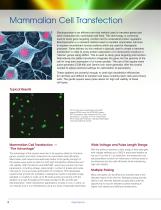
Mammalian Cell Transfection: Electroporation is highlighted as a non-viral method for gene delivery in mammalian cells, crucial for studying gene function and protein regulation. The ECM 830 and Gemini twin wave generators provide precise control over electrical settings, enhancing transfection efficiency and cell viability.
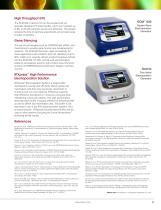
High Throughput and Gene Silencing: The ECM 830 system, coupled with a high throughput plate handler, allows for efficient transfection of multiple samples. It supports technologies like CRISPR/Cas9 and siRNA for gene function analysis, achieving high cell viability.
In Vivo, In Utero, and In Ovo Applications: Electroporation is used for gene and drug delivery in living tissues, with applications in gene therapy, cancer treatment, and vaccine development. The document details the use of specialty electrodes for various transfection methods.
Conclusion: The document provides a comprehensive overview of electroporation systems and their applications across different cell types and research areas, emphasizing the versatility and efficiency of the ECM systems in gene delivery and transfection processes.
Introduction: This document provides an overview of various studies and applications related to electroporation and electrofusion technologies, particularly focusing on their use in genetic research and transgenic animal development. It highlights the efficiency and versatility of systems like the ECM™ 2001+ and AgilePulse™ MAX for cell manipulation and gene delivery.
Electroporation and Electrofusion Systems: The ECM™ 2001+ is a multifunctional system capable of both AC and DC square wave pulses, used for applications ranging from embryo manipulation to plant tissue transformation. It is particularly noted for its efficiency in hybridoma production and mammalian cell transfection. The system allows for precise control over voltage, pulse lengths, and frequency, enhancing cell fusion and transfection outcomes.
Applications:- Hybridoma Production: Used for monoclonal antibody production and cancer vaccine development, showing higher fusion rates compared to chemical methods.
- Nuclear Transfer: Utilized for generating transgenic animals by introducing donor cell nuclei into recipient oocytes.
- Plant Fusion: Facilitates the fusion of plant protoplasts to create hybrids with desirable traits without cytotoxic effects.
Large Volume Transfection: The AgilePulse™ MAX system is designed for large-volume transfection, optimizing cellular uptake with minimal heating. It is used for applications such as gene editing, drug delivery, and cancer immunotherapy. The system employs Pulse Agile® technology to enhance transfection efficiency and cell viability.
Research Highlights:- Zebrafish Model: Used to study vertebrate development and retinal axon guidance.
- Mouse Embryonic Brain: Techniques developed for single-cell level detection of miRNA during development.
- Transgenic Animal Development: Non-surgical gene delivery methods have been developed for creating transgenic mice.
Conclusion: Electroporation and electrofusion technologies offer significant advantages in genetic research and transgenic development. The systems discussed provide versatile and efficient solutions for a wide range of applications, from basic research to therapeutic development.
Introduction: The document discusses the AgilePulse In Vivo System, a technology designed to enhance transfection efficiency through electroporation. This system is particularly beneficial for applications such as vaccine development, gene therapy, and cancer vaccines.
Specifications and Procedures: The AgilePulse system utilizes a programmable waveform generator with patented Pulse Agile® technology. This technology employs a sequence of short, high-intensity pulses followed by long, low-intensity pulses to facilitate DNA delivery into cells. The system is designed for intra-dermal, intra-muscular, and intra-tumor applications, providing uniform and reliable electroporation.
Applications: The system is suitable for various applications, including vaccine development, animal immunization, antibody production, and intra-tumor gene delivery. It significantly enhances the immune response, particularly in dermal delivery of DNA vaccines.
CRISPR and Gene Editing: The document also covers the use of BTX electroporation systems for CRISPR-based transfection. These systems support a wide range of cell types and applications, including in vitro, in vivo, and ex vivo transfections. Electroporation is highlighted as a method of choice for introducing CRISPR constructs due to its high efficiency and low toxicity.
Optimization and Best Practices: Optimization of electroporation involves selecting the appropriate waveform, field strength, and pulse length. Factors such as cell diameter, DNA concentration, temperature, and electroporation buffer are crucial for successful transfection. The document provides guidelines for optimizing these parameters to achieve the best results.
Conclusion: The AgilePulse In Vivo System and BTX electroporation systems offer advanced solutions for gene delivery and editing, enhancing efficiency and reliability across various applications. The document provides detailed specifications and optimization strategies to maximize the effectiveness of these technologies.
Electroporation Parameters: Electroporation involves applying an electrical field to cells to increase membrane permeability, allowing molecules like DNA to enter. Key parameters include temperature, pulse length, number of pulses, and buffer composition.
Temperature: Lower temperatures can increase uptake of molecules but may damage certain cell lines. Standard pulse voltage at room temperature needs to be doubled at 4°C.
Pulse Length: Measured in micro to milliseconds, pulse length varies with the pulse generator type. It works with field strength to enhance pore formation. Adjustments in voltage should be countered by changes in pulse length.
Number of Pulses: Single pulses are typical, but multiple pulses may be needed for some cell lines, using lower voltages to avoid damage.
Electroporation Buffer: Buffer choice affects resistance and pulse length. High resistance buffers are needed for prokaryotic cells, while low conductance buffers like BTXpress™ are recommended for mammalian cells.
Nucleic Acid Concentrations: DNA concentrations typically range from 5–20 µg/ml. Higher concentrations may improve efficiency. Buffer components like EDTA can reduce efficiency.
Electrofusion vs. PEG: Electrofusion uses electrical fields to fuse cells, offering higher efficiency and reproducibility compared to PEG-mediated fusion, which can be less reliable and more cytotoxic.
Electroporation Systems:ECM™ 399: Designed for bacteria and yeast, offering high transformation efficiencies.ECM™ 630: Suitable for a wide range of applications, including mammalian and plant cells, with flexible voltage and time constants.
High Throughput System: Allows processing of multiple samples quickly using multi-well plates, enhancing experimental efficiency.
Overview: The document provides detailed information on various electroporation systems, focusing on high throughput and versatile applications for gene, drug, and protein delivery. It highlights the components, specifications, and applications of the ECM 630, ECM 830, and Gemini Twin Wave Electroporation Systems.
ECM 630 High Throughput System: This system includes multi-well plates, an HT plate handler, and the ECM 630 generator. It is designed for quick and efficient processing of large sample numbers, optimizing electroporation conditions for high efficiency. The system is available in configurations for 25-well and 96-well plates, with options for monitoring and enhanced safety features.
ECM 830 Electroporation System: The ECM 830 is a versatile square wave pulse generator suitable for various applications, including CRISPR transfections and mammalian cell transfection. It offers a wide voltage range, multiple pulsing capabilities, and data management features. The system can be used with a safety dome or stand and is compatible with a range of BTX specialty electrodes.
Gemini Twin Wave Electroporation System: This system combines square wave and exponential decay wave electroporation in a single unit, providing flexibility for transfecting eukaryotic and prokaryotic cells. It features a simple user interface, extensive protocol storage, and advanced safety features to prevent arcing. The Gemini X2 and SC models cater to different experimental needs, offering remote operation and comprehensive data logging.
Applications and Features: The systems are designed for a wide range of applications, including mammalian cell transfection, CRISPR, in vivo and in vitro gene delivery, and high throughput screening. Key features include user-defined protocols, safety checks, and the ability to handle various cell types and experimental conditions.
Ordering Information: The document provides detailed ordering information for each system, including item numbers and included components, ensuring users can select the appropriate configuration for their research needs.
Overview: The document provides detailed information on advanced electroporation and electrofusion systems designed for high-efficiency cell transfection and fusion applications. These systems are particularly effective for difficult-to-transfect cell types, including stem cells and primary cells, ensuring high cell viability.
Features:- AC waveform range: 0.2 – 2.0 MHz
- Square wave electroporation capabilities
- Voltage range: 5 V to 3000 V
- Advanced programming for multiple AC steps
- Operates at low impedance loads
- Large touchscreen interface
Systems and Applications:Waveforms: AC sine wave aligns cells for electrofusion, while square DC waveform is used for fusion pulse or mammalian electroporation.Electrofusion: Facilitates fast, efficient cell fusion for hybridoma production, hybrid cell formation, and nuclear transfer applications. The system uses a combination of AC and DC wave pulses for efficient fusion.Hybridoma Production: Suitable for large-scale and medium-scale hybridoma production using various chamber and electrode configurations. The system can be used with or without proprietary fusion mediums.
Specifications:Electroporation: Used for transfecting mammalian cell lines to express recombinant proteins. The ECM 2001++ system allows for optimization of electrical settings.Adherent Cell Transfection: Allows electroporation of adherent cells directly in growth dishes, avoiding trypsinization.Square Wave Pulse, DC: Voltage range from 5 to 3000 V with high accuracy and customizable pulse lengths.AC Steps: Frequency range from 0.2 to 2 MHz with customizable voltage and duration.
Ordering Information: Various configurations of the ECM 2001+ system are available, including cell fusion, electroporation, embryo manipulation, and hybridoma production systems.
Hybrimune™ Hybridoma Production System: An advanced electrofusion system for efficient cell fusion in hybridoma production. It features a user-friendly programmable waveform generator and innovative fusion chambers for optimal electric field stimulation.
AgilePulse™ In Vivo Waveform Electroporation System: Designed for vaccine development and gene therapy, this system provides efficient DNA vaccination delivery through intra-muscular or intra-dermal electroporation. It features a simple user interface and patented Pulse Agile technology for enhanced transfection efficiency.
Conclusion: The document outlines the capabilities and applications of advanced electroporation and electrofusion systems, emphasizing their efficiency, programmability, and suitability for various cell types and production scales.
Overview: The document provides a comprehensive guide on the AgilePulse™ MAX System, an advanced electroporation solution designed for efficient transfection of large cell volumes. It highlights the system's applications, specifications, and features, along with additional products like the Enhancer 3000 Monitoring System and MicroJect 1000A System.
Main Sections:
- Applications: The AgilePulse MAX System is used for various applications including gene delivery, siRNA delivery, cancer immunotherapy, and large-scale virus production. It is particularly effective for transfecting eukaryotic cells for protein production and CRISPR transfections.
- System Features: The system is engineered for large-volume applications, maximizing cellular uptake with minimal heating. It uses a proprietary BTXpress Cytoporation Medium and patented Pulse Agile technology to optimize pulse parameters for high efficiency and cell viability.
- Specifications: The system includes a user-friendly touch screen interface, a voltage range of 50 to 1,200 V, and a pulse width range of 0.050 to 10 ms. It supports data export via USB and operates within a temperature range of 10 to 40°C.
- Enhancer 3000 Monitoring System: This system optimizes electroporation settings, captures results for documentation, and tracks key parameters. It interfaces with various electroporation systems and includes features for safe operation and data analysis.
- MicroJect 1000A System: Designed for precise delivery of genes, proteins, and other macromolecules by direct injection. It offers consistent performance with digitally-controlled pressure regulation and is suitable for applications like nuclear transfer and transgenic animal development.
- Electrode Selection Guide: BTX offers a range of electrodes and chambers specialized for different tissues and applications, including in vivo, ex vivo, and in ovo gene delivery.
Key Features and Benefits:
- Pulse Agile Technology: Enhances transfection efficiency and cell viability by using a sequence of high-intensity and low-intensity pulses.
- Scalability: Protocols can be scaled from small laboratory cuvettes to large-volume transfections.
- Compatibility: The system is compatible with a wide range of transfectants and cell lines, allowing for versatile applications.
- Ease of Use: The touch screen interface and USB data export simplify operation and data management.
Conclusion: The AgilePulse MAX System and its associated products provide a robust solution for efficient and scalable electroporation, suitable for a variety of research and clinical applications.
Overview: Genetrodes are reusable electrodes designed for in vivo and in ovo electroporation applications, such as drug and gene delivery. They come in two styles: straight needle type with gold tips and beveled ends, and L-shaped with blunt ends. These electrodes are used with BTX Electroporation Systems to introduce electric fields that create transient pores in cells, facilitating molecule uptake.
Specifications:- Compatible with ECM 830, ECM 2001+, Gemini X2
- Voltage Range: 0 to 200 VDC
- Pulse Length Range: 10 μs to 99 ms
- Electrode Tip Diameter: 0.5 mm
- Electrode Gap: 1 to 10 mm
- Life Span: Approximately 1500 pulses
Ordering Information: Various Genetrode models and kits are available, each with specific dimensions and configurations, including necessary holders and cables for connection to electroporation systems.
Applications:- In vivo drug or gene delivery
- Intra-muscular and intra-dermal gene therapy
Electroporation enhances gene expression significantly compared to injection alone, making it effective for DNA vaccination and inducing immune responses in large animals.
2-Needle Array Electrodes: Designed for intra-muscle or intra-dermal delivery, available with 5 mm and 10 mm gaps. The kit includes a reusable handle and disposable needle arrays, suitable for various species and tissues.
Tweezertrodes™ Electrodes: Reusable, tweezer-style electrodes for in vivo, ex vivo, and in utero applications. Available in various sizes and materials, they are used for localized electroporation and have proven effective in transgenic and knockout mouse production.
Oocyte Electrodes: Slide-type electrodes for drug or gene delivery into oocytes or zygotes, useful for transgenic animal model creation, including CRISPR applications.
Genepaddles™ Electrodes: Paddle-style electrodes for in vivo and in vitro applications, designed for fragile tissues like brain tissue. They are available in different sizes and are used for nuclear transfer fusion applications.
AgilePulse™ Needle Array Electrodes: Miniature needles for DNA vaccine delivery and gene therapy research, providing uniform electric fields in dermal or muscular tissue.
Specifications and Features:- Needle Specifications: Various needle models are made of stainless steel with fine or trocar points. They have a consistent spacing of 1.5 mm in a row and 4-6 mm between rows, with needle diameters of 0.3 mm or 0.7 mm and lengths ranging from 2 mm to 25 mm.
- Electrode Features: The electrodes are designed to create uniform electric fields, minimize tissue trauma, and are disposable and sterile. They are constructed from medical-grade plastic and surgical steel, ensuring safety and reliability.
Applications:- Petri Dish Electrode: Used for electroporating adherent cells or tissues in a Petri dish, compatible with BTX Generators like Gemini X2, ECM 830, and ECM 2001+. It supports a voltage range of 0 to 2000 V and a volume range of 10 to 50 ml.
- Caliper Electrodes: Reusable electrodes for in vivo applications such as drug or gene delivery, with adjustable electrode plates and compatibility with ECM 830, ECM 2001+, and Gemini X2.
- Petri Dish Platinum Electrodes: Designed for ex vivo tissue transfection, available in different chamber sizes to accommodate various tissue samples.
- Flatpack Chambers: Used for prokaryotic cell electroporation and high-efficiency stem cell transfection, offering different gap sizes and volume capacities.
- Petri Pulser and Adherent Cell Electrodes: Reusable applicators for electroporating adherent cells in situ, compatible with various ECM generators.
Ordering Information:- Various electrodes and chambers are available with specific item numbers for ordering, including Petri Dish Electrode, Caliper Electrodes, and Flatpack Chambers.
- Accessories such as adapter sets and connection cables are required for compatibility with different ECM generators.
Conclusion: The document provides detailed specifications and applications for various electroporation electrodes and chambers, highlighting their compatibility with BTX generators and their use in different biological and medical applications.
Microslides and Electrofusion: Microslides are available in four gap sizes (0.5, 1.0, 3.2, and 10 mm) and are used for cell manipulation applications. The smaller gaps (0.5 and 1.0 mm) are ideal for embryo fusion due to their divergent energy field, while the larger gaps (3.2 and 10 mm) provide a homogeneous field suitable for hybridoma cell fusion. Microslides consist of a glass slide and stainless steel strips in a plastic Petri dish, compatible with ECM 2001+, Gemini X2, and ECM 830 generators.
BTXpress® Cytofusion™ Medium C: This medium is designed to enhance cell fusion efficiency and maintain high cell viability. It is optimized for eukaryotic electrofusion, providing a stable environment with low conductivity to minimize heating. The medium is sterile filtered and free from animal products, making it suitable for hybridoma production in monoclonal antibody discovery.
Recommendations for Use: Maintain sterility and use aseptic techniques. Thorough washing with BTXpress Cytofusion Medium C is crucial to avoid disruption of the fusion process. Electrofusion should be conducted at room temperature, and cells should not remain in the medium for more than an hour post-wash.
BTXpress® Electroporation Solution: This single buffer solution is designed for efficient gene delivery into mammalian cells, including those difficult to transfect by other methods. It offers high transfection efficiency and cell viability, suitable for DNA and siRNA delivery. The solution is cost-effective and compatible with various electroporation systems.
Electroporation Cuvettes Plus: These cuvettes are used for electroporation and electrofusion across various cell types, including bacteria, yeast, and mammalian cells. They are available in different gap sizes (1 mm, 2 mm, and 4 mm) and are designed for high field strengths and easy sample handling.
Safety Stands and Domes: These accessories ensure safe delivery of high-voltage electrical pulses during electroporation. They are compatible with multiple electroporation systems and allow for simultaneous processing of cuvettes.
Specifications: The document outlines the specifications for electroporation equipment, including power requirements (100 to 240 VAC, 50/60 Hz, 15 W, 0.50 A fuse), voltage range (0 to 3000 VDC), pulse length (10 µs to 10 s), and operating conditions (temperature 5° to 40°C, relative humidity 20 to 80%, maximum altitude 2,000 m). The insulation category is CAT I, and the pollution degree is II.
Physical Characteristics: The equipment dimensions are 23 x 21.5 x 14 cm, weighing 4.8 kg. Accessories include a safety dome and stand.
Applications: The equipment is used for mammalian cell transfection (siRNA, plasmid DNA, cDNA libraries) and transformation of bacteria and yeast (BAC library, plasmid DNA).
High Throughput Plate Handlers: These handlers are designed for processing multi-well electroporation plates, compatible with ECM 630, ECM 830, and Gemini X2 systems. They feature pulse switching technology and gold-plated contacts for 96-well plates, with manual (HT-100) or auto-sense (HT-200) track switching.
Electroporation Plates: Sterile multi-well plates are available for various cell types, with options for 25-well and 96-well formats, featuring different gap sizes and volumes.
Cables & Adapters: Various cables and adapters are available for connecting electroporation systems to electrodes, including micrograbber adapters and coaxial cables.
Foot Pedals & Switches: Foot pedals and switches allow hands-free operation of electroporation systems, useful for in vivo/in ovo applications.
Contact Information: The document provides contact details for various international offices, including the USA, UK, Spain, France, Germany, Canada, and China.






 PheCOMP system
 Body Reversal Corridor
 Barnes maze
 ACTIVITY WHEEL
 IR Actimeter
 Pumps
Pumps PERFUSION SYSTEMS
 Anesthesia Systems
 Behavioral Research