


LUNGguard

LUNGguard
Paragonix aims to set a new standard for organ preservation and transport, enhancing patient outcomes globally. The Paragonix LUNGguard™ Donor Lung Preservation System is FDA cleared and CE marked, providing a sterile, temperature-controlled environment for donor lung transportation. It is designed for ease of use in demanding clinical settings, with temperature monitoring via a Bluetooth® connected app.
The 2017 US Donor Lung Allocation Policy changes have increased ischemic times, necessitating longer travel distances for donor lungs. The ISHLT 2020 Consensus Statement warns against ice contact to prevent tissue damage. Traditional ice storage leads to unpredictable cooling, risking damage below 2°C, which can cause primary graft dysfunction (PGD).
Hypothermic damage to pulmonary endothelium is a known risk, exacerbated by prolonged ischemic times and low temperatures. The ISHLT advises avoiding ice proximity to prevent irreversible cellular damage. Preservation solutions should maintain temperatures between 2°C to 8°C.
The LUNGguard™ system offers a predictable, repeatable, and measurable preservation environment, moving away from ice storage. It features a secure outer shell, a triple bag system, continuous temperature monitoring, and Bluetooth® data transmission. The system maintains stable temperatures between 4-8°C for over 40 hours.
This multi-center, post-market observational registry aims to evaluate clinical effectiveness in patients with transplanted donor lungs preserved using LUNGguard™. It includes short-term, intermediate, and long-term outcome assessments.
The Paragonix LUNGguard™ system provides a controlled environment for lung preservation, addressing the limitations of traditional ice storage and improving transplant outcomes.
Catalog excerpts
At Paragonix our mission is to create a new standard for organ preservation and transport that improves patient outcomes worldwide. We strive to protect the ultimate donation with the dignity and safety it deserves to give patients every possible advantage to thrive. The Paragonix LUNGguard Donor Lung Preservation System is an FDA cleared and CE marked preservation device for donor lung transportation. Paragonix LUNGguard™ provides a sterile and temperature controlled environment for organs traveling between operating rooms. The product is designed to be easy-to-use in stressful, clinically demanding...
Open the catalog to page 2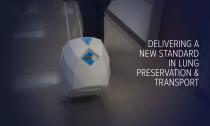
DELIVERING A NEW STANDARD IN LUNG PRESERVATION & TRANSPORT
Open the catalog to page 3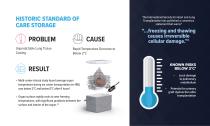
HISTORIC STANDARD OF CARE STORAGE PROBLEM Unpredictable Lung Tissue Cooling The International Society for Heart and Lung Transplantation has published a consensus statement that warns4 “…freezing and thawing causes irreversible cellular damage.”4 Rapid Temperature Decrease to Below 2°C KNOWN RISKS BELOW 2°C5 RESULT • Multi-center clinical study found average organ temperature during ice cooler transportation (n=186) was below 2°C and below 0°C after 6 hours1 • Organ surface rapidly cools to near freezing temperatures, with significant gradients between the surface and interior of the organ.2,3...
Open the catalog to page 4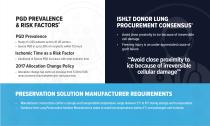
PGD PREVALENCE & RISK FACTORS ISHLT DONOR LUNG PROCUREMENT CONSENSUS • Avoid close proximity to ice because of irreversible cell damage • Freezing injury is an under-appreciated cause of graft failure • Study of 1,225 patients across 10 US centers • Severe PGD in up to 30% of recipients within 72 hours Ischemic Time as a Risk Factor • Likelihood of Severe PGD increases with total ischemic time 2017 Allocation Change Policy • Allocation change has led to an increase from 5.30 to 5.66 mean ischemic time between pre- and post-eras “Avoid close proximity to ice because of irreversible cellular damage”4...
Open the catalog to page 5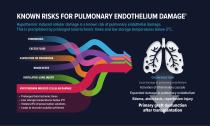
KNOWN RISKS FOR PULMONARY ENDOTHELIUM DAMAGE Hypothermic induced cellular damage is a known risk of pulmonary endothelial damage. This is precipitated by prolonged total ischemic times and low storage temperatures below 2°C. THROMBOSIS EXCESS FLUID ASPIRATION OR PNEUMONIA BRAIN DEATH VENTILATOR-LUNG INJURY CHAIN REACTION Local damage to pulmonary endothelium HYPOTHERMIA INDUCED CELLULAR DAMAGE • Prolonged total ischemic times • Low storage temperatures below 2°C • Violates IFU of preservation solutions • Leads to incorrect solution pH levels Activation of inflammatory cascade Expanded damage...
Open the catalog to page 6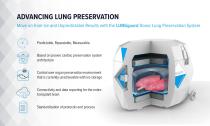
ADVANCING LUNG PRESERVATION Move on from Ice and Unpredictable Results with the LUNGguard Donor Lung Preservation System Predictable, Repeatable, Measurable. Based on proven cardiac preservation system architecture Control over organ preservation environment that is currently unachievable with ice storage Connectivity and data reporting for the entire transplant team Standardization of protocols and process
Open the catalog to page 7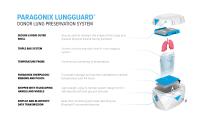
PARAGONIX LUNGGUARD® DONOR LUNG PRESERVATION SYSTEM SECURE & RIGID OUTER SHELL Secure vault to maintain the shape of the lungs and prevent physical trauma during transport Utilizes industry standard best-in-care bagging system TEMPERATURE PROBE Continuous monitoring of temperature PARAGONIX SHERPACOOL® RIBBONS AND POUCH Consistent storage environment validated to maintain temperature over 44 hours SHIPPER WITH TELESCOPING HANDLE AND WHEELS Light-weight, easy to handle system design to fit in standard aircraft and ground vehicles DISPLAY AND BLUETOOTH® DATA TRANSMISSION Real-time monitoring and...
Open the catalog to page 8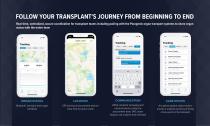
FOLLOW YOUR TRANSPLANT'S JOURNEY FROM BEGINNING TO END Real-time, centralized, secure coordination for transplant teams including pairing with the Paragonix organ transport systems to share organ status with the entire team ORGAN STATUS Bluetooth pairing to track organ conditions ® CASE STATUS GPS tracking of procurement team en route from the donor center HIPAA compliant messaging and communications to keep the procurement team, OPO, donor hospital, and recipient team informed At-a-glance graphic status trackers provide a snapshot summary of timing of key events in the transplant
Open the catalog to page 9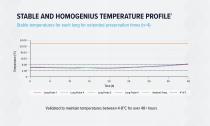
STABLE AND HOMOGENIUS TEMPERATURE PROFILE Stable temperatures for each lung for extended preservation times (n=4) 24.00 Time (h) Lung Probe 1 Ambient Temp. Validated to maintain temperatures between 4-8°C for over 40+ hours
Open the catalog to page 10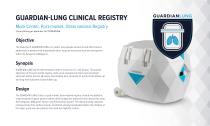
GUARDIAN-LUNG CLINICAL REGISTRY Multi-Center, Post-market, Observational Registry ClinicalTrials.gov Identifier: NCT04930289 Objective The objective of GUARDIAN-LUNG is to collect and evaluate various clinical effectiveness parameters in patients with transplanted donor lung that were preserved and transported within the Paragonix LUNGguard™. Synopsis GUARDIAN-LUNG will include transplant centers across the U.S. and Europe. The primary objectives of the post-market registry study are to evaluate short term post-transplant outcomes (within the first 48 hours), intermediate term outcomes (3- and...
Open the catalog to page 11
References 1. Horch et al., Transplant Proceed 2002 2. Validation data on file with Paragonix Technologies 3. Hendry et al., J Thorac and Cardiovasc Surg 1989 4. Copeland et al. ISHLT Donor Heart and Lung 2020 Consensus Statement 5. Munshi, L. et al. The Lancet Respiratory Medicine 2013 6. Diamond et al. American Journal of Respiratory and Critical Care Medicine 2012 7. Data on file Indications for Use: The Paragonix LUNGguard™ (LUNGguard™) is intended to be used for the static hypothermic preservation of lungs during transportation and eventual transplantation into a recipient using cold storage...
Open the catalog to page 12All Paragonix catalogs and technical brochures
 LIVERguard
2 Pages
 SherpaPak
12 Pages
- VirtualExpo Group
- Our Partners
- Recruitment
- Testimonials