
- Catalogs
- PATH medical
- TYMPANOMETRY ADD-ON FOR SENTIERO ADVANCED

- Company
- Products
- Catalogs
- News & Trends
- Exhibitions
TYMPANOMETRY ADD-ON FOR SENTIERO ADVANCED
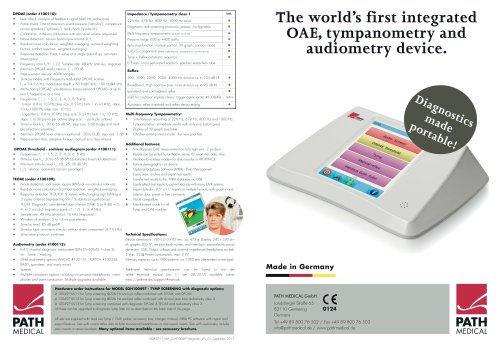
TYMPANOMETRY ADD-ON FOR SENTIERO ADVANCED
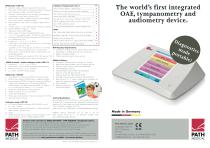
- DPOAE (Distortion Product Otoacoustic Emissions): Includes leak and probe checks, in-the-ear calibration, noise detection, and response detection using F-test. Frequency ratio f2/f1 is 1.22 with a sample rate of 48 kHz. Stimulus levels range from 30 to 65 dB SPL.
- TEOAE (Transient Evoked Otoacoustic Emissions): Features noise detection, residual noise calculation, and response detection with a sample rate of 48 kHz for stimulus and 16 kHz for response. Stimulus level is 85 dB peSPL.
- Audiometry: Full 2-channel diagnostic audiometer with options for air, bone, and masking. Includes child audiometry and multiple transducer options.
- Multi-frequency Tympanometry: Simultaneous recording of multiple frequencies (226 Hz, 678 Hz, 800 Hz, 1000 Hz) with immediate results and 3D graph display.
- Data Management: MIRA software for data transfer, archiving, and exporting test results. Compatible with EMR systems and allows remote display of results.
- Use frequency modulation (FMDPOAE®) to reduce fine structure notches and enhance screening robustness.
- Optimal DPOAE stimulation is necessary for detecting amplitudes in noisy environments, using the Scissor Paradigm for robust detection.
- Simultaneous OAE measurement on both ears, interface for wireless data transfer, and optional database software for enhanced data management.
- Device dimensions are 150 x 210 x 45 mm with a memory capacity for up to 1000 patients.
Catalog excerpts
Multi-frequency Tympanometry: • Simultaneous recording of 226 Hz, 678 Hz, 800 Hz and 1000 Hz Tympanometry - immediate results with only one button press • Display of 3D graph available • Children entertainment mode - the new pilot test • Leak check: analysis of feedback signal (440 Hz probe tone) • Probe check: limit of maximum sound pressure (“stimulus"), comparison across speakers (“symmetry"), leak check (“probe fit") • Calibration: in-the-ear calibration with ear-canal volume adjustment • Noise detection: narrow band noise around 2f2-f1 • Residual noise calculation: weighted averaging, summed weighting factors, artifact rejection: weighted averaging • Response detection: F-test, F-value at a single point (Fsp), automatic retest option • Frequency ratio f2/f1: 1.22. Sample rate: 48 kHz (stimulus, response) • Minimum DPOAE level criterion: L1 - 70 dB • Measurement interval: 4096 samples • Stimulus modes with Frequency-modulated DPOAE license: • Multi-channel DPOAE: simultaneous measurement of DPOAEs at up to two f2 frequencies at a time - Linear: 0.8 to 10 kHz (step size: 0.5 kHz from 1 to 10 kHz), steps: 10 to 1000 Hz (step size: 10 Hz) - Logarithmic: 0.8 to 10 kHz (step size: 0.5 kHz from 1 to 10 kHz), steps: 1 to 30 points per octave (step size: 1 point per octave) • Stimulus levels L2: 30 to 65 dB SPL; step size: 5 dB (single and multiple selections possible) • Minimum DPOAE level criterion (optional): -20 to 0 dB; step size: 5 dB • Measurement time: adaptive timeout, manual min/max timeout DPOAE threshold - cochlear audiogram (order #100111): • Stimulus level L2: 20 to 65 dB SPL (automated threshold detection) • Minimum stimulus level L2: 20, 25, 30 dB SPL • L2/L1 relation: automatic (scissor paradigm) • Noise detection: root mean square (RMS) of non-stimulus intervals • Residual noise calculation & artifact rejection: weighted averaging • Response detection TEQUICK: 8 values with changing sign fulfilling a 3 sigma criterion (representing 99.7 % statistical significance) TEOAE Diagnostic: user-defined stop criterion (SNR: 6 or 9 dB) in 3, • Sample rate: 48 kHz (stimulus), 16 kHz (response) • Window of analysis: 5 to 13 ms post-stimulus • Stimulus level: 85 dB peSPL • Stimulus type: short-term stimulus without direct component (0.7-6 kHz) • Stimulation protocol: nonlinear • Full 2 channel diagnostic audiometer (DIN EN 60645-1 class 3) air - bone - masking • Child audiometry options (MAGIC #100112 , MATCH #100356, BASD, spondees and many more). • Multiple transducer options including circumaural headphones, insert phones and bone conduction. Multiple upgrades available. Additional features: • Simultaneous OAE measurement on left/right ear - 2 probes! • Results can be sorted by birthdate, name, ID, examiner, date, time • Interface to wireless modem for data transfer to PATHTRACK • Patient demographics on device • Optional Database Software (MIRA) - Data Management: Easily view, archive and export test results • Transfer test results to the MIRA database via USB • Easily attach test results to patient records with many EMR systems • Export full-color, 8.5" x 11" reports in multiple formats, with graphic and tabular data, preset or free comments • Noah compatible • Entertainment mode for all Tymp and OAE modules Technical Specifications: Device dimensions: 150 x 210 x 45 mm, ca. 475 g. Display: 240 x 320 pixel; graphic LCD 5", resistive touch screen, real time-clock, piezo-electric sound generator, USB, Output voltage and nominal impedance (headphone socket): 5 Vpp, 32 Q Power consumption: max. 2 W. Memory capacity: up to 1000 patients, ca. 1000 tests (dependent on test type). Additional technical specifications can be found in the detailed technical manual (rev 11 per 08/2017) available online https://pathme.de/support/#manuals The world’s first integrated OAE, tympanometry and audiometry device. PATHMEDICAL Hardware order instructions for MODEL SOH100497 - TYMP SCREENING with diagnostic options: #100497-US11 forTymp screening <@2!26 Hz and ipsi reflex combined with TEOAE and DPOAE # 100497-US12 for Tymp screening @226 Hz and ipsi reflex combined with clinical pure tone audiometry class 3 # 100497-US13 for Tymp screening combined with diagnostic DPOAE & TEOAE and audiometry class 3. All these can be upgraded to diagnostic tymp later on as described on the back side of this page. All sets are supplied with: dual use Tymp / OAE probe, accessory box, charger, manual, MIRA PC software with import and export features. Sets with contra reflex also include monoaural headphones or monoaural inserts. Sets with audiometry include stero inserts or stereo headsets. Many optional items available - see accessory brochure. PATH MEDICAL GmbH Landsberger Strabe 65 82110 Germering Germany
Open the catalog to page 1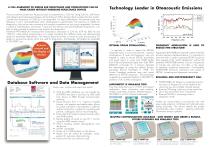
A FULL ASSESMENT OF MIDDLE EAR REFLECTANCE AND CONDUCTANCE CAN BE MADE EASIER WITHOUT WIDEBAND REFLECTANCE DEVICES Technology Leader in Otoacoustic Emissions The most common probe tone frequency used in tympanometry is 226 Hz. Using 226 Hz, well known and categorized tympanogram shapes can be obtained. When testing infants younger than four months, a probe tone frequency at 1000 Hz is recommended. For many pathologies, the optimal probe tone frequency is not a well established value. Multifrequency tympanometry can improve on middle ear diagnostics, but can be time consuming with analysis sometimes...
Open the catalog to page 2All PATH medical catalogs and technical brochures
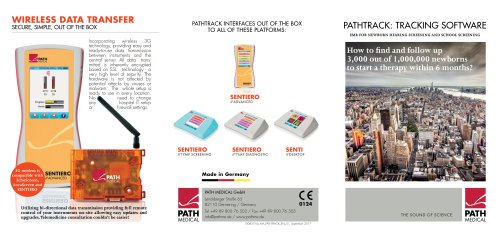 WIRELESS DATA TRANSFER
2 Pages
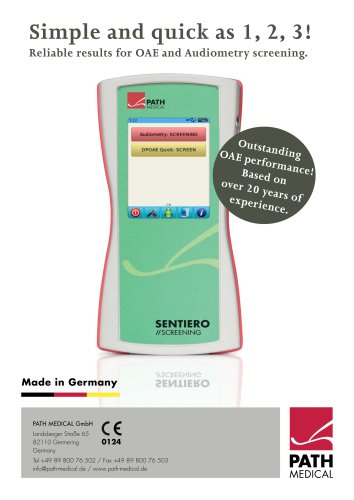 Simple and quick
2 Pages
 SENTIERO
12 Pages
 QSCREEN®
5 Pages
 Accessories and Consumables
2 Pages
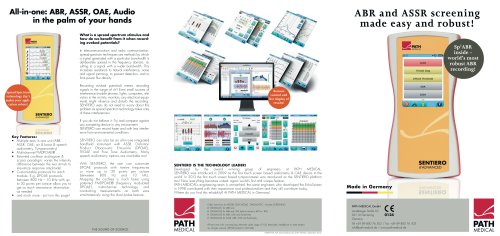
Archived catalogs
 Sentiero Advanced
2 Pages
 SENTIERO Desktop
2 Pages
 Senti
2 Pages
 pathTrack
2 Pages
