


MULTI-PURPOSE CARTS

MULTI-PURPOSE CARTS
Overview of Multi-Purpose Carts
This document provides a technical overview of multi-purpose carts, focusing on their design, specifications, operational procedures, and recommended best practices.
1. Specifications
- Design: Multi-purpose carts are designed for versatility, capable of transporting various types of loads across different environments.
- Materials: Typically constructed from durable metals or reinforced plastics to ensure longevity and load-bearing capacity.
- Load Capacity: Varies depending on model, generally ranging from light-duty (up to 100 kg) to heavy-duty (over 500 kg).
- Dimensions: Standard sizes are adaptable, with customizable options to fit specific operational needs.
2. Operational Procedures
- Loading: Proper weight distribution is critical to maintain balance and prevent tipping.
- Movement: Carts should be maneuvered carefully, especially on uneven surfaces, to avoid accidents.
- Maintenance: Regular inspection of wheels, brakes, and structural integrity is recommended to ensure safety and performance.
3. Standards and Norms
- Compliance with industry safety standards such as OSHA or equivalent local regulations is mandatory.
- Material and construction standards must meet ISO certifications relevant to load-bearing equipment.
4. Recommendations and Best Practices
- Use carts within their specified load limits to avoid damage and ensure operator safety.
- Train personnel on proper handling techniques to maximize efficiency and reduce injury risk.
- Implement routine maintenance schedules and document inspections.
5. Summary of Key Data
Tables and diagrams (not included here) typically illustrate load capacities, dimension variations, and maintenance checklists, emphasizing critical parameters such as maximum load, wheel type, and braking mechanisms.
Note: For detailed technical drawings and specific model data, refer to the manufacturer’s documentation.
Catalog excerpts
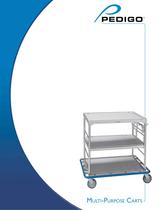
MULTI-PURPOSE CARTS
Open the catalog to page 1
MULTI-PURPOSE CARTS
Open the catalog to page 2All Pedigo catalogs and technical brochures
 space station
2 Pages
 element
2 Pages
 Pedigo Complete Catalog 2019
82 Pages
 Mayo Stands
2 Pages
 Footstools
2 Pages
 Utility Carts
2 Pages
 Supply Carts
2 Pages
 Basin Stands & Kick Buckets
2 Pages
 sterilizer carts
2 Pages
 stretcher accessories
3 Pages
 7500-NE Eye Stretcher
2 Pages
 7500 GUARDIAN Stretcher
2 Pages
 5400 Universal Stretcher
2 Pages
 utility tables
2 Pages
 over-operating tables
2 Pages
 Instrument Tables
2 Pages
 Warmers
4 Pages
 ivNow
ivNow2 Pages
 PEDIGO Complete Catalogue 2016
84 Pages
 Instrument Assembly Station
2 Pages
 Seating
8 Pages
 Pedigo Product Catalog 2015
80 Pages
 hampers linen
2 Pages
 P-1083-6
1 Page
 revolution
2 Pages
 PRODUCT CATEGORIES
81 Pages
 CENTRAL SUPPLY TABLES
2 Pages
 ergo chair
2 Pages
 LABOR & DELIVERY
2 Pages
 IV STANDS
2 Pages
 INFUSION PUMP STAND
2 Pages
 sealed Case Carts
1 Page
 STERILE PROCESSING EQUIPMENT
2 Pages
 DISTRIBUTION CARTS
2 Pages
 Surgical Case Carts
2 Pages
 Wall Cabinets
2 Pages
 cabinet
2 Pages
 BASSINETS
2 Pages
 SPACE STATION
2 Pages


Archived catalogs
 MAYO STANDS
2 Pages
 Utility Carts
2 Pages
 SUPPLY CARTS
2 Pages

- Medical dolly
- Hospital wardrobe
- Healthcare facility stool
- Instrument trolley
- Stretcher trolley
- Stainless steel cabinet
- Infusion stand
- Transport gurney
- 2 doors wardrobe
- 1-door wardrobe
- Wardrobe with drawer
- Stool with backrest
- IV pole on castors
- Height-adjustable stretcher trolley
- Swivel stool
- Stainless steel infusion stand
- Trolley with door
- 2-section stretcher trolley
- Surgical trolley
- Stretcher trolley with side rails