
- Catalogs
- Peira bvba
- HTSScratcher

HTSScratcher

HTSScratcher
Overview of Peira HTSScratcher
The document appears to focus on the Peira HTSScratcher, a technical product or system. However, due to the limited content provided, detailed specifications, procedures, standards, or recommendations cannot be extracted or summarized.
Summary
Insufficient information is available to generate a structured summary. No technical data, operational guidelines, or normative references are present in the provided text.
Catalog excerpts
Somtifr'c fnst^am&nts In essence HTS uses a brute-force approach to collect a large amount of experimental data - usually observations about how some biological entity reacts to exposure to various chemical compounds - in a relatively short time. The screen in this context is the larger experiment, with a single goal (usually testing a scientific hypothesis), to which all this data may subsequently be applied. Existing methodologies show a lack of consistency in generating those scratches. Gaps are made either with a hand tool or by specially developed but abruptly moving apparatus, disturbing the cell monolayers. For HTS experiments where thousands of well plates must be scratched consistently the The "HTSScratcher" was designed in close cooperation with HTS researchers in order to remove bottlenecks in the assay preparation phase of the experiment. The apparatus provides support and guidance for a commercially available hand tool which is commonly used. Four guidance shafts guarantee a perfect horizontal position of the scratch needles-plate relative to the well plate beneath. When lowering the tool, a controlled spring counterforce ensures the downward movement is smooth and controlled. When touching the well plate, the needle-tool can be moved horizontally over a determined distance, thus creating a scratch in the cell culture without damaging the plastic well plate. The sledge support which runs over eight polyamide rollers assures smooth transport and rapid removal and loading of the well plates. Peira bvba | Scientific Instruments | www.peira.be
Open the catalog to page 1
Easy to operate and to maintain. Versatility as the apparatus can be used for a 96 well plate or for a 384 well plate. Improved efficiency and effectiveness of the experiment. TECHNICAL DATA Peira bvba | Scientific Instruments | www.peira.be
Open the catalog to page 2All Peira bvba catalogs and technical brochures
 Peira RollerMill
1 Page
 Peira HumanShaker
1 Page
 Peira NanoSizer
1 Page
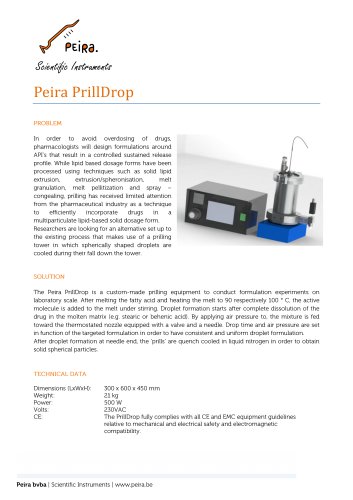 Peira PrillDrop
1 Page
 Peira Lab reactors
1 Page
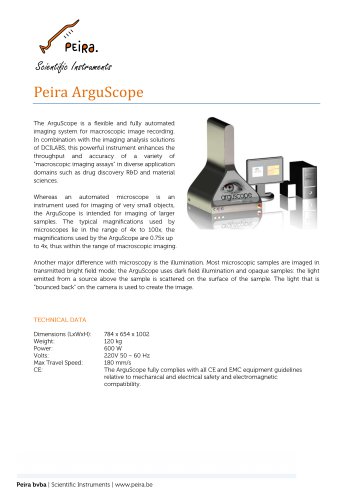 Peira ArguScope
1 Page
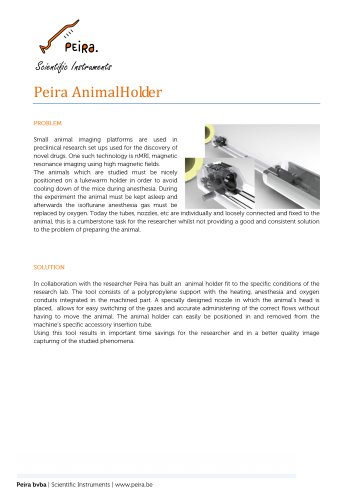 Peira AnimalHolder
1 Page
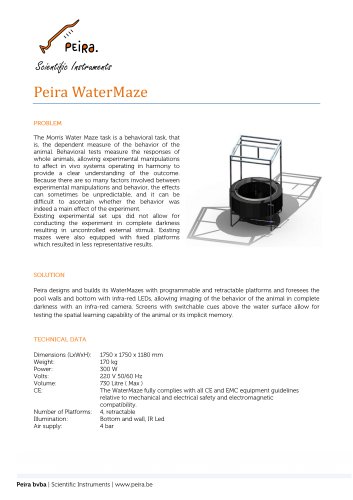 Peira WaterMaze
1 Page
 Peira NeuroVisioScan
1 Page
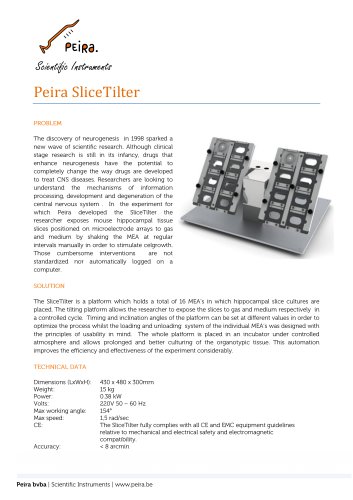 Peira SliceTilter
2 Pages
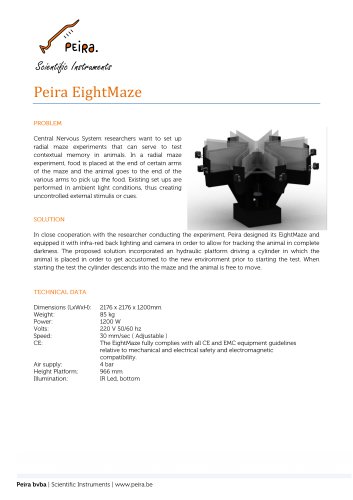 EightMaze
1 Page
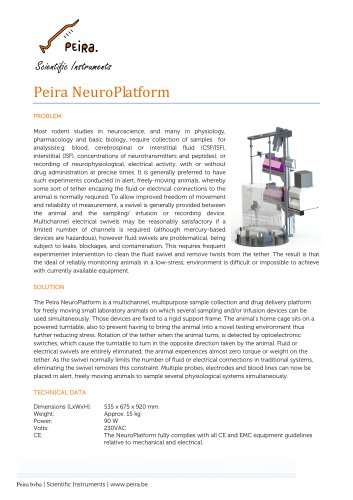 NeuroPlatform
1 Page
 WoundScratcher
1 Page
 TM900
TM9003 Pages
