- Catalogs
- PEPperPRINT
- One-stop Solution for the Fingerprint Analysis of Immune Adverse Effects

- Products
- Catalogs
- News & Trends
- Exhibitions
One-stop Solution for the Fingerprint Analysis of Immune Adverse Effects
One-stop Solution for the Fingerprint Analysis of Immune Adverse Effects
Catalog excerpts
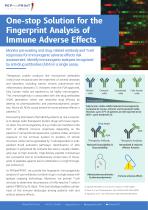
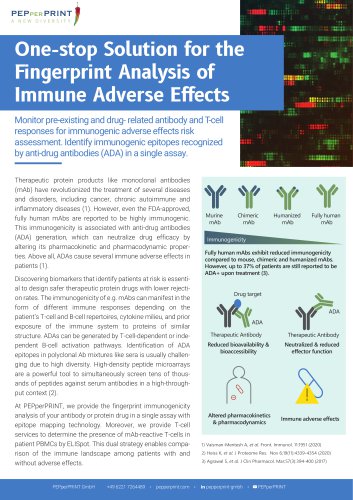
One-stop Solution for the Fingerprint Analysis of Immune Adverse Effects Monitor pre-existing and drug- related antibody and T-cell responses for immunogenic adverse effects risk assessment. Identify immunogenic epitopes recognized by anti-drug antibodies (ADA) in a single assay. Therapeutic protein products like monoclonal antibodies (mAb) have revolutionized the treatment of several diseases and disorders, including cancer, chronic autoimmune and inflammatory diseases (1). However, even the FDA-approved, fully human mAbs are reported to be highly immunogenic. This immunogenicity is associated with anti-drug antibodies (ADA) generation, which can neutralize drug efficacy by altering its pharmacokinetic and pharmacodynamic properties. Above all, ADAs cause several immune adverse effects in patients (1). Discovering biomarkers that identify patients at risk is essential to design safer therapeutic protein drugs with lower rejection rates. The immunogenicity of e.g. mAbs can manifest in the form of different immune responses depending on the patient’s T-cell and B-cell repertoires, cytokine milieu, and prior exposure of the immune system to proteins of similar structure. ADAs can be generated by T-cell-dependent or independent B-cell activation pathways. Identification of ADA epitopes in polyclonal Ab mixtures like sera is usually challenging due to high diversity. High-density peptide microarrays are a powerful tool to simultaneously screen tens of thousands of peptides against serum antibodies in a high-throughput context (2). At PEPperPRINT, we provide the fingerprint immunogenicity analysis of your antibody or protein drug in a single assay with epitope mapping technology. Moreover, we provide T-cell services to determine the presence of mAb-reactive T-cells in patient PBMCs by ELISpot. This dual strategy enables comparison of the immune landscape among patients with and without adverse effects. PEPperPRINT GmbH • Immunogenicity Fully human mAbs exhibit reduced immunogenicity compared to mouse, chimeric and humanized mAbs. However, up to 37% of patients are still reported to be ADA+ upon treatment (3). Drug target ADA ADA Therapeutic Antibody Therapeutic Antibody Reduced bioavailability & bioaccessibility Neutralized & reduced effector function Altered pharmacokinetics & pharmacodynamics Immune adverse effects 1) Vaisman-Mentesh A, et al. Front. Immunol. 11:1951 (2020) 2) Heiss K, et al. J Proteome Res. Nov 6;19(11):4339-4354 (2020) 3) Agrawal S, et al. J Clin Pharmacol. Mar;57(3):394-400 (2017)
Open the catalog to page 1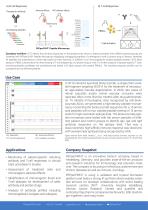
A) B-Cell Responses Therapeutic antibody Adverse effects NO adverse effects Overlapping peptides Exemplary workflow: A) To detect the anti-drug responses on the epitope level, serum or plasma samples from different patient groups are screened with PEPperCHIP® Peptide Microarrays displaying overlapping peptides of a therapeutic mAb or protein drug of interest. Identified hit peptides are presented as a heat map based on their reactivity, in addition to an immunoglobulin isotype/subtype analysis. B) ELISpot assays in PBMC cultures allow for direct-testing of T-cell antigenicity of a protein drug...
Open the catalog to page 2All PEPperPRINT catalogs and technical brochures
 Antibody Validation
2 Pages