
- Catalogs
- PHC Europe
- ProteoSave™ Brochure

ProteoSave™ Brochure

ProteoSave™ Brochure
ProteoSave™ is a specialized product designed to prevent the non-specific binding of proteins, peptides, and cells to surfaces, which is a common issue in standard tubes and plates. This is achieved through a high-density coating of hydroxyl groups on the surface, which is covalently bound to minimize elution.
Principle
The primary function of ProteoSave™ is to preserve precious biological samples by reducing adsorption to plastic surfaces. The ultra-hydrophilic polymer coating prevents protein denaturation and adsorption, making it ideal for preserving proteins, antibodies, and peptides.
Features
- Significant reduction in protein, peptide, and cell adsorption.
- Minimal material elution due to covalent attachment of the polymer.
- Resistance to organic solvents, detergents, and heat (boiling at 100°C for 10 minutes).
Comparison with Competitors
Figures illustrate the superior performance of ProteoSave™ in preventing protein adsorption and maintaining protein structure compared to hydrophobic surfaces.
Applications
- Preservation of high-value samples like proteins, antibodies, and vaccines.
- Protein assays and enzyme catalysis.
- Preparation of dilution series.
Product Lineup
ProteoSave™ offers a variety of tubes and plates, including microtubes and 96-well plates, available in different sizes and sterilization options.
Resistance and Stability
- Detergent resistance: Effective against CHAPS, TritonX, and Tween20.
- Organic solvent resistance: Compatible with methanol, ethanol, 2-propanol, and others.
- Temperature stability: Operates effectively from -80°C to 40°C.
Catalog excerpts
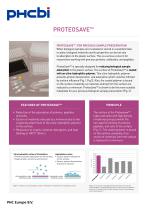
PROTEOSAVE™ PROTEOSAVE™: FOR PRECIOUS SAMPLE PRESERVATION When biological samples are incubated or stored in a standard tube or plate, biological materials and its properties can be lost due to adsorption to the plastic surface. This is a serious concern for researchers working with precious proteins, antibodies, and peptides. ProteoSave™ is specially designed for reducing biological sample adsorption to the plastic surface. The surface of ProteoSave™ is coated with an ultra-hydrophilic polymer. This ultra-hydrophilic polymer prevents protein denaturation and adsorption which could be inflicted by surface influence (Fig.1, Fig.2). Also, the coated polymer is bound on the surface covalently, so materials eluting from the surface are reduced to a minimum. ProteoSave™ is shown to be the more suitable tube/plate for your precious biological sample preservation (Fig. 2). PRINCIPLE The surface of the Proteosave™ tubes and wells with high density of hydroxyl groups prevent the non-specific binding of proteins, peptides, and cells to the surface (Fig. 1). The coated polymer is bound on the surface covalently, thus elution of materials from the surface is reduced to a minimum. Reduction of the adsorption of proteins, peptides and cells. Elution of materials reduced to a minimum due to the covalently attachment of the ultra-hydrophilic polymer to the surface. Resistance to organic solvents, detergents, and heat (boiling at 100°C 10min.). Hydrophobic surface • Causes protein adsorption on the surface. • Causes protein denaturation and loss of function. Ultra-hydrophilic surface of ProteoSaveTM • Prevents protein adsorption on the surface. • Keeps protein structure and function. Natural Proteins Denatured Proteins Figure 1. Features of Ultra-hydrophilic surface of ProteoSave™ compared with a hydrophobic surface Hydrophobic surface Tube/Plate surface Ultra-hydrophilic surface Tube/Plate surface Figure 2. The number of peptides detected by nanoLC Ultra 2D with TripleTOF®5600 rom Hep3B digested extracts. (Data Courtesy of Masahiro Kamita, Ph.D , National Cancer Center Research Institute, Chemo
Open the catalog to page 1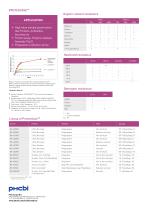
PROTEOSAVE™ Organic solvent resistance APPLICATION High value sample preservation like Proteins, Antibodies, Vaccines etc. Protein assay- Enzyme catalysis (example Fig.3). Preparation of dilution series. Reaction efficiency (%) Methods & Material Reaction Containers: PROTEOSAVE™ 1.5mL microtube, Competitor X, Competitor Y Reaction reagent: SGP11 3mM(0.43mg) (TOKYO CHEMICAL INDUSTRY CO., LTD.), Phosphate buffer(pH7.0) 50mM, Endo-M 10mU/mL(0.5mU) (No. A1651, TOKYO CHEMICAL INDUSTRY CO., LTD.) Total Volume:50 μL, Temperature:30 ºC. Reaction timeslot (hours):1st, 2nd, 3rd, 4th, 5th, 6th, 24th...
Open the catalog to page 2All PHC Europe catalogs and technical brochures
 FACSCOPE® B - CUR-CRFCB-01
2 Pages
 Racks Brochure
16 Pages
 Cold Chain Brochure
16 Pages
 MCO Cleaning Brochure
28 Pages
 MIR Brochure
6 Pages
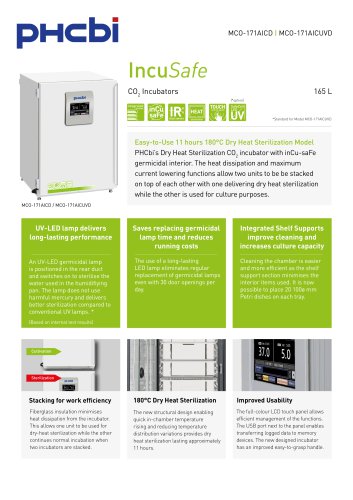
 Incusafe Brochure
36 Pages
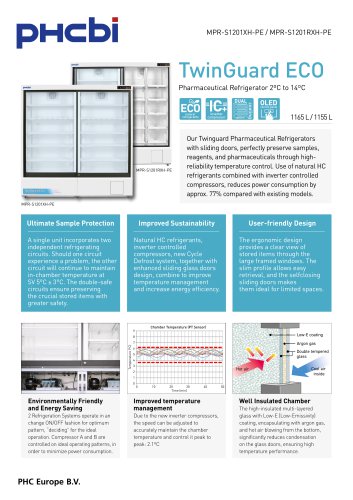
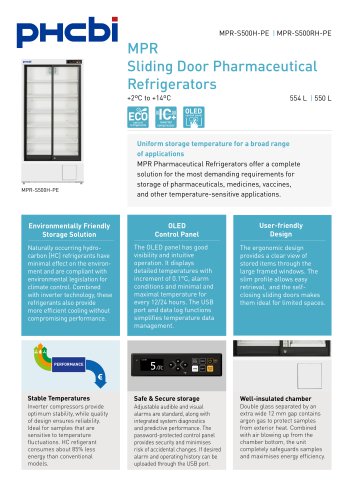
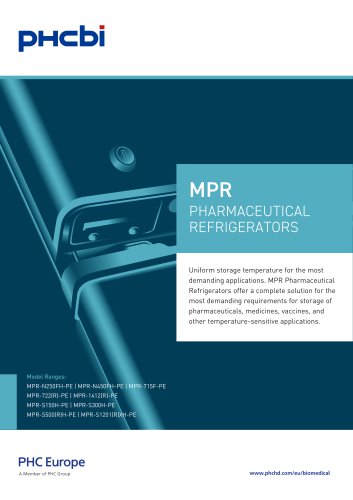 MPR Brochure
20 Pages
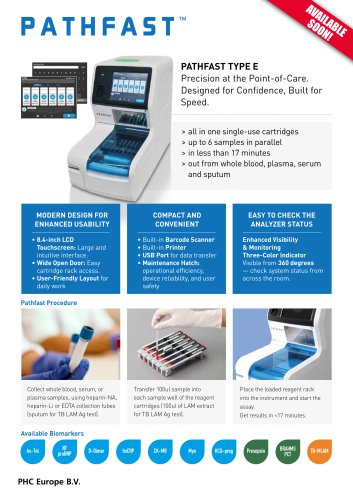 PATHFAST™ TYPE E
2 Pages
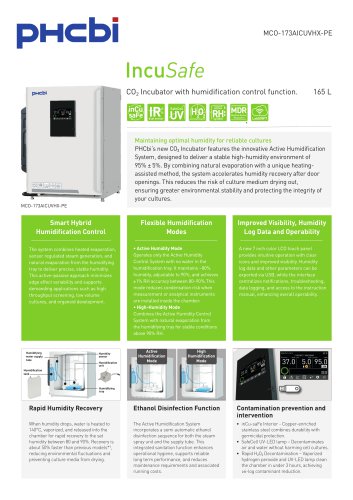 MCO-173AICUVHX-PE
3 Pages
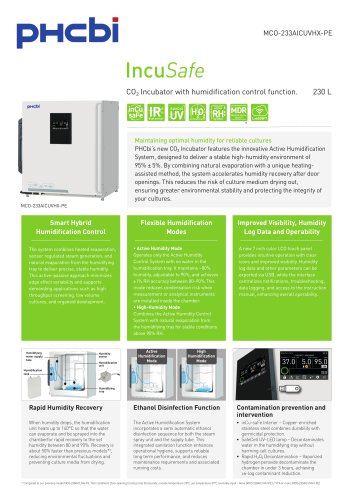 MCO-233AICUVHX-PE
2 Pages
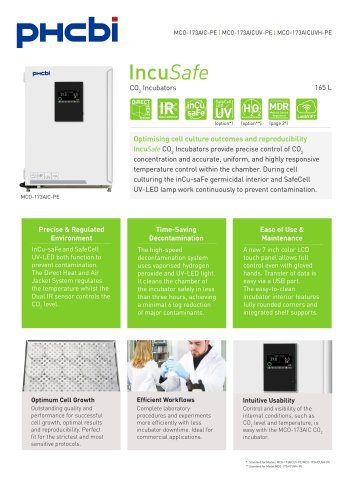 MCO-173AIC(UV)H)-PE
2 Pages
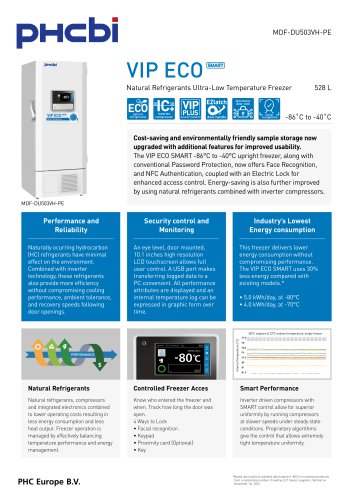
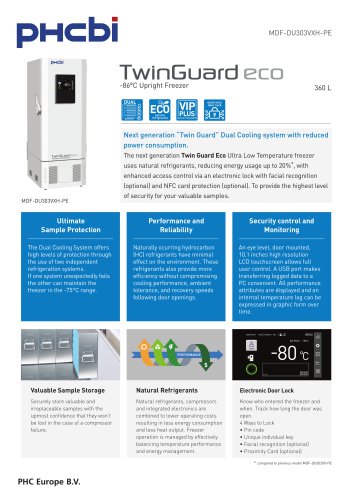 MDF-DU303VXH-PE
2 Pages
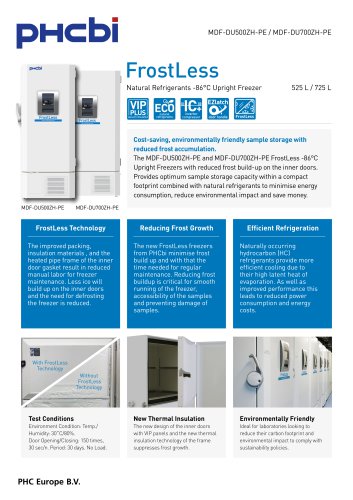
 ULT Brochure
52 Pages
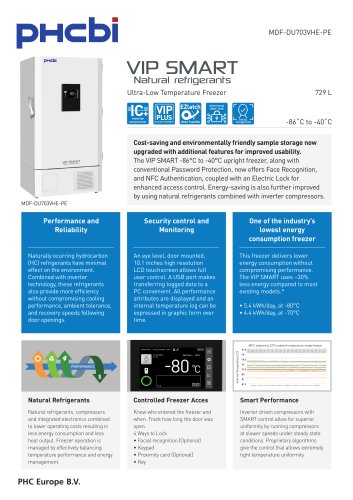
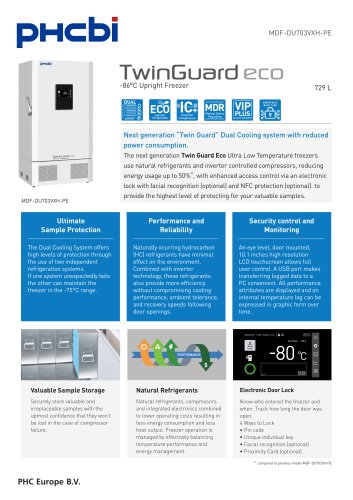 MDF-DU703VXH-PE Productsheet
2 Pages
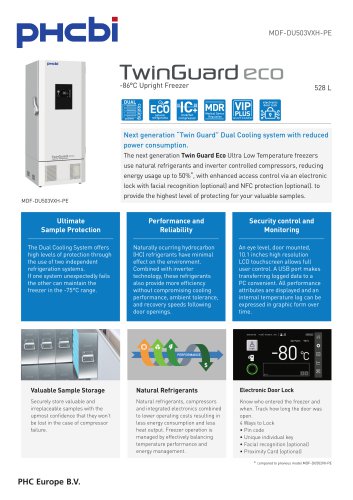 MDF-DU503VXH-PE Productsheet
2 Pages
 STEMFULL™ Brochure
2 Pages
 Cryogenic Vials Brochure
2 Pages
 PATHFAST™ Presepsin
6 Pages
 MCO-50AIC-PE CO2 Incubators
2 Pages
 MCO-50M-PE CO2 Incubators
2 Pages
 Cleanroom Classification
4 Pages
 MIR-554-PE Cooled Incubator
2 Pages
 MDF-DU901VHL-PE
2 Pages
 MPR-S150H-PE & MPR-S300H-PE
2 Pages
 MPR-N450FHD-PE
2 Pages
 Commitment to PHC Quality
32 Pages
 PRIMESURFACE®
4 Pages
 MPR-1014R-PE
2 Pages
 MPR-N450FH-PE
2 Pages
 MDF-U731M-PE -30°C Freezer
2 Pages
 MCO-170AIC-PE CO2 Incubators
2 Pages
 MLR-352-PE Climate Chamber
2 Pages
 MIR-554 Cooled Incubator
2 Pages
 MCO-170AC-PE CO2 Incubators
2 Pages
 MCO-230AIC-PE CO2 Incubators
2 Pages
 MCO-80IC-PE CO2 Incubator
2 Pages
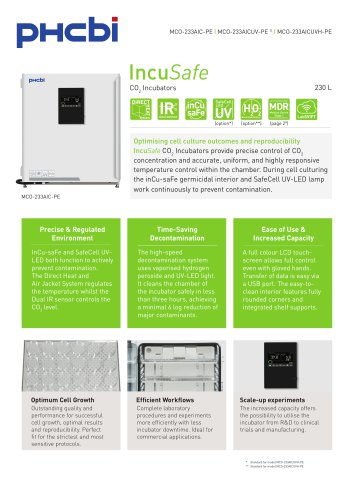
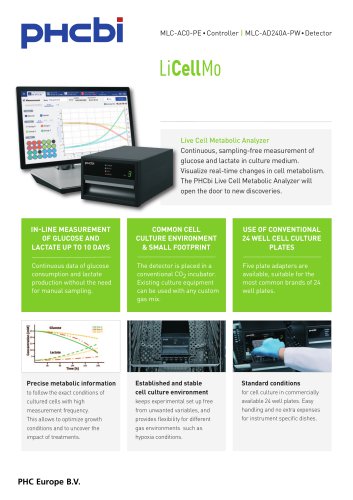
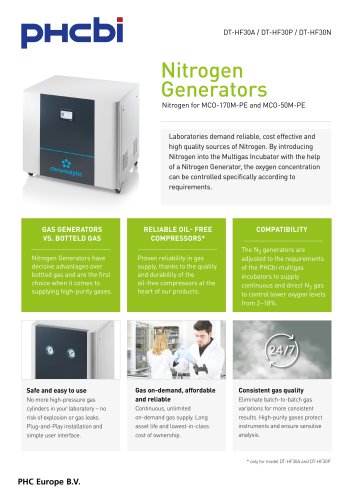






Archived catalogs
 MCO-50AICL-PE Co2 Incubator
2 Pages
 MCO-5AC-PE CO2 Incubators
2 Pages
 MLS
MLS2 Pages
 ULTRA LOW TEMPERATURE FREEZERS
16 Pages
 Biomedical Freezers
4 Pages
 MIR-162/262
2 Pages
 Autoclaves MLS-2420/3020
2 Pages
 MPR-S163-PE & MPR-S313-PE
2 Pages
 Bloodbank Refrigerators
4 Pages
 MIR-H163-H263
2 Pages
 MBR Blood Bank refrigerators
2 Pages
 MIR Cooled Incubators
4 Pages
 Biomedical Freezer MDF-U731M
2 Pages
 MDF-U731M-PE
2 Pages
 MDF-U5412-PE
2 Pages
 MDF-U3386S-PE
2 Pages
 MDF-U4186S-PE
2 Pages
 MDF-U5386S-PE
2 Pages
 Cooled Incubators
4 Pages
 TwinGuard ULT Freezers brochure
12 Pages
 Biological Safety Cabinet
2 Pages
 MDF-DU302VX-PE
2 Pages
 Panasonic - Cryopreservation
28 Pages
 Incubateurs multigaz
2 Pages
 MDF-U700VX-PE
2 Pages
 MDF-U500VX-PE
2 Pages
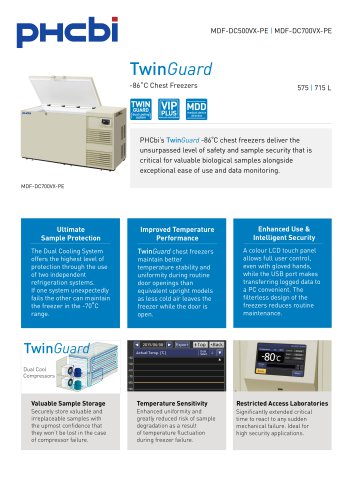
 TwinGuard -86 chest freezers
2 Pages




- PHC Europe test kit
- PHC Europe blood test kit
- Serum detection kit
- Sterilizer
- PHC Europe immunoassay test kit
- PHC Europe cabinet refrigerator
- PHC Europe plasma test kit
- Immunoassay rapid diagnostic test
- Steam sterilizer
- Infectious disease detection kit
- PHC Europe laboratory freezer
- 1-door refrigerator
- PHC Europe laboratory refrigerator
- PHC Europe 1-door freezer
- Electric refrigerator
- PHC Europe laboratory incubator
- PHC Europe refrigerator with glass door
- PHC Europe whole blood test kit
- Stainless steel sterilizer
- PHC Europe pharmacy refrigerator