
- Catalogs
- Pie Medical Imaging
- CAAS QCA whitepaper


CAAS QCA whitepaper

CAAS QCA whitepaper
Coronary angiography is a critical tool for diagnosing and treating coronary artery disease. Traditional visual estimation has limitations, such as variability based on operator experience. Quantitative Coronary Analysis (QCA) offers a more accurate and reproducible method, enhancing clinical and research applications.
Clinical Practice: QCA provides precise measurements of stenosis severity, lesion length, and reference vessel diameter, aiding in the selection of appropriate interventions and devices. It helps predict the effectiveness of PCI and reduces the risk of restenosis.
Research Setting: QCA is used to evaluate treatment effectiveness, such as stent placement or drug treatments. It provides parameters like acute luminal gain and late luminal loss, enhancing the statistical power of research studies.
CAAS QCA is extensively validated for accuracy and precision. It offers single-click analysis, improved contour detection, and dedicated bifurcation analysis. The system also includes features for analyzing total occlusions and drug-eluting stents (DES).
QCA is a valuable tool in both clinical and research settings, offering precise and reproducible measurements. CAAS QCA is widely used and continuously improved, providing insights that support decision-making in interventional cardiology.
Catalog excerpts

CAAS QCA The applications and benefits of quantitative coronary angiography
Open the catalog to page 1
Coronary angiography is routinely used for diagnosis and treatment of millions of patients who have or are at risk of coronary artery disease. In clinical practice visual estimation (eye-balling) is a common way of evaluating coronary angiograms. Visual estimation has however several limitations, e.g. high variability associated with operator experience and only general estimation of the vessel dimensions. Quantitative Coronary Analysis (QCA) being highly accurate and reproducible can refine the visual estimate and provide several important measurements of the coronary anatomy. The use of QCA...
Open the catalog to page 2
quantitative measures of the residual diameter [2] stenosis after stent implantation . Research setting In a research setting QCA is used after completing coronary angiography or intervention, to evaluate the effectiveness of treatments, such as balloon or stent placement or drug treatment. For studies on coronary devices, QCA is performed on images acquired before treatment, immediately after treatment and at followup. Dedicated core laboratories usually perform the analysis to obtain independent analysis. The most important parameters in research, calculated using QCA, are: • Acute luminal...
Open the catalog to page 3
and interventional cardiology. Therefore we can conclude QCA continuous to offer important insights for clinical research and clinical practice. To overcome the limitations of 2D single vessel QCA, QCA is continuously improved and expanded with new analysis options like 2D bifurcation QCA, 3D single vessel and 3D bifurcation QCA. Analysis of Total Occlusions (100% stenosis) Total occlusions can be analyzed. In research studies this is a great benefit because now also for these cases pre- and post data can be compared and these patients can be included. In clinical practice the length of the total...
Open the catalog to page 4
Becanusstraat 13D 6216 BX Maastricht The Netherlands +31 43 3281328 [email protected] www.piemedicalimaging.com SMS938 (April, 2011)
Open the catalog to page 5All Pie Medical Imaging catalogs and technical brochures
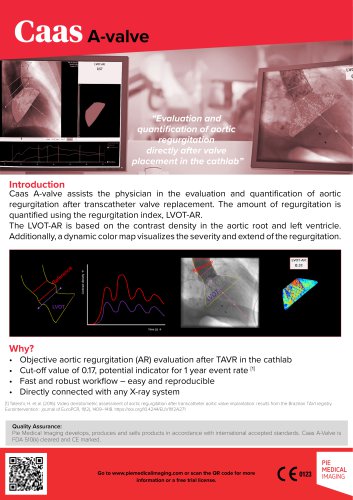 CAAS A-Valve brochure
1 Page
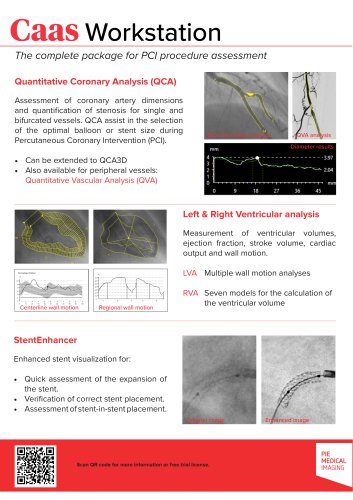 CAAS QVA
2 Pages
 CAAS QCA brochure
2 Pages
 CAAS LVA
2 Pages
 CAAS Workstation
2 Pages
 RVA
RVA2 Pages
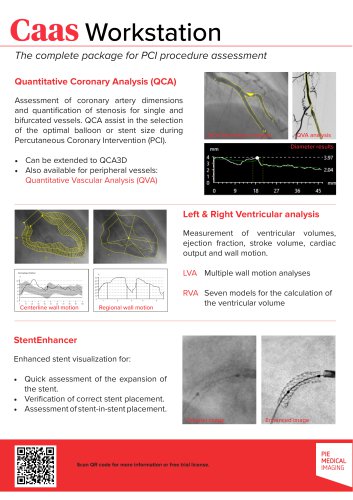 Stent Enhancer
2 Pages
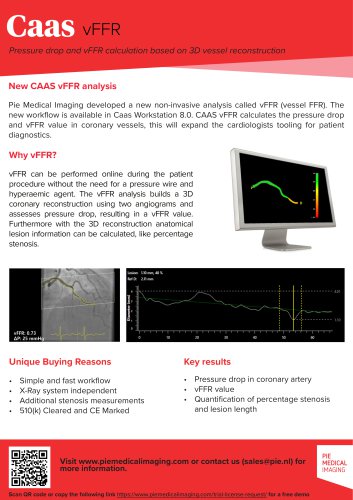 CAAS vFFR
2 Pages
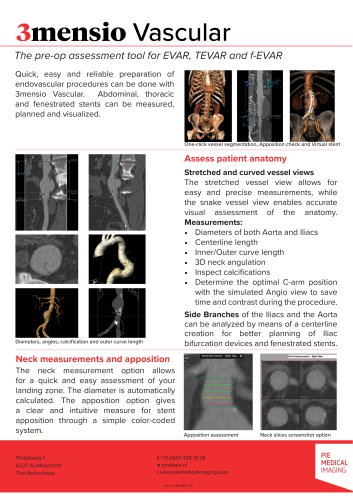 3mensio vascular
2 Pages
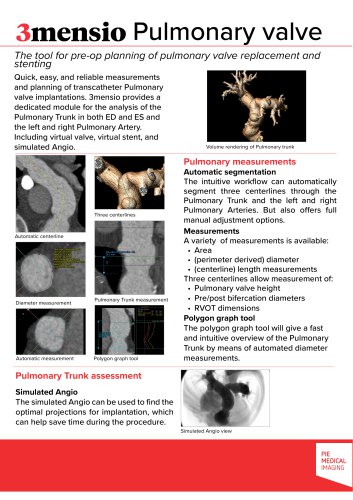 3mensio Pulmonary valve
2 Pages
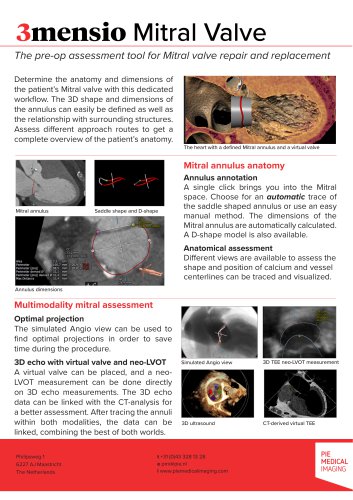 3mensio Mitral valve
2 Pages
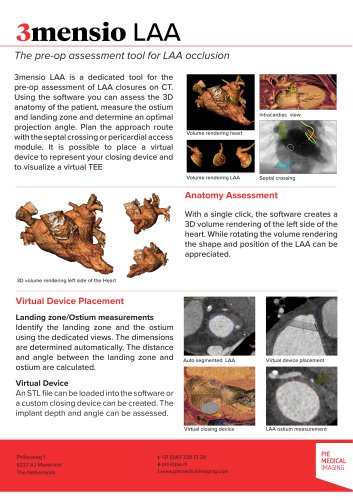 3mensio LAA
2 Pages
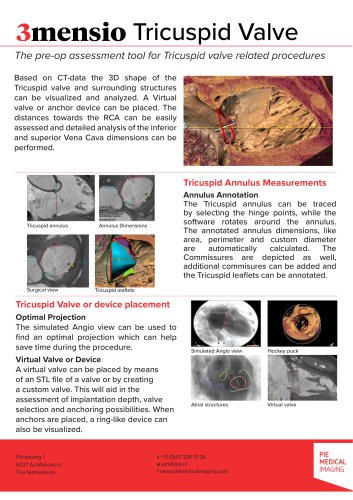 3mensio SH Tricuspid Valve
2 Pages
 3mensio Aortic valve
2 Pages
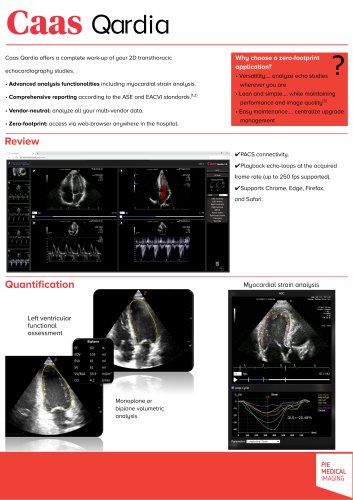 Caas Qardia
2 Pages
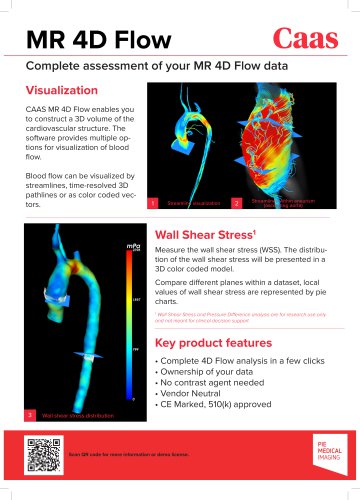 MR-4D-Flow
2 Pages
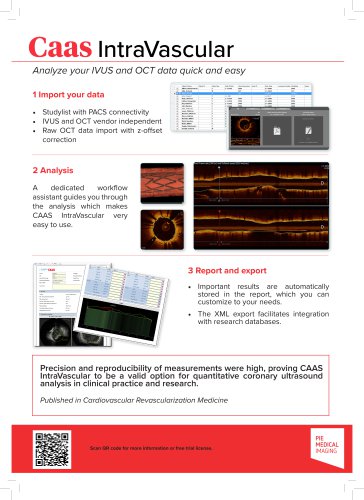 CAAS-IntraVascular
2 Pages
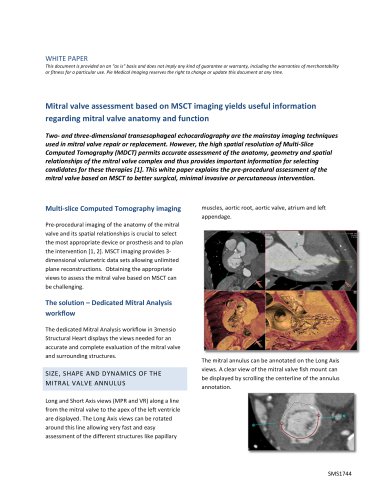 Mitral valve WHITE PAPER
3 Pages
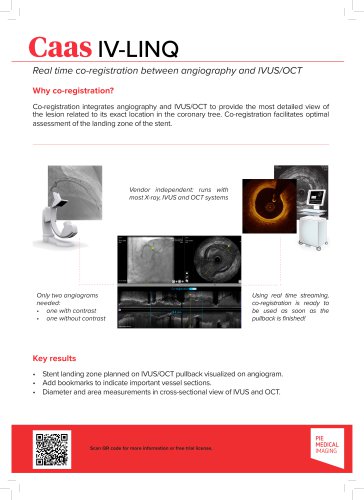 Caas IV-LINQ
2 Pages
 StentEnhancer
4 Pages
 MRV | MR Flow
6 Pages
 QCA 3D
5 Pages
 CAAS MRV
6 Pages
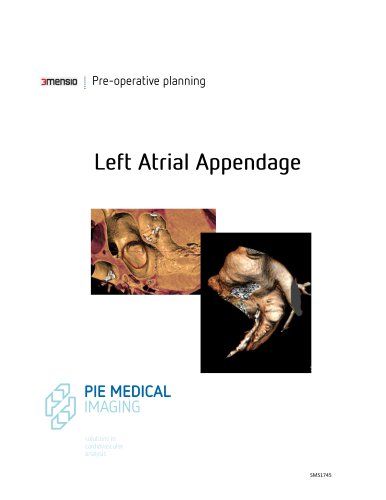
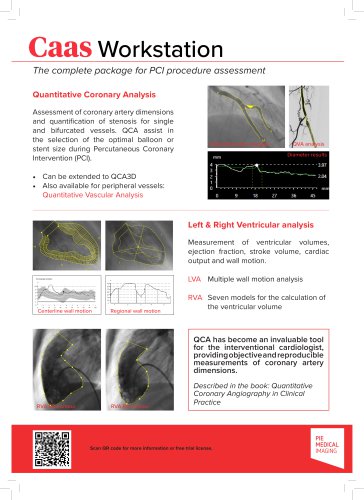

Archived catalogs
 3mensio Aortic Root
6 Pages
 3mensio Structural heart
6 Pages
 LAA
LAA6 Pages
 MR 4D Flow
6 Pages
 CAAS IntraVascular
6 Pages
- Analysis software
- Radiology software
- Visualization software
- Tablet computer software
- Tablet PC software
- Reporting software
- Windows software
- Diagnostic software
- Planning software
- Hospital software
- Automated software
- Treatment software
- Traceability software
- Capture software
- Software module
- Measurement software
- Import software
- Medical software on site
- Server-based software
- Printing software