


QCA 3D

QCA 3D
Two-dimensional Quantitative Coronary Analysis (QCA) has been a standard method for determining lesion length and stent size during percutaneous coronary interventions (PCI) for over 25 years. However, it has limitations such as foreshortening and out-of-plane magnification. CAAS QCA 3D by Pie Medical Imaging addresses these limitations by providing improved analysis of lesions with complex morphology.
Input Requirements
3D QCA requires two standard coronary angiograms with at least a 30-degree difference in rotation and angulation. The 3D reconstruction is calculated in real-time without user input for calibration, using information from DICOM angiograms.
Output and Benefits
- Stenotic Length & Stent Length: QCA 3D calculates the true three-dimensional geometric shape and vessel length, avoiding foreshortening. Validation studies show minimal difference from true lengths, aiding in stent decision-making.
- Cross-sectional Area & Stent Size: The system provides accurate calculations of minimum luminal area, correlating highly with intravascular ultrasound (IVUS) measurements. This offers a cost-efficient alternative for stent placement decisions.
- Optimal Projection: The program provides an optimal projection to adjust the C-arm position, reducing contrast use during interventions.
- Bifurcation Angle: QCA 3D accurately calculates bifurcation angles, overcoming under or overestimation issues in standard angiograms.
- True Carina Visualization: Combines two projections for optimal 3D reconstruction of bifurcation areas without vessel overlap.
- Co-registration with Other Modalities: Integrates with IVUS and OCT for precise location mapping in the coronary tree.
Conclusion
3D QCA supports decision-making in PCI procedures, potentially improving patient treatment. Validation studies confirm its accuracy and reproducibility, making it a leading 3D QCA software.
References
References include studies from Transcatheter Cardiovascular Therapeutics, EuroIntervention, and others, validating the technology's efficacy.
Catalog excerpts

CAAS QCA 3D Taking coronary quantification to the next level
Open the catalog to page 1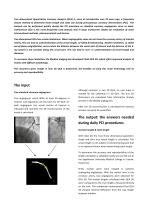
Two dimensional Quantitative Coronary Analysis (QCA) is, since its introduction over 25 years ago, a frequently chosen method to determine lesion length and stent size during percutaneous coronary interventions (PCI). The analysis can be performed quickly during the PCI procedure as standard coronary angiograms serve as input. Furthermore QCA is the most frequently used analysis tool in large multicenter studies for evaluation of novel interventional methods, pharmaceuticals and devices. Two dimensional QCA has certain limitations. When angiographic views do not show the coronary artery of interest...
Open the catalog to page 2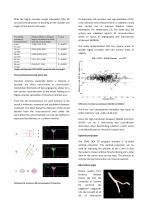
With the highly accurate length calculation QCA 3D can assist the physician in deciding on the number and length of the stents to be used. True length Median difference between P value (number of length calculated with CAAS measurements) QCA 3D and true length 5 mm -0.06 (-0.15, 0.03) P < 0.0001 (n=122) 10 mm 0.325 (0.04, 0.61) P < 0.0001 (n=126) 20 mm 0.285 (0.003, 0.57) P < 0.0001 (n=124) 25 mm 0.22 (-0.15, 0.58) P < 0.0001 (n=62) 40 mm 0.69 (0.07, 1.31) P < 0.0001 (n=64) Length calculated by CAAS QCA3D compared with true length To determine the accuracy and reproducibility of the cross-sectional...
Open the catalog to page 3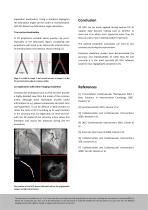
angulation parameters. Using a standard angiogram the bifurcation angles can be under or overestimated. QCA 3D allows true bifurcation angle calculation. True carina visualization In 2D projections possible vessel overlap can occur, especially at the bifurcated region. Combining two projections will result in an optimal 3D reconstruction of the bifurcation area without vessel overlap [2]. Conclusion 3D QCA can be easily applied during routine PCI to support daily decision making such as whether to stent and if so which stent should be used. Thus 3D QCA can play a role in optimal patient treatment....
Open the catalog to page 4
Solutions in Cardiovascular Analysis
Open the catalog to page 5All Pie Medical Imaging catalogs and technical brochures
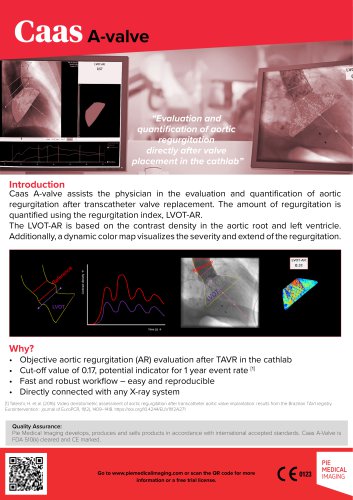 CAAS A-Valve brochure
1 Page
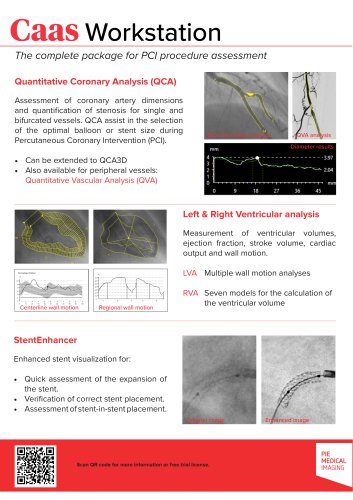 CAAS QVA
2 Pages
 CAAS QCA brochure
2 Pages
 CAAS LVA
2 Pages
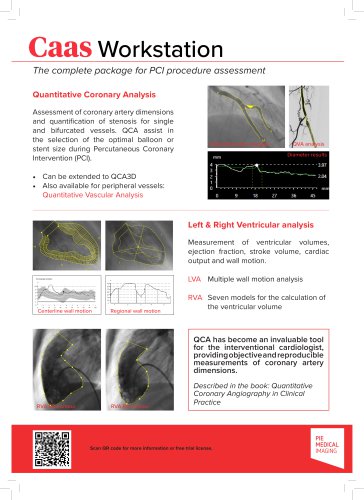
 CAAS Workstation
2 Pages
 RVA
RVA2 Pages
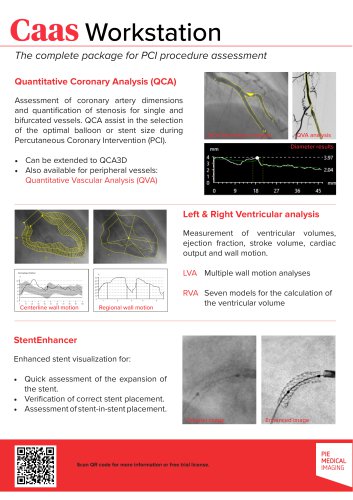 Stent Enhancer
2 Pages
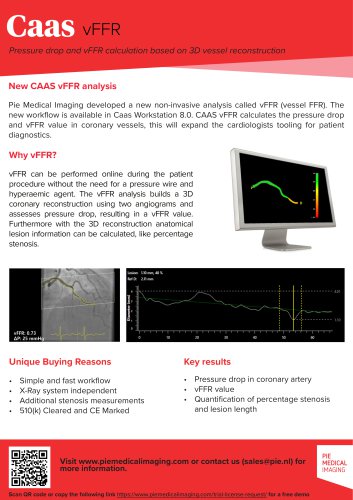 CAAS vFFR
2 Pages
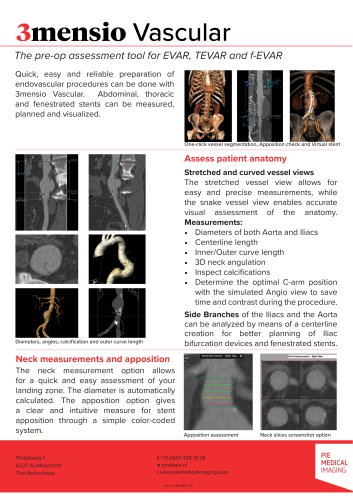 3mensio vascular
2 Pages
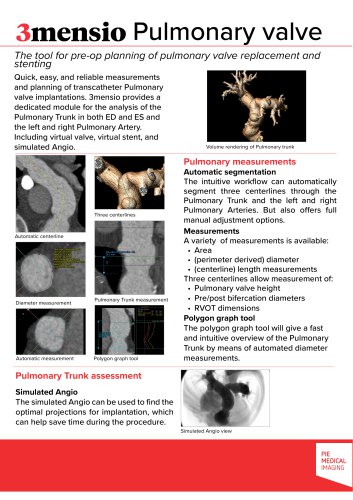 3mensio Pulmonary valve
2 Pages
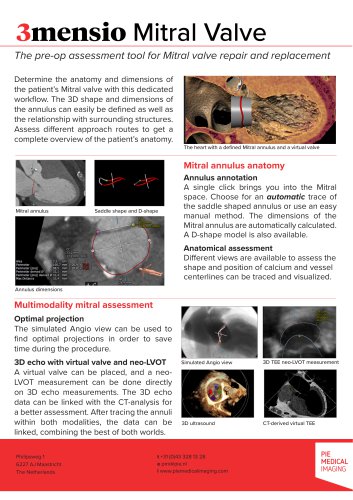 3mensio Mitral valve
2 Pages
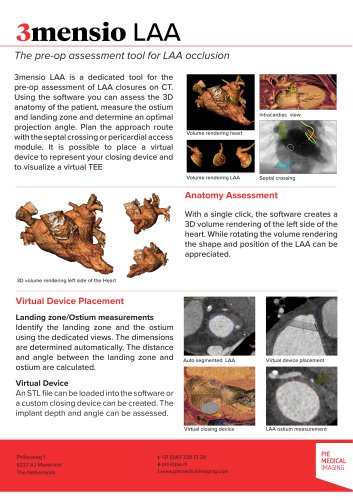 3mensio LAA
2 Pages
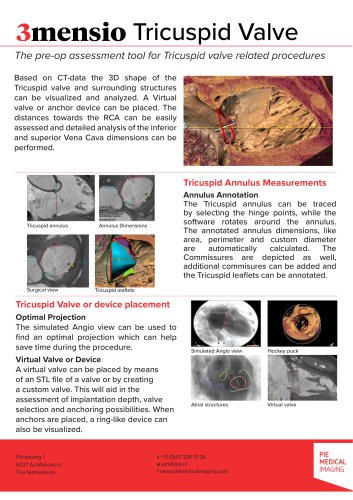 3mensio SH Tricuspid Valve
2 Pages
 3mensio Aortic valve
2 Pages
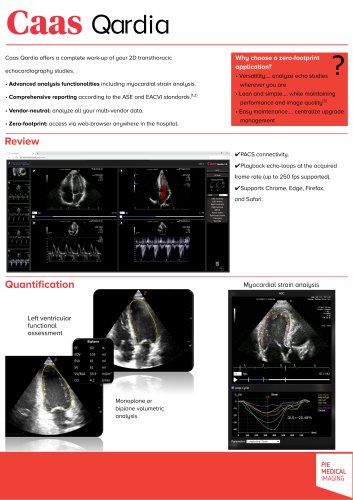 Caas Qardia
2 Pages
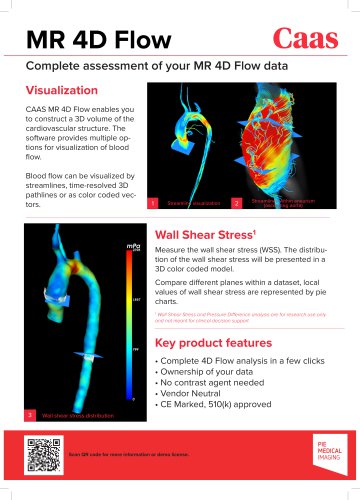 MR-4D-Flow
2 Pages
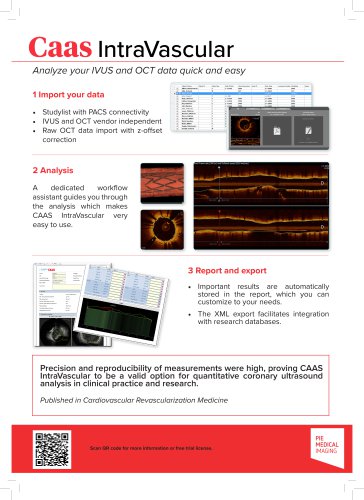 CAAS-IntraVascular
2 Pages
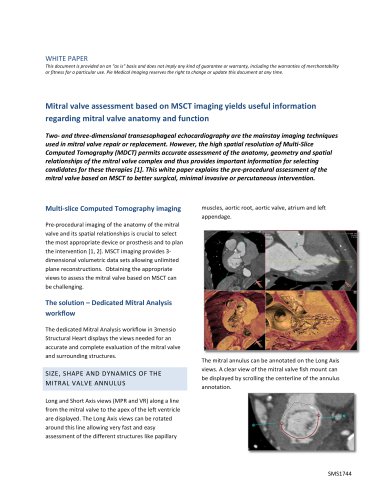 Mitral valve WHITE PAPER
3 Pages
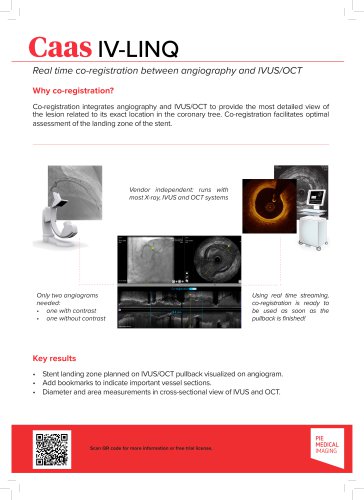 Caas IV-LINQ
2 Pages
 StentEnhancer
4 Pages
 MRV | MR Flow
6 Pages
 CAAS MRV
6 Pages
 CAAS QCA whitepaper
5 Pages

Archived catalogs
 3mensio Aortic Root
6 Pages
 3mensio Structural heart
6 Pages
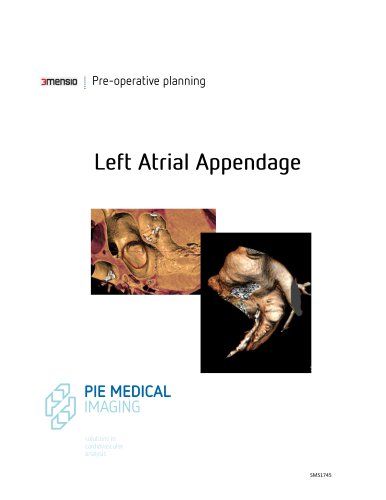
 LAA
LAA6 Pages
 MR 4D Flow
6 Pages
 CAAS IntraVascular
6 Pages
- Analysis software
- Radiology software
- Visualization software
- Tablet computer software
- Tablet PC software
- Reporting software
- Windows software
- Diagnostic software
- Planning software
- Hospital software
- Automated software
- Treatment software
- Traceability software
- Capture software
- Software module
- Measurement software
- Import software
- Medical software on site
- Server-based software
- Printing software