
- Catalogs
- Plastifil SA
- PLASCOAT PPA 571 ES


PLASCOAT PPA 571 ES

PLASCOAT PPA 571 ES
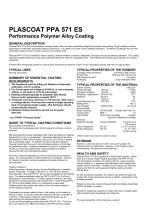
Plascoat PPA 571 ES is a thermoplastic coating powder designed for exterior applications on mild steel, galvanized steel, and aluminum. It is halogen-free, with low smoke and toxicity in combustion fumes. The coating is resistant to stress cracking, weather conditions, detergents, salt spray, and pollutants, maintaining excellent adhesion without a primer.
Common applications include fencing and fan guards.
- Metalwork must be grit blasted or chemically pretreated.
- For Corona guns, set voltage at 30-50 kV or amps to 10-20 microamps.
- Ensure metal temperature exceeds 150°C during heating.
- Coating thickness must be at least 170 microns.
- Regular adhesion checks are necessary.
Recommended pretreatment involves degreasing and removing mill scale and corrosion. For mild steel, grit blasting or phosphating is advised. Galvanized steel should be grit blasted or treated with a phosphate system. Aluminum requires degreasing, with chromate treatment recommended for maximum corrosion resistance. The heating schedule ranges from 160°C to 220°C for 5-40 minutes, depending on metal thickness.
- Coverage: 5.2m²/kg at 200 microns
- Particle Size: 95% less than 150 microns
- Bulk Density: 0.40 g/cm³
- Packaging: 20 kg boxes
- Specific Gravity: 0.96 g/cm³
- Tensile Strength: 14 MPa
- Elongation at Break: 800%
- Brittleness Temperature: -78°C
- Hardness: Shore A 95, Shore D 44
- Vicat Softening Point: 70°C
- Melting Point: 105°C
- Tear Strength: 22 N.mm
- Environmental Stress Cracking: >1000 hrs
- Toxicity Index: 1.8
- Dielectric Strength: 47.8 KV/mm at 370 microns
- Volume Resistivity: 3 x 10¹⁷ Ohm.cm
- Surface Resistivity: 8 x 10¹⁷ Ohm at 200 microns
Store in a clean, dry area at 10-25°C, away from sunlight. Use older stocks first.
Handle with care to avoid dust inhalation. The material can ignite if exposed to high temperatures. Refer to Plascoat Health and Safety Data Sheet HS504 for more information.
- Recommended Thickness: 170-300 microns
- Appearance: Smooth/Glossy
- Gloss: 70 (ISO 2813)
- Impact Strength: Various values depending on conditions
- Abrasion: 60 mg weight loss (ASTM D4060/84)
- Salt Spray Resistance: Minimal adhesion loss
- Chemical Resistance: Good for dilute acids, alkalis, and salts; poor for solvents
- Weathering: No significant change after 2000 hrs or 3 years
- Burning Characteristics: Not easily ignitable, Class 1 surface spread of flame
- Safe Working Temperature: 60°C max
Plascoat operates under ISO 9001:2000 quality management and offers a range of services including custom coating and equipment supply.
Catalog excerpts
PLASCOAT PPA 571 ES Performance Polymer Alloy Coating GENERAL DESCRIPTION Plascoat PPA 571 ES is a thermoplastic coating powder which has been specifically designed to provide a long lasting, tough coating for exterior applications to mild steel, galvanised steel and aluminium. It is based on an alloy of acid modified polyolefins. Therefore it is Halogen free and the combustion fumes are low in smoke and have a low toxicity index. Plascoat PPA 571 ES is resistant to stress cracking, adverse weather conditions, detergents, salt spray and typical airborne pollutants. The coating maintains excellent adhesion to the metal substrate without the need for a separate primer. The material also provides good abrasion and impact resistance. If PPA571ES oversprayed powder is to be recycled then blend a maximum of 25% of this oversprayed powder with 75% of virgin powder. TYPICAL USES TYPICAL PROPERTIES OF THE POWDER Coverage (100% efficiency) Particle Size Bulk Density (at rest)* Packaging SUMMARY OF ESSENTIAL COATING REQUIREMENTS 1. The metalwork must be either grit blasted or chemically pretreated prior to coating. * 2. For Corona guns set voltage at 30-50 kV, or use overspray setting, or set amps to 10 to 20 microamps. 3. Heating schedule typically as polyester (See below). Ensure metal temperature exceeds 150°C. * 4. Thickness must be a minimum of 170 microns. (See note 2 re voltage above). This may also require a longer spraying time or increased powder supply. This thickness should be periodically checked. 5. Adhesion checks should be carried out at regular intervals.* 5.2m 2/Kg at 200 microns 95% less than 150 microns 0.40 g/cm3 20 kg cardboard boxes TYPICAL PROPERTIES OF THE MATERIAL Specific Gravity* Tensile Strength Elongation at Break Brittleness Temperature Hardness Vicat Softening Point Melting Point Tear Strength Environmental Stress Cracking Toxicity Index Flammability ISO 527 ISO 527 ASTM D-746 Shore A Shore D ISO 306 ASTM D1938 ASTM D1693 Greater than 1000 hrs NES 7 1.8 UL94 3.2mm moulding Unrated (see also Properties of Coating) Electrical Dielectric Strength Recommended Pretreatment: The metal must be degreased and all mill scale and corrosion products removed. Volume Resistivity Surface Resistivity Mild steel should be solvent degreased then either grit blasted to Swedish Standard SA 2½ to 3 or phosphated. Galvanised steel should be either grit blasted at 0.3MPa (40 psi) using a fine grit (0.2 to 0.5mm) or treated with a phosphate system. To achieve maximum long term adhesion, Plascoat recommend the use of zinc phosphate systems on both steel and galvanised steel. If chemical pretreatment is used it is essential to remove any previously applied resin based pretreatment systems. Discuss this with your pretreatment supplier. *These values may vary from colour to colour GUIDE TO TYPICAL COATING CONDITIONS Aluminium should be degreased to remove lubricants and processing soaps. For most purposes no further treatment is necessary. However for maximum long term corrosion resistance chromate treatment is recommended. Coating Conditions: When the powder is applied using a Corona Discharge gun a negative polarity is required. A voltage of 30-50 kV or 10 to 20 micro-amps is recommended. Plascoat PPA 571 ES can also be applied by Tribocharge guns. The heating schedule should be 160°C to 220°C for 5-40 mins depending on metal thickness. To ensure optimum adhesion, the metal temperature during processing must exceed 150°C. Since Plascoat PPA 571 ES is a thermoplastic there is no crosslinking to take place. Therefore when the powder has melted to form a smooth coating no further heating is required. Overheating can cause craters to form in the coating, or the coating to reduce in gloss. It may also cause the coating to discolour in storage or in service. Thicknesses outside the recommended range may be detrimental to the properties of the coating. Do not cure thermosetting powder paints with PPA 571 ES. The fumes from such systems can affect the surface of the PPA 571 ES coatings. 47.8 KV/mm at 370 microns 3 x 10¹⁷ Ohm.cm 8 x 10¹⁷ Ohm at 200 microns STORAGE Stored in a clean dry area at 10-25°C and out of sunlight, the material should not deteriorate. However, in the interest of good housekeeping, old stocks should be used first. HEALTH AND SAFETY Plascoat PPA 571 ES is supplied as a finely divided powder. Whilst there are no known health hazards associated with PPA 571 ES, normal handling precautions for dealing with fine organic powders should be taken - i.e. excessive dust generation and inhaling of the powder should be avoided. Facilities may be required for removing excess dust from the working area during the coating of certain difficult items. As with all polymeric powders, the material can ignite if brought into contact with a high temperature source or ignition - particularly in the fluidised condition. Reference should be made to Plascoat Health and Safety Data Sheet HS504, available on request. Should the coating be required for contact with food or potable water, further details should be obtained from Plascoat. For typical properties of the coating see ove
Open the catalog to page 1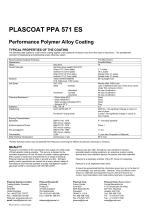
PLASCOAT PPA 571 ES Performance Polymer Alloy Coating TYPICAL PROPERTIES OF THE COATING The following data applies to a 200 micron coating applied under standard conditions onto 3mm thick steel or aluminium. The pretreatment consisted of degreasing and gritblasting unless otherwise stated. Recommended Coating Thickness Appearance Gloss Impact Strength Abrasion Salt Spray ISO 2813 Gardner (drop weight) ISO 6272 Direct 23°C (3mm plate) Indirect 0°C (3mm plate) Direct 23°C (0.7mm plate) Indirect 0°C (0.7mm plate) Taber ASTM D4060/84 H18, 500g load, 1000 cycles ISO 7253 Steel - Scribed - Unscribed...
Open the catalog to page 2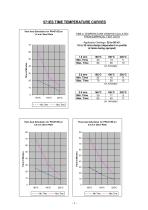
571ES TIME TEMPERATURE CURVES Post-heat Schedules for PPA571ES on 1.5 m m Steel Plate TIME & TEMPERATURE GRAPHS COLLATED FROM EMPIRICAL TEST DATA Application Settings: 30 to 50 kV, 10 to 30 microAmps (dependent on profile of items being sprayed) Post-heat Schedules for PPA571ES on 2.0 m m Steel Plate Post-heat Schedules for PPA571ES on 3.0 m m Steel Plate
Open the catalog to page 3All Plastifil SA catalogs and technical brochures
 Rilsan PA 11
7 Pages
 COMPANY PROFILE
14 Pages
 QUALITY POLICY
1 Page
