
- Catalogs
- Plastisud SAS
- Le + Plastisud


Le + Plastisud
Le + Plastisud
The article discusses innovations in thin-walled packaging, focusing on the development of injection-compression moulding technology. This technology aims to produce lighter packaging solutions, responding to market demands for cost-effective and high-performance packaging.
Technological Innovations
Coveris, in collaboration with Unilever and Plastisud, developed a new injection-compression moulding technology. This system uses a 4+4 stack mould with integrated in-mould label (IML) decoration, producing lightweight 500g Eurotubs. The technology allows for up to 20% weight savings by reducing wall thickness while maintaining mechanical properties.
Development and Implementation
The development began in 2011, with the first industrial system launched in early 2016. The system was tested at Coveris's Centre of Excellence in Germany before commercial production. The technology is compatible with various machine types, including hydraulic, toggle, and full-electric machines.
Market Impact and Future Developments
Yves Caunègre of Coveris anticipates widespread success for the technology. The company is exploring further lightweight packaging solutions and has been using Trexel’s Mucell technology since 2008. The injection-compression process offers significant weight reductions and cost advantages, allowing the use of smaller machines and reducing clamping force requirements.
Demonstrations and Trials
A demonstration system was showcased at Fakuma 2015 and is being used for market trials. The technology introduces no additional limitations on part geometry and can produce parts with wall thicknesses as low as 0.4 mm.
Conclusion
Coveris is expanding the application of injection-compression technology to lids, offering advantages over traditional thermoforming methods. The technology promises significant cost savings and improved product quality, positioning it as a competitive solution in the packaging industry.
Catalog excerpts
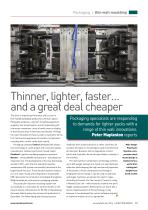
Packaging | thin wall moulding Thinner, lighter, faster… and a great deal cheaper The drive to improve performance and cut cost in thin-walled packaging production continues apace. Packaging producers, injection moulding equipment suppliers and mould makers are all responding with numerous innovations, many of which were on display at the Fakuma show in Germany last October. Perhaps the most innovative of these is what is claimed to be the first commercial application of injection-compression Packaging specialists are responding to demands for lighter packs with a range of thin wall innovations. Peter Mapleston reports moulding with a multi-cavity stack mould. Packaging company Coveris developed the produc- materials from Coveris divisions in other countries, for Main image: tion technology in a joint project with consumer goods instance the 40µm in-mould labels used in the EU Food manufacturer Unilever and French mould maker & Consumer Business Unit in Angoulème, France Plastisud. Injection moulding equipment producer (which are claimed to be the thinnest labels currently in Netstal – a KraussMaffei Group brand - also played an important role. The development of the new technology injection-compression stack mould design is The new injection-compression technology achieves started in 2011, with the first industrial injection up to 20% weight savings as a result of a wall thickness world first, compression IML system successfully launched at the reduction while keeping the high mechanical properties cutting part beginning of this year. The production system compris- of the product. As the compression technology is es a 4+4 stack mould with integrated in-mould label integrated into the mould, it can be used on hydraulic (IML) decoration for production of probably the lightest and toggle machines, as well as full-electric types, 500g Eurotubs yet, primarily for packaging spreads. according to Coveris. For the moment, Coveris is using The production injection moulding system ran a Netstal Elion unit – which features a hybrid five-point successfully on a trial basis for several months in the toggle clamping system. Netstal point out that it has a Coveris Centre of Excellence for IM-IML in Ravensburg, lead in implementation of the technology, if only Germany, before going into commercial production in because it has developed the control software required December. The Ravensburg plant also processes to make the mould run on its equipment.
Open the catalog to page 1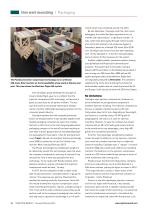
thin wall moulding | Packaging mould, which was completed around mid-2015. By late November, Caunègre said that, after some debugging, the mould had been operational for six months and had produced “a significant number” of tubs, which have been going through market acceptance trials with Unilever. Full production began in December, based on a Netstal 320-tonne Elion 3200 unit. Caunègre says Coveris has also been speaking with “all the big players” in the thin-wall packaging arena to attract further business for the system. Another, slightly smaller, production system is being used by Netstal...
Open the catalog to page 2