- Catalogs
- Podartis Srl Unipersonale
- Effect of Obesity on Knee and Ankle Biomechanicsduring Walking

Effect of Obesity on Knee and Ankle Biomechanicsduring Walking
Effect of Obesity on Knee and Ankle Biomechanicsduring Walking
Obesity is associated with an increased risk of musculoskeletal disorders, such as osteoarthritis, due to the additional forces exerted on weight-bearing joints during activities like walking. This study aims to analyze the impact of obesity on knee and ankle biomechanics during walking by comparing gait in obese individuals to that of normal-weight individuals.
Methods
The study included 32 young obese individuals and 16 normal-weight controls, categorized into three BMI classes. Gait analysis was performed using a motion capture system and force platforms to assess kinematic and kinetic parameters.
Results
Significant differences in knee and ankle mechanics were observed in obese individuals compared to controls. Key findings include:
- Reduced knee flexion and increased knee ab-adduction angle throughout the gait cycle.
- Abnormal knee flex-extension moment.
- Reduced ankle range of motion and lower peak plantarflexor moment and power during terminal stance.
Discussion
The study highlights the mechanical impact of obesity on gait, with altered knee and ankle biomechanics in obese individuals. These findings emphasize the importance of addressing obesity to reduce the risk of joint damage and osteoarthritis.
Conclusion
Obesity significantly affects knee and ankle biomechanics during walking, potentially increasing the risk of osteoarthritis. Further research is needed to explore interventions that can mitigate these biomechanical changes.
Key Findings
- Knee and Ankle Kinematics: Obese individuals showed reduced dynamic joint excursion and plantarflexion moment compared to controls, with higher knee adduction angles and extra knee rotation at initial contact.
- Kinetic Parameters: Differences in kinetic parameters were observed between obesity classes, with higher values in the most obese class, though not significant when normalized to body weight.
- Gait Patterns: Obese individuals walked with reduced knee flexion during early stance, possibly due to knee extensor weakness, and increased knee adduction and step width, potentially leading to osteoarthritis.
- Ankle Joint: Reduced plantarflexion and ankle range of motion were noted, likely due to plantarflexor muscle weakness and reduced physical activity.
Limitations
The study's limitations include a small sample size, particularly in obesity Class 1, and potential variability due to combining male and female subjects. Further research is needed to explore gender-specific effects and the impact of different obesity degrees on gait.
Conclusions
Targeted orthotics could alleviate pain and improve function in obese individuals, though their effectiveness may be limited by the high forces exerted on joints and orthotics due to excessive body weight.
Author Contributions and Acknowledgments
The study was conducted by a team of researchers who contributed to various aspects, including conceptualization, methodology, and data analysis. The authors acknowledge the contributions of several individuals in data processing.
Ethical Considerations
The study was approved by the Institutional Ethics Committee, and informed consent was obtained from all participants.
Catalog excerpts
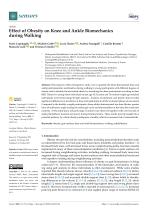
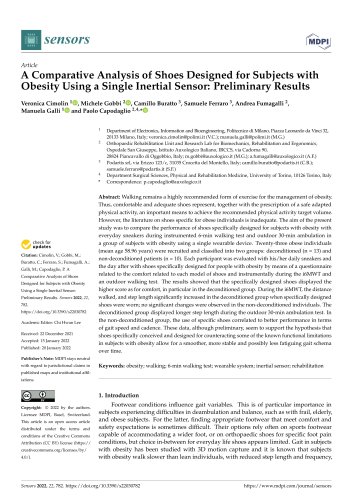
sensors Article Effect of Obesity on Knee and Ankle Biomechanics during Walking Paolo Capodaglio 1,2, * , Michele Gobbi 1 , Lucia Donno 3 , Andrea Fumagalli 1 , Camillo Buratto 4 , Manuela Galli 3 and Veronica Cimolin 3 1 Citation: Capodaglio, P.; Gobbi, M.; Donno, L.; Fumagalli, A.; Buratto, C.; Galli, M.; Cimolin, V. Effect of Obesity on Knee and Ankle Biomechanics during Walking. Sensors 2021, 21, 7114. https://doi.org/10.3390/ s21217114 Orthopaedic Rehabilitation Unit and Clinical Lab for Gait Analysis and Posture, Ospedale San Giuseppe, Istituto Auxologico Italiano, IRCCS, Via Cadorna 90, 28824 Verbania, Italy; [email protected] (M.G.); [email protected] (A.F.) Department of Surgical Sciences, Physical and Rehabilitation Medicine, University of Torino, Via Giuseppe Verdi, 8, 10124 Torino, Italy Department of Electronics, Information and Bioengineering, Politecnico di Milano, Piazza Leonardo da Vinci 32, 20133 Milano, Italy; [email protected] (L.D.); [email protected] (M.G.); [email protected] (V.C.) Podartis srl, Via Erizzo 123/c, 31035 Crocetta del Montello, Italy; [email protected] Correspondence: [email protected] Abstract: The purpose of this retrospective study was to quantify the three-dimensional knee and ankle joint kinematics and kinetics during walking in young participants with different degrees of obesity and to identify the associated effects by stratifying the obese participants according to their BMI. Thirty-two young obese individuals (mean age 30.32 years) and 16 normal-weight age-matched individuals were tested using 3D gait analysis. Analysis of kinematic and kinetic data revealed significant differences in mechanics at knee and ankle joints in all the evaluated planes of movement. Compared to the healthy-weight participants, obese adults demonstrated less knee flexion, greater knee ab-adduction angle during the entire gait cycle and abnormalities at the knee flex-extension moment. At the ankle joint, reduced range of motion was observed together with a lower peak of ankle plantarflexor moment and power during terminal stance. These results provide insight into a potential pathway by which obesity predisposes a healthy adult for increased risk of osteoarthritis. Keywords: obesity; gait analysis; knee and ankle biomechanics; walking; rehabilitation Academic Editors: Alberto Brunete and Eline van der Kruk Received: 27 September 2021 Accepted: 22 October 2021 Published: 27 October 2021 Publisher’s Note: MDPI stays neutral with regard to jurisdictional claims in published maps and institutional affiliations. Copyright: © 2021 by the authors. Licensee MDPI, Basel, Switzerland. This article is an open access article distributed under the terms and conditions of the Creative Commons Attribution (CC BY) license (https:// creativecommons.org/licenses/by/ 1. Introduction Obesity elevates the risk for comorbidities, including musculoskeletal disorders such as osteoarthritis (OA), low back pain, soft tissue injury, tendinitis and plantar fasciitis [1–3]. Increased body mass, with increased forces across weight-bearing joints, has been causally implicated in many of these musculoskeletal conditions [4]. Forces on joint surfaces are increased during weightbearing activities, including walking. Increased body mass may augment risk of damage and injury to joint surfaces and other musculoskeletal structures with repetitive loading during weightbearing activities. A deeper understanding about influence of obesity on gait biomechanics is being achieved [5–8]. However, the characterization of the kinematics and kinetics of walking using gait analysis in obese individuals is often inconsistent. While some studies reported that obesity induces slower velocity [3,6,9,10], reduced cadence [3,9,10], diminished stride length and single support time [2,3,6,10], lower swing time [10,11], increased stance time [6,10,11] and increased double support time [6,12], others failed in identifying differences as for velocity [2,11–14], cadence [11,12,15], step length [9,12,14], stride length [15], stance time [11], single and double leg support time and swing phase duration [9]. However, increased step width is reported in most papers [2,3,12,14,15]. Increased peak hip joint flexion [16], extension [10] and sagittal plane range of motion (ROM) [5]
Open the catalog to page 1
have been found. Conversely, no changes in hip joint sagittal plane ROM have been reported [16]. Finally, some papers describe an increased hip adduction during terminal stance and pre-swing and higher knee adduction in stance and swing [6,16] together with higher ankle plantarflexion and lower knee flexion [10] as compared to lean counterparts. It appears that investigations on the effects of obesity on walking using gait analysis have generated inconsistent results so far. Only few studies have reported frontal and transversal plane biomechanics of the knee joint at specific points during the...
Open the catalog to page 2
capture system (460 VICON, Oxford Metrics Ltd., Oxford, U.K.) with a sampling rate of 100 Hz and two force platforms (Kistler, CH). For a complete assessment, two TV camera video systems for videorecording were synchronized with the optoelectronic system and the platforms. On each subject, a preliminary collection of the following anthropometric data was performed: body mass, height, anterior superior iliac spines (ASIS) distance (pelvis width), greater trochanter-ipsilateral ASIS distance (pelvic height), ASIS-ipsilateral medial malleolus distance (leg length), medial-lateral femoral condyles...
Open the catalog to page 3
Collected data were thus exported by Vicon Polygon Application, Oxford, U.K., version 2.4, and processed using the dedicated software Vicon Polygon Application, Oxford, U.K., version 1.10.433.0, to assess specific kinematic and kinetic parameters with a focus on knee and ankle joints. — Knee flexion angle (KFE-IC index), knee rotation angle on the transverse plane (KRot-IC index) and ankle dorsiflexion angle (ADP-IC index) at Initial Contact; — Maximum knee ab-adduction in stance (MaxKAASt index) and in swing phase (MaxKAASw index); — Maximum knee rotation angle on the transverse plane (MaxKRot...
Open the catalog to page 4All Podartis Srl Unipersonale catalogs and technical brochures
 Clinical Study
2 Pages
 PODARTIS
2 Pages