
- Catalogs
- Podartis Srl Unipersonale
- Pedobarographic and kinematic analysis

Pedobarographic and kinematic analysis
Pedobarographic and kinematic analysis
Forefoot offloading shoes (FOS) are orthopedic footwear designed to protect the forefoot post-surgery or during conservative treatments. This study compares the effects of a traditional half-shoe and a double-rocker full-outsole shoe against a control shoe, focusing on pedobarographic, kinematic, and kinetic parameters.
Methods
Ten healthy female participants walked in three footwear conditions: control/half-shoe, control/full-outsole, and control/control. Gait analysis and plantar pressure measurements were conducted using a sensor insole system, with statistical analyses assessing differences in kinematic and kinetic parameters.
Results
The half-shoe resulted in the slowest walking speed and shortest stride length, significantly reducing forefoot plantar load compared to the full-outsole shoe and control. The full-outsole shoe showed the highest mean pressure at the rearfoot, with kinematic analysis revealing more natural sagittal-plane ankle kinematics compared to the control.
Conclusions
The half-shoe effectively reduces forefoot load but alters gait parameters and kinematics at proximal lower limb joints. The full-outsole shoe maintains more natural joint kinematics but is less effective in load reduction.
Background
FOS are recommended post-surgery or for conservative treatment of forefoot conditions. The half-shoe design reduces forefoot pressure but may cause discomfort and instability. Various FOS designs have been assessed for their effectiveness in offloading and comfort.
Pedobarographic Measurements
Pressure was measured using Pedar sensor insoles. The half-shoe showed lower mean and peak pressures at the forefoot compared to control, while the full-outsole shoe had the highest rearfoot pressure.
Kinematic and Kinetic Measurements
Joint rotations and moments were calculated using a motion capture system. The half-shoe showed significant alterations in kinematics, particularly in the third rocker of stance.
Statistical Analysis
Differences in pedobarographic, kinematic, and kinetic parameters were assessed using non-parametric tests. The half-shoe showed significant differences from control in most parameters.
Discussion
The study highlights the trade-offs between effective offloading and maintaining natural gait patterns. The half-shoe is more effective in load reduction but at the cost of altered gait dynamics, while the full-outsole shoe offers a balance between offloading and natural kinematics.
Pedobarographic Analysis
The half-shoe significantly reduced forefoot pressure compared to the control shoe, with increased force at the midfoot. The full-outsole shoe did not show significant differences in pedobarographic parameters compared to the control, except for increased rearfoot pressure.
Kinematic Analysis
The full-outsole shoe resulted in less alteration of proximal lower limb joints compared to the half-shoe. The half-shoe showed significant changes in pelvis motion and reduced hip extension and knee ROM.
Kinetic Analysis
Both shoe designs showed strong correlation with control in terms of external moments at lower limb joints. However, the half-shoe exhibited a significantly lower peak ankle flexion moment in late stance.
Limitations
The study's limitations include a small sample size and potential measurement bias due to marker placement. Further research is needed to generalize findings to older populations or patients undergoing forefoot surgery.
Conclusion
The document provides insights into the effectiveness of different footwear in managing plantar pressure and kinematic parameters, with a focus on diabetic foot care and post-operative conditions.
Catalog excerpts
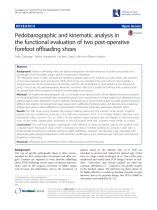
Caravaggi et al. Journal of Foot and Ankle Research (2015) 8:59 DOI 10.1186/s13047-015-0116-3 JOURNAL OF FOOT AND ANKLE RESEARCH Open Access Pedobarographic and kinematic analysis in the functional evaluation of two post-operative forefoot offloading shoes Paolo Caravaggi*, Alessia Giangrande, Lisa Berti, Giada Lullini and Alberto Leardini Abstract Background: Forefoot offloading shoes are special orthopaedic footwear designed to protect and unload the injured part of the foot after surgery and for conservative treatments. The offloading action is often achieved by transferring plantar load to the rearfoot via rocker shoes with reduced contact area between shoe and ground. While these shoes are intended to be worn only for short periods, a compromise must be found between functionality and the risk of alterations in gait patterns at the lower limb joints. In this study, the pedobarographic, kinematic and kinetic effects of a traditional half-shoe and a double-rocker full-outsole shoe were compared to those of a comfortable shoe (control). Methods: Ten healthy female participants (28.2 ± 10.0 years) were asked to walk in three different footwear conditions for the left/right foot: control/half-shoe, control/full-outsole, and control/control. Full gait analysis was obtained in three walking trials for each participant in each condition. Simultaneously a sensor insole system recorded plantar pressure in different foot regions. Normalized root-mean-square error, coefficient of determination, and frame-by-frame statistical analysis were used to assess differences in time-histories of kinematic and kinetic parameters between shoes. Results: The half -shoe group showed the slowest walking speed and the shortest stride length. Forefoot plantar load was significantly reduced in the half-shoe (maximum force as % of Body Weight: half-shoe = 62.1; full-outsole = 86.9; control = 93.5; p < 0.001). At the rearfoot, mean pressure was the highest in the full-outsole shoe. At the ankle, sagittal-plane kinematics in the full-outsole shoe had a pattern more similar to control. Conclusions: The half-shoe appears significantly more effective in reducing plantar load at the forefoot than a double-rocker full-outsole shoe, which is designed to reduce forefoot loading by using an insole with a thicker profile anteriorly as to maintain the foot in slight dorsiflexion. However, the half-shoe is also associated with altered gait spatio-temporal parameters, more kinematic modifications at the proximal lower limb joints and reduced propulsion in late stance. Keywords: Offloading shoes, Kinematics, Kinetics, Plantar pressure, Lower limb joints Background The use of specific orthopaedic shoes is often recommended for foot conservative treatments and after surgery. Patients are required to wear forefoot offloading shoes (FOS) following several types of forefoot interventions, such as the surgical correction of hallux valgus and of lesser toe deformities, and in the treatment of * Correspondence: [email protected] Movement Analysis Laboratory and Functional-Clinical Evaluation of Prostheses, Istituto Ortopedico Rizzoli, Via di Barbiano 1/10, 40136 Bologna, Italy plantar ulcers in the diabetic foot [1–3]. FOS are intended to protect and unload the injured part of the foot via a large variety of designs [4–6]. One of the most traditional and widely-used FOS design, known as halfshoe - “talus-shoe” and “reverse camber” are other less common definitions [7] - features a low-profile outsole in the forefoot region. The half-shoe has been shown to be highly effective in reducing forefoot pressure in gait; however, due to its peculiar design, this FOS is liable to discomfort and instability [8–12]. © 2015 Caravaggi et al. Open Access This article is distributed under the terms of the Creative Commons Attribution 4.0 International License (http://creativecommons.org/licenses/by/4.0/), which permits unrestricted use, distribution, and reproduction in any medium, provided you give appropriate credit to the original author(s) and the source, provide a link to the Creative Commons license, and indicate if changes were made. The Creative Commons Public Domain Dedication waiver (http://creativecommons.org/publicdomain/zero/1.0/) applies to the data made available in this article, unless othe
Open the catalog to page 1
Caravaggi et al. Journal of Foot and Ankle Research (2015) 8:59 While several shoe designs for forefoot offloading have been proposed to address these issues, only few have been assessed thoroughly by established functional analysis before being introduced in the market. A FOS featuring a short-outsole design has proved to be extremely effective in reducing forefoot pressure when compared to the half-shoe, in either appropriate and inappropriate use – i.e. while attempting to put weight on the forefoot [8]. However the participants recruited in the study reported a more comfortable walk when...
Open the catalog to page 2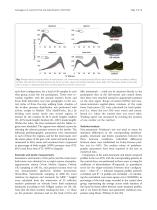
Caravaggi et al. Journal of Foot and Ankle Research (2015) 8:59 Fig. 1 Region-based temporal profiles of peak pressure. Left, time-histories of peak pressure (kPa) for each shoe condition at rearfoot, midfoot, forefoot and total foot. Temporal patterns are shown as mean values and standard deviation bands. Right, the three shoes tested in the study (top to bottom): a traditional half-shoe, the full-outsole shoe and the control shoe each shoe configuration, for a total of 30 samples in each shoe group across the ten participants. These were recorded, together with the ground reaction forces and...
Open the catalog to page 3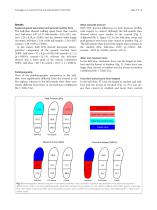
Caravaggi et al. Journal of Foot and Ankle Research (2015) 8:59 Mean and peak pressure Spatio-temporal parameters and ground reaction force Both FOS showed differences in peak pressure profiles with respect to control, although the full-outsole shoe showed values more similar to the control (Fig. 1, Additional file 2: Figure S1). In the half-shoe, mean and peak pressure were lower than control at forefoot (Fig. 2). The full-outsole shoe showed the largest mean pressure in the rearfoot (kPa, half-shoe = 102.9 (p = 0.021); fulloutsole = 120.3 (p = 0.044); control = 101.1). The half-shoe showed...
Open the catalog to page 4All Podartis Srl Unipersonale catalogs and technical brochures
 PODARTIS
2 Pages