PODARTIS
PODARTIS
The study aimed to evaluate the offloading efficacy of two forefoot offloading shoes, WPS® half shoe Podartis® and TD® Podartis®, compared to normal shoes in diabetic patients. It also analyzed the transfer of load in the contralateral foot and patient comfort.
Thirteen diabetic patients with forefoot lesions participated. A sensor insole system (Pedar system, Novel) was used to measure plantar pressure during three walking tests: 1) both feet in standard shoes, 2) ulcerated foot in WPS® half shoe, 3) ulcerated foot in TD® shoe with ZERO® insole. The study evaluated plantar pressure peaks, mean pressure in the contralateral foot, and comfort using a visual analogue scale.
The WPS® shoe significantly reduced forefoot pressure by 60% compared to normal shoes. The TD® shoe with ZERO® insole reduced pressure peaks by 47%. No significant difference was found between WPS® and TD® in pressure reduction, but TD® provided significantly higher walking comfort.
Both WPS® and TD® shoes effectively offload forefoot lesions, significantly reducing peak pressure without major load transfer to the contralateral foot. TD® shoes offered higher comfort, likely due to reduced postural discrepancy.
A separate study compared WPS® talus and TD® shoes in 20 female patients post-metatarsophalangeal osteotomy. The TD® shoe allowed a gait pattern closer to natural walking, reducing step pattern alteration risks. The TD® shoe with ZERO® insole is recommended for diabetic individuals, seniors, and those with movement deficits.
Catalog excerpts
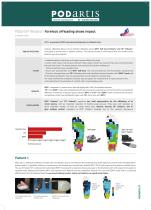
PODartis® Research: Forefoot offloading shoes impact Dr. Roberto Da Ros 2015 - presented at ISDF International Symposium on Diabetic Foot Evaluate offloading efficacy of two forefoot offloading shoes, WPS® half shoe Podartis® and TD® Podartis®, com-pared to normal shoe in diabetic patients. The transfer of load in contro-lateral foot and comfort of the patients were also analysed . 13 diabetic patients with lesions on forefoot were enrolled in the study. A sensor insole system with pressure detector (Pedar system, Novel) was used and they were inserted between foot and shoe insole. The plantar pressure was evaluated during three walking test - First test: both feet wore a standard shoe - Second test: ulcerated foot wore WPS® half shoe; the non-ulcerated foot wore the patient’s standard shoe - Third test: ulcerated foot wore TD® (offloading shoe with rigid biomechanical outsole) with ZERO® insole with 8° of forefoot dorsiflection; the non-ulcerated foot wore the patient’s standard shoe. The study involved the evaluation of plantar pressure peaks, the measurement of mean pressure in the contro-lateral foot, the evaluation of comfort with a visual analogue scale. WPS®, compared to a normal shoe, reduced significantly ( 60% ) the forefoot pressure. TD® with ZERO® insole reduced significantly the pressure peaks compared to a normal shoe (47%). No significant difference in reduction of pressure peaks between WPS® and TD® with ZERO® insole was found, but the perceived walking comfort was significantly higher with TD® rather than with WPS®. WPS® Podartis® and TD® Podartis® represent two valid opportunities for the offloading of forefoot lesions, with an important reduction of forefoot peak pressure. They were well tolerated without important transfer of load on contra lateral foot. Patients wearing TD® Podartis® felt higher walking comfort compared to WPS® Podartis® probably due to less postural discrepancy. Standard shoe WITH WPS® WITH TD® AND ZERO® INSOLE Forefoot pressure Patient 1 Male, age 77, affected by diabetes and with open neuropathic ulcer on the 2ND and 3th metatarsal head of the right foot, covered with a bandage. Minor balance deficit. A significant reduction of pressures on the forefoot was recorded with Podartis WPS® (43%) with respect to the patient’s standard shoes. The use of Podartis TD® combined with customized ZERO® insole lead to a reduction of pressure peaks on the forefoot by 26% with respect to the patient’s standard shoes. Walking with Podartis WPS® was reported to be difficult and not comfortable. Podartis TD® used with ZERO® insole with a customized offload under the 3rd metatarsal head the perceived walking comfort, safety and stability was significantly higher. 32 27 70 85 Patient walking with Podartis WPS® The patient before the treatment The patient wearing Podartis TD® ZERO® Insole with local offloading Patient walki
Open the catalog to page 1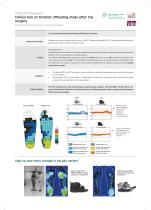
PODartis® Research: Clinical test on forefoot offloading shoes after the surgery. (IOR, Laboratory of Movement Analysis, Dir. Prof. Giannini, Bologna) 2014: updated and presented during ESM Boston Congress Compare two types of post-surgery shoes. The WPS® Podartis talus and the TD® Podartis with biomechanical rigid outsole with the “ZERO®” 8° talism insole Nr. of patients: 20 female patients who underwent metatarsophalangeal osteotomy for hallux valgus deformity were analyzed together with a control group of healthy patients. Two different offloading shoe styles were compared: WPS® talus shoe...
Open the catalog to page 2