
- Catalogs
- Point Implant
- POINT IMPLANT SYSTEM 2024-2025 PRODUCT CATALOG

POINT IMPLANT SYSTEM 2024-2025 PRODUCT CATALOG
POINT IMPLANT SYSTEM 2024-2025 PRODUCT CATALOG
The document is a product catalog for the Point Implant System, focusing on their UV Implants and related technologies for 2024-2025. It highlights the company's dedication to innovation and its global reputation as a leading implant company.
Point Implant has a history of advancements in medical imaging and dental solutions, including electronic charts and digital imaging devices. The company has expanded through branch offices and mergers to enhance its product offerings.
- UV Implants: These implants use UV light to enhance surface properties, improving blood activation and osseointegration. The UV Active system removes hydrocarbons and alters surface charges to increase blood wettability.
- Point UV Activator: A device that uses UV light to improve organic matter adhesion on implant surfaces, enhancing hydrophilicity without harmful ozone production.
- Photocatalytic UV Treatment: This patented technology increases osseointegration rates by removing surface hydrocarbons and restoring surface charges, resulting in a super-hydrophilic surface.
- Osseointegration: UV implants show a 98% osseointegration rate, compared to 50-65% for conventional implants, due to enhanced cell activity and surface properties.
- Tapered Form: The implants have a tapered structure for initial stability and reduced osseointegration periods.
- S.L.A Surface: This surface treatment maximizes initial fixation and minimizes bone pressure, enhancing stability and reducing fracture risk.
The company has obtained certifications including CE, ISO 13485, FDA, and NMPA for its dental implants.
Point Implant System's catalog showcases advanced UV implant technology, emphasizing improved osseointegration, stability, and safety, positioning the company as a leader in the dental implant industry.
The document outlines the design features of a UV-treated dental implant system, including reduced fracture risk, thread pitch minimizing bone pressure, and a root form design enhancing initial fixation and reducing nerve blockage risks. The system features a tapered form for stability and a conical seal connection for improved soft tissue health.
The document highlights the world's first sealed photocatalytic treatment technology, enhancing titanium surface hydrophilicity, improving osseointegration and blood interaction. UV treatment transforms surfaces to superhydrophilic, significantly increasing bone-to-implant contact (BIC) and osseointegration rate.
UV implants demonstrate superior bioactivity, increasing secondary stability and eliminating the stability dip common in conventional implants. They achieve osseointegration in 3 weeks, allowing early prosthetic loading within 2 weeks of placement, with a 98% osseointegration rate.
The Point NAVI system offers a digital navigation guide for precise implant placement, reducing pain and recovery time through incision-free surgery, allowing for one-day implants.
Several clinical case studies demonstrate the effectiveness of UV implants, showing high survival rates, excellent initial stability, and minimal bone resorption over six years. The Point NAVI system is detailed for accurate implant positioning in challenging cases.
The UV implant system, with advanced surface treatment and digital navigation capabilities, offers significant improvements in implant stability, osseointegration, and patient recovery times, making it a reliable choice for dental implant procedures.
- Case #1: Early loading with an acrylic resin temporary tooth showed significant stability increase within two weeks, with final restoration after seven weeks.
- Case #2: A 52-year-old male with a maxillary sinus graft showed stable implant integration despite chronic sinusitis, with final restorations completed three months post-placement.
- Case #3: An 83-year-old female with mandibular posterior implants showed stable healing, with final prosthesis completed after two months.
- Case #4: A 77-year-old female with loose mandibular dentures received implants with early loading, and final prosthesis completed four weeks post-placement.
The document details implant fixtures, including SMⅡ UV Pin Type and SLA Fixtures, with recommended mounting torques and design features for optimal stability and immediate loading capabilities. Specifications for abutments, impression copings, and other components are included.
- Drill Insertion: Insert the drill into the extension and press until it clicks. Tighten by turning. Code: PDE2300
- Parallel Pin: Used to check drilling angle after initial drilling. Path check available after Ø 2.2 and Ø 3.0 drilling. Codes: OPP4000, OPP5000
- Torque Wrench: Adjusts implant placement or tightens components with a constant torque. Maximum torque: 40 Ncm. Code: RWS
- Torque Extension: Extends the length of the Torque Ratchet tool by 10mm. Maximum recommended torque: 40 Ncm. Code: OSTE
- Point NaVi KIT: Includes various drills and drivers for guided implantation. Codes: AGTP_LEDT, AGPD_LEDT, etc.
- Tissue Punch: Used for flapless procedures and bone leveling. Marked at 1.5mm intervals for depth adjustment.
- Point Drill: Forms initial hole in bone, recommended RPM: 800. Not for use on sharp ridges.
- Tube Drill: Prevents slipping on sharp ridges, used for precise drilling in thin bones.
- Guide Taper Drill: Available in various lengths and diameters, color-coded for fixture size compatibility.
- Fixture Driver - HP Hand Driver: For placing fixtures using a low-speed handpiece. Codes: AGFDHM_LEDT, AGFDHR_LEDT
- Fixture Driver – HD Hand Driver: For final fixture placement using a wrench. Codes: AGFDTM_LEDT, AGFDTR_LEDT
- Bone Profile: Removes bone around the fixture during surgery stages. Code: AGBP_LEDT
- Point Narrow NaVi KIT: Used in narrow bone ridges, compatible with Nobel and Straumann systems.
- Hand Driver: 1.2 Hex Driver for tightening or removing abutments and screws.
- Torque Driver: 1.2 Hex Torque Driver for abutment and screw, maximum torque: 60 Ncm.
- Machine Driver: 1.2 Hex Machine Driver for applying torque to abutments and screws.
- Features elasticity, low height, and special materials for durability. Includes metal housing and various replacement males.
- Intraoral setting method involves checking soft tissue height, installing locator abutments, and securing denture caps.
- Includes various cylinders, abutments, and impression copings for prosthetic applications.
Catalog excerpts

POINT IMPLANT SYSTEM
Open the catalog to page 1
POINT IMPLANT SYSTEM Contents
Open the catalog to page 3
1998 O 1999 O2000 O 2001 O We are the people who constantly seek changePoint Implant will be recognized by the world as a Great Implant Company 01 Software business registration Development Digital Medical Image software. Start development the electronic chart for Windows "COM.DR" (project name) 02 which is developed with specialist and medical information program technician. 01 Established Point System 03 Launched "Hellow Chart 95" that is the first electronic chart for Windows in Korea 05 Launched new product 'PosVision II', Present medical video DB 'Posgragh.' 11 Selection of application construction...
Open the catalog to page 4
01 Launched LED Intra-oral Camera PDL2003 Complete development of image for Windows XP 02 Found Cyber AS Center 03 Complete development of CRM (texting service) 05 Moved and expanded PointNix head quarter's building Become top largest shareholder of UBCare 12 Registered as a venture company for new technology company Acquired LED oral camera CE certification. 01 Acquired Product license for medical camera PDL2003H 04 Launched digital panorama CDR PanX (Schick) 06 Launched panorama equipment PC1000/laser1000 12 Launched dental electronic chart O.K Pen 01 Currently, around 3,000 dental clinic and...
Open the catalog to page 5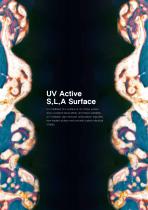
UV Active S.L.A Surface UV irradiated SLA surface of UV Active system show excellent blood affinity and blood wettability. UV irradiation also removes hydrocarbon impurities from implant surface and converts surface electrical charge.
Open the catalog to page 6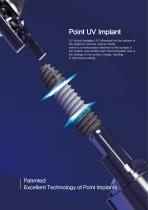
Point UV Implant UV Active irradiates UV (Ultraviolet) on the surface of the implant to remove organic matter, which is a hydrocarbon attached to the surface of the implant, and exhibits high blood activation due to the change of the surface charge, resulting in high blood wetting. Patented Excellent Technology of Point Implants
Open the catalog to page 7
• It can simultaniousely activate up to 32 Fixtures. • Eco-friendly natural light does not generate harmful to the human body Ozone , making it suitable for use in a closed operating room. • Point UV Activator is the only device that photocatalyticaly activates, and enhances hydrophilicity of Implant surface.
Open the catalog to page 8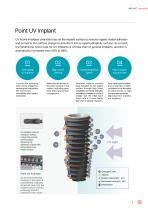
Point UV Implant UV Active irradiates ultraviolet rays on the implant surface to remove organic matter adhesion and converts the surface charge to activate it into a superhydrophilic surface. As a result, the initial bone fusion rate for UV implants is 4 times than of general implants, and BIC is dramatically increased from 50% to 98%. Osseointegration Speed Speed It shows the antiaging effect of the implant by removing the hydrocarbon film that occurs immediately after implant production. Blood clots are formed on the entire surface of the implant, indicating rapid bone fusion and contact osteogenesis....
Open the catalog to page 9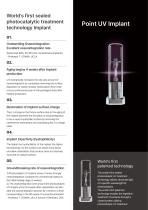
World's first sealed photocatalytic treatment technology Implant 01. Outstanding Osseointegration Excellent osseointegration rate (More than 98%, 50-65% for conventioanal implants) - Professor T. OGAWA, UCLA 02. Aging begins 4 weeks after implant production. UV dramatically increases the rate and amount of osseointegration by completely removing the surface deposition of carbon (mainly hydrocarbon form) that occurs continuously even in the packaged state after implant production. 03. Restoration of implant surface charge The (-) charge on the fixture surface due to the aging of the implant prevents...
Open the catalog to page 10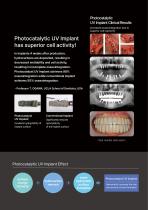
Photocatalytic UV Implant Clinical Results Increased osseointegration due to superior cell reactivity Photocatalytic UV Implant has superior cell activity! In implants 4 weeks after production, hydrocarbons are deposited, resulting in decreased wettability and cell activity, resulting in incomplete osseointegration. Photocatalyst UV Implant achieves 98% osseointegration while conventional implant achieves 50% osseointegration. - Professor T. OGAWA, UCLA School of Dentistry, USA Photocatalyst UV Implant Excellent hydrophilicity of implant surface Conventional Implant Significantly reduced hydrophilicity...
Open the catalog to page 11
World's first sealed photocatalytic treatment technology Implant Point UV Implant / TAPER 01. Easy & Stability Easy drilling system and excellent initial fixation and stability. 02. Tapered Form & Osseointegration The taper structure of the fixture grants initial stability in any bone environment and shortens Osseointegration period with the best S.L.A surface treatment. Minimize Crestal Bone Loss Minimizes crestal bone loss by reducing stress on the crestal bone with an open thread on the upper bevel of the fixture. Shorten the Osseointegration period by increasing the contact area between bone...
Open the catalog to page 12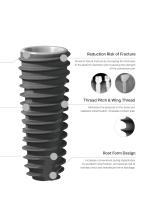
Reduction Risk of Fracture Prevents fixture fracture by increasing the thickness of the platform diameter and increasing the strength of the connection part Thread Pitch & Wing Thread Minimizes the pressure on the bone and stabilizes initial fixation, increases contact area Root Form Design Increases convenience during implantation by excellent initial fixation, and reduces risk of maxillary sinus and mandibular nerve blockage.
Open the catalog to page 13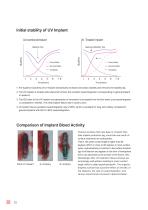
Initial stability of UV Implant Conventional Implant Primary Stability Secondary Stability Primary Stability Secondary Stability Total Stability Total Stability 1. The Superior bioactivity of UV Implant dramatically increases secondary stability and removes the stability dip. 2. The UV Implant at 2weeks after placement shows the excellent osseointegration corresponding to general implant in weeks 8. 3. The ISQ value of the UV Implant next generation of innovative is increased from the first week, and osseointegraion is completed in 3weeks. The initial implant failure rate is close to zero. 4....
Open the catalog to page 14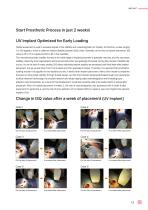
Start Prosthetic Process in just 2 weeks! UV Implant Optimized for Early Loading Osstell equipment is used to evaluate degree of the stability and osseointegration for Implant. At this time, a value ranging 1 to 100 appears, which is called an Implant Stability Quotient (ISQ) value. Generally, at the time of Implant placement, ISQ value is 55 to 75 in maxilla and 65 to 85 in the mandible. The mechanical primary stability formed at the initial stage of Implant placement is gradually reduced, and the secondary stability caused by bone regeneration and bone reconstruction was gradually increased....
Open the catalog to page 15- Analysis software
- Titanium dental implant
- Dental treatment unit
- Examination lamp
- Radiology software
- LED examination lamp
- Dental unit with light
- Straight dental implant
- Dental software
- 3D printer
- Treatment software
- Internal dental implant
- Cylindrical dental implant
- Dental milling machine
- Chair on castors
- 3D scanner
- CAD/CAM milling machine
- Chair with high backrest
- Simulation software