
- Catalogs
- PortaCheck
- UdderCheck™

UdderCheck™
UdderCheck™
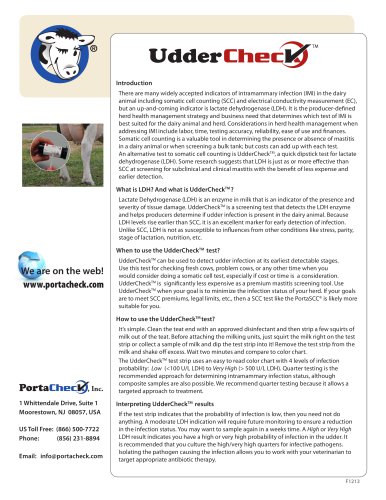
Intramammary infection (IMI) in dairy animals can be detected using various indicators such as somatic cell counting (SCC) and electrical conductivity measurement (EC). A newer indicator is lactate dehydrogenase (LDH). The choice of test depends on the herd health management strategy, considering factors like labor, time, accuracy, reliability, ease of use, and cost. While SCC is effective for detecting mastitis, it can be costly. An alternative is the UdderCheckTM test, which is a cost-effective dipstick test for LDH, offering early detection of mastitis.
What is LDH and UdderCheckTM?
Lactate Dehydrogenase (LDH) is an enzyme indicating tissue damage severity in milk. UdderCheckTM detects LDH to identify udder infections early, as LDH levels rise before SCC. Unlike SCC, LDH is less affected by stress, parity, lactation stage, and nutrition.
When to Use UdderCheckTM?
UdderCheckTM is suitable for early detection of udder infections, especially in fresh or problem cows, or when cost and time are considerations. It is less expensive than SCC tests and ideal for minimizing herd infection status. However, for meeting SCC premiums or legal limits, SCC tests like PortaSCC® may be more appropriate.
How to Use UdderCheckTM?
To use UdderCheckTM, clean the teat end, strip a few squirts of milk, and apply it to the test strip. After two minutes, compare the strip to a color chart indicating infection probability from Low to Very High. Quarter testing is recommended for targeted treatment, though composite samples are possible.
Interpreting UdderCheckTM Results
A low infection probability requires no action. Moderate results need future monitoring. High or Very High results suggest a high infection probability, necessitating pathogen culture and targeted antibiotic therapy with veterinary assistance.
Contact Information
Website: www.portacheck.com
Address: 1 Whittendale Drive, Suite 1, Moorestown, NJ 08057, USA
US Toll Free: (866) 500-7722
Phone: (856) 231-8894
Email: [email protected]
Catalog excerpts
Introduction There are many widely accepted indicators of intramammary infection (IMI) in the dairy animal including somatic cell counting (SCC) and electrical conductivity measurement (EC), but an up-and-coming indicator is lactate dehydrogenase (LDH). It is the producer-defined herd health management strategy and business need that determines which test of IMI is best suited for the dairy animal and herd. Considerations in herd health management when addressing IMI include labor, time, testing accuracy, reliability, ease of use and finances. Somatic cell counting is a valuable tool in determining the presence or absence of mastitis in a dairy animal or when screening a bulk tank; but costs can add up with each test. An alternative test to somatic cell counting is UdderCheckTM, a quick dipstick test for lactate dehydrogenase (LDH). Some research suggests that LDH is just as or more effective than SCC at screening for subclinical and clinical mastitis with the benefit of less expense and earlier detection. What is LDH? And what is UdderCheckTM ? Lactate Dehydrogenase (LDH) is an enzyme in milk that is an indicator of the presence and severity of tissue damage. UdderCheckTM is a screening test that detects the LDH enzyme and helps producers determine if udder infection is present in the dairy animal. Because LDH levels rise earlier than SCC, it is an excellent marker for early detection of infection. Unlike SCC, LDH is not as susceptible to influences from other conditions like stress, parity, stage of lactation, nutrition, etc. When to use the UdderCheckTM test? UdderCheckTM can be used to detect udder infection at its earliest detectable stages. Use this test for checking fresh cows, problem cows, or any other time when you would consider doing a somatic cell test, especially if cost or time is a consideration. UdderCheckTM is significantly less expensive as a premium mastitis screening tool. Use UdderCheckTM when your goal is to minimize the infection status of your herd. If your goals are to meet SCC premiums, legal limits, etc., then a SCC test like the PortaSCC® is likely more suitable for you. How to use the UdderCheckTM test? It’s simple. Clean the teat end with an approved disinfectant and then strip a few squirts of milk out of the teat. Before attaching the milking units, just squirt the milk right on the test strip or collect a sample of milk and dip the test strip into it! Remove the test strip from the milk and shake off excess. Wait two minutes and compare to color chart. The UdderCheckTM test strip uses an easy to read color chart with 4 levels of infection probability: Low (<100 U/L LDH) to Very High (> 500 U/L LDH). Quarter testing is the recommended approach for determining intramammary infection status, although composite samples are also possible. We recommend quarter testing because it allows a targeted approach to treatment. 1 Whittendale Drive, Suite 1 Moorestown, NJ 08057, USA US Toll Free: (866) 500-7722 Phone: (856) 231-8894 Email: [email protected] Interpreting UdderCheckTM results If the test strip indicates that the probability of infection is low, then you need not do anything. A moderate LDH indication will require future monitoring to ensure a reduction in the infection status. You may want to sample again in a weeks time. A High or Very High LDH result indicates you have a high or very high probability of infection in the udder. It is recommended that you culture the high/very high quarters for infective pathogens. Isolating the pathogen causing the infection allows you to work with your veterinarian to target appropriate antibiotic therapy. F1213
Open the catalog to page 1All PortaCheck catalogs and technical brochures
 Monitoring IgG in Calves
2 Pages
 Glucose Monitoring
2 Pages
 On-farm testing solutions
4 Pages
 PortaSCC
2 Pages
 PortaBHB
1 Page

Archived catalogs
 PortaCheck Products
4 Pages