
- Catalogs
- PreciGenome LLC
- iFlow™ droplet system and single platform technical note

- Products
- Catalogs
- News & Trends
- Exhibitions
iFlow™ droplet system and single platform technical note
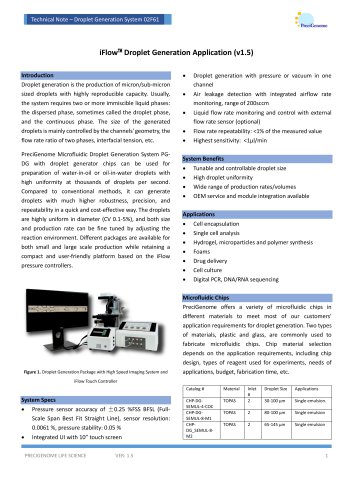
iFlow™ droplet system and single platform technical note
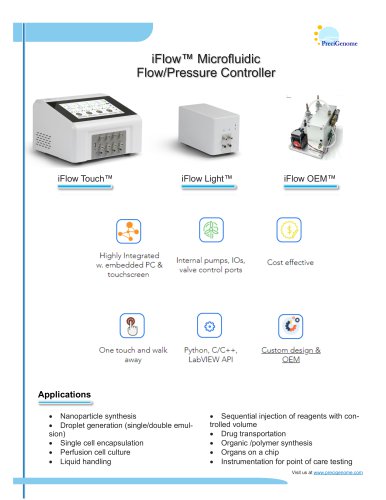
The PreciGenome Microfluidic Droplet Generation System PG-DG is designed for creating micron/sub-micron sized droplets with high uniformity and precision, suitable for various scales of application.
The system includes a high-accuracy pressure sensor, a 10” touch screen UI, and features for air leakage detection and liquid flow rate monitoring. It allows for tunable droplet sizes and offers OEM services.
Key applications include cell encapsulation, single cell analysis, hydrogel synthesis, drug delivery, cell culture, and digital PCR.
PreciGenome offers microfluidic chips made from plastic and glass, tailored for different droplet generation needs.
The system comprises the iFlow Controller, a high-speed imaging system, and various setup options for different volume requirements.
The system generates droplets by applying pressure to reservoirs containing aqueous and oil solutions, which are then pushed into microfluidic chips.
Materials include polystyrene microspheres, surfactants, and oils. The procedure involves preparing solutions, plasma treating chips, and using reservoir kits for droplet production.
Case Study 1: Demonstrated single bead encapsulation for single cell studies using the DG-DEMUL chip.
Case Study 2: Involved Drop-Seq application using different bead sizes to mimic barcoding beads and cells.
Droplet size and production rate are adjustable via pressure ratios. The system supports single and double emulsion configurations, requiring specific pressure settings for stability.
The PreciGenome Droplet Generation System is a robust and precise tool for droplet production, applicable to a wide range of life science applications.
This document provides insights into the droplet generation system, focusing on bead encapsulation within droplets for applications like Drop-Seq.
Discusses single and double emulsion droplets, highlighting bead encapsulation efficiency. Single emulsion droplets had a 14.8% single encapsulation rate from a starting concentration of 18 million beads/ml.
Outlines the use of the DG-DEMUL-3-COC chip for encapsulation, focusing on pressure tuning and microfluidic setup for optimal rates.
Includes figures and tables on encapsulation distributions and bead concentrations, such as Table 7 showing single emulsion bead encapsulation data.
Describes isolating cells in droplets with barcoded beads, using 20 μm polystyrene beads to mimic barcoded beads, with encapsulation probabilities modeled by the Poisson distribution.
The iFlow platform is a robust tool for droplet generation, offering control over droplet size and production rate, suitable for various stages from discovery to scaled production.
Further details are available on PreciGenome's website, with references for additional research.
Catalog excerpts
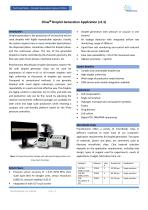
Technical Note - Droplet Generation System 02F61 Droplet generation is the production of micron/sub-micron sized droplets with highly reproducible capacity. Usually, the system requires two or more immiscible liquid phases: the dispersed phase, sometimes called the droplet phase, and the continuous phase. The size of the generated droplets is mainly controlled by the channels' geometry, the flow rate ratio of two phases, interfacial tension, etc. Droplet generation with pressure or vacuum in one channel Air leakage detection with integrated airflow rate monitoring, range of 200sccm Liquid flow rate monitoring and control with external flow rate sensor (optional) Flow rate repeatability: <1% of the measured value Highest sensitivity: <1pl/min PreciGenome Microfluidic Droplet Generation System PG-DG with droplet generator chips can be used for preparation of water-in-oil or oil-in-water droplets with high uniformity at thousands of droplets per second. Compared to conventional methods, it can generate droplets with much higher robustness, precision, and repeatability in a quick and cost-effective way. The droplets are highly uniform in diameter (CV 0.1-5%), and both size and production rate can be fine tuned by adjusting the reaction environment. Different packages are available for both small and large scale production while retaining a compact and user-friendly platform based on the iFlow pressure controllers. • Tunable and controllable droplet size • High droplet uniformity • Wide range of production rates/volumes • OEM service and module integration available • Cell encapsulation • Single cell analysis • Hydrogel, microparticles and polymer synthesis • Drug delivery • Cell culture • Digital PCR, DNA/RNA sequencing PreciGenome offers a variety of microfluidic chips in different materials to meet most of our customers' application requirements for droplet generation. Two types of materials, plastic and glass, are commonly used to fabricate microfluidic chips. Chip material selection depends on the application requirements, including chip design, types of reagent used for experiments, needs of applications, budget, fabrication time, etc. System Specs • Pressure sensor accuracy of ±0.25 %FSS BFSL (Full-Scale Span Best Fit Straight Line), sensor resolution: 0.0061 %, pressure stability: 0.05 % • Integrated UI with 10" touch screen PRECIGENOME LIFE SCIENCE
Open the catalog to page 1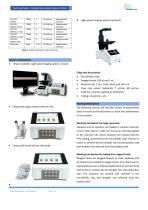
Preci Genome Technical Note - Droplet Generation System 02F61 Table 1. Droplet Generation Chip information System Components • iFlow Controller, high speed imaging system, mount High speed imaging system (optional) • Microfluidic chips • Flow rate sensor (optional): 7 ^l/min, 80 ^l/min, 1ml/min, 5ml/min (extend to 10ml/min) Working Mechanism The following section will describe results of experiments done in-house by PreciGenome to show the performance of our product. Working mechanism for large reservoirs: Aqueous and oil solutions are loaded in sample reservoirs (1.5ml, 15ml, 50ml, or 100+ ml)....
Open the catalog to page 2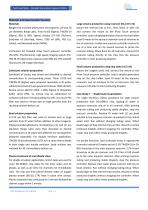
Technical Note – Droplet Generation System 02F61 Materials and Experimental Procedure Materials Reagent list included polystyrene microspheres (10 and 20 μm diameter, Bangs Labs), Triton X-100 (Sigma), TWEEN-20 (Sigma), BSA (≥ 98%, Sigma), (Krytox 157-FSH (DuPont), EvaGreen oil (Bio-Rad), Novec 7500 oil (3M), PBS (1x, Cytiva), and deionized water (MiliQ). Instrument list included iFlow Touch pressure controller (PG-MFC, PreciGenome), high speed imaging system (PGHSV-M, PreciGenome), plasma treater (BD-20, ETP) and ZOE fluorescent cell imager (Bio-Rad). Surfactant solution preparation Surfactant...
Open the catalog to page 3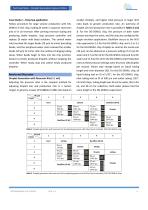
Preci Genome Technical Note - Droplet Generation System 02F61 Case Study 2 - Drop-Seq application Follow procedure for large volume production with DG-DEMUL-3-COC chip, loading DI water in aqueous reservoirs and oil in oil reservoir. After priming reservoir tubing and producing stable droplets, stop pressure controller and replace DI water with bead solutions. The central water inlet received the larger beads (20 ^m) to mimic barcoding beads, and the peripheral water inlet received the smaller beads (10 ^m) to mimic cells. Run without changing tubing setup. When beads begin to flow into the chip...
Open the catalog to page 4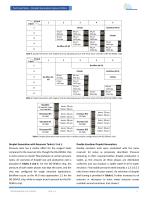
Technical Note - Droplet Generation System 02F61 Preci Genome Table 4. Droplet Generation with reagent tanks by adjusting pressure with iFlow Touch controller (CHP-DG-SEMUL chip) Table 6. Droplet Generation with reservoir kits in double emulsion configuration (CHP-DG-DEMUL chip) Droplet Generation with Reservoir Tanks (<1 ml ): Pressure ratio has a similar effect for the reagent tanks compared to the reservoir kits, though the DG-DEMUL chip is more prone to chaotic flow behavior at certain pressure ratios. An overview of droplet size and production rate is provided in Tables 4 and 5. For the...
Open the catalog to page 5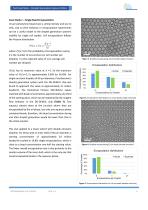
Technical Note – Droplet Generation System 02F61 Case Study 1 – Single Bead Encapsulation: 10 μm polystyrene beads have a similar density and size to cells, and so their behavior in encapsulation experiments can be a useful model to the droplet generation system’s viability for single cell studies. Cell encapsulation follows the Poisson distribution: ݜưݑ ذݑ ҢȒݜ ưݑ! where Pr(x=k) is the probability of encapsulation events, k is the number of occurrences (or cell number per droplet), ؎ is the expected value of x (or average cell number per droplet) ۰ݑðݑ(߰ݑ = Űݑ) = This also applied to a lesser...
Open the catalog to page 6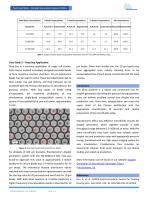
Technical Note – Droplet Generation System 02F61 Initial Bead Concentration (beads/ml) Actual (%) Expected (%) Actual (%) Expected (%) 2+ beads Encapsulations Actual (%) Expected (%) Actual (%) Expected (%) Table 7. Single emulsion bead encapsulation data with reservoir kits (CHP-DG-DEMUL chip). Case Study 2 – Drop-Seq Application: Drop-Seq is a common application of single cell studies. Cells may be isolated in droplets alongside barcoded beads to form miniature reaction chambers. 20 μm polystyrene beads may be used to mimic these barcoded beads due to their similar size and density, and their...
Open the catalog to page 7All PreciGenome LLC catalogs and technical brochures
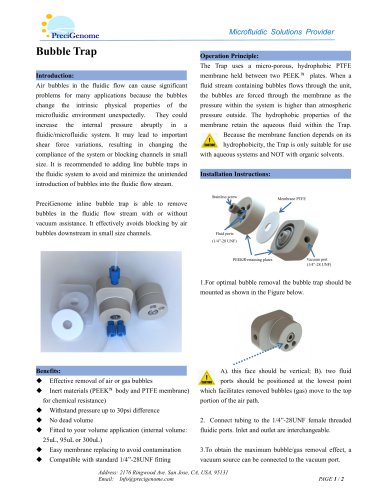 PreciGenome bubble trap
2 Pages
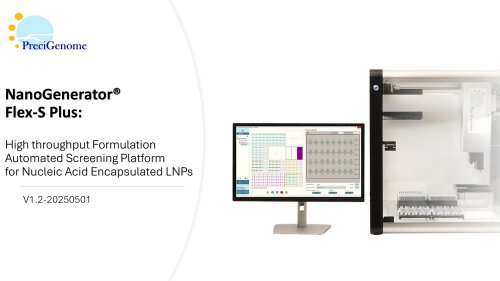
 NanoGenerator brochure
24 Pages
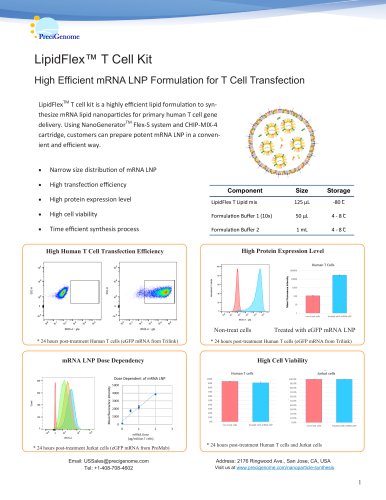 LipidFlex™ T cell kit
1 Page
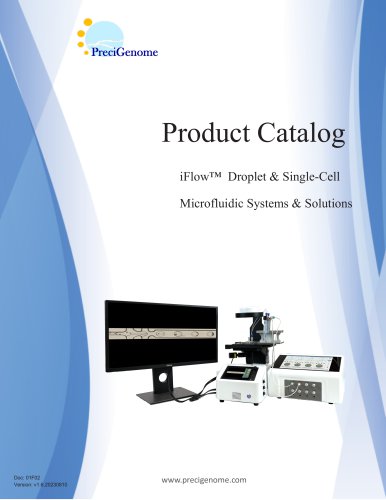 PreciGenome iFlow™
16 Pages
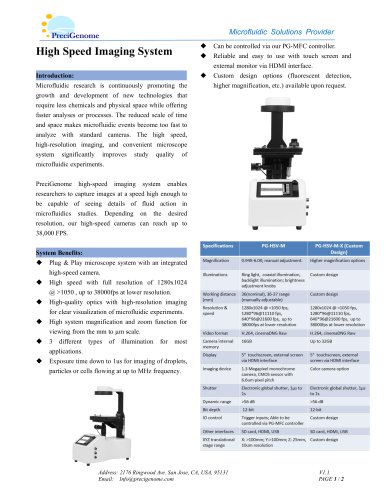 High Speed Imaging System
2 Pages
- Detection kit
- Microscopy
- Respiratory disease assay kit
- Compound microscope
- Laboratory microscope
- Laboratory testing system
- COVID-19 assay kit
- PCR system
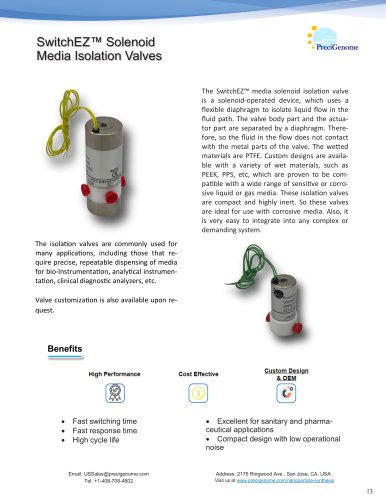
- Solenoid valve
- Real-time assay kit
- Throat detection kit
- Nasal detection kit
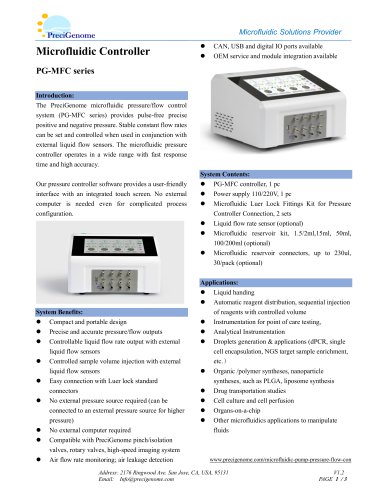
- Laboratory pump
- Laboratory sensor
- Digital microscope
- Flow sensor
- High-resolution microscope
- Zoom microscope
- Digital thermal cycler