
- Catalogs
- PreciGenome LLC
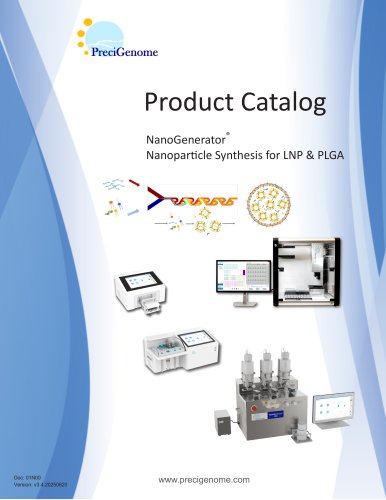
- PreciGenome NanoGenerator brochure

- Products
- Catalogs
- News & Trends
- Exhibitions
PreciGenome NanoGenerator brochure
PreciGenome NanoGenerator brochure
The document details PreciGenome's NanoGenerator®, a platform for nanoparticle synthesis using microfluidic mixing. This method provides superior control over size, homogeneity, and repeatability compared to traditional batch synthesis. It is used for producing nanoparticles like lipid nanoparticles (LNPs), liposomes, and PLGA nanoparticles, applicable in vaccine development, gene therapy, and cell therapy.
- High Performance & Efficiency: Offers tunable size (40-200 nm), low polydispersity index (PDI), and high encapsulation efficiency.
- Open Platform: Compatible with various reagents and microfluidic chips.
- Scalable Throughput: Ranges from 100 µL to over 20 L.
- Simple Operation: Features easy setup, compact size, and intuitive touchscreen interface.
- Cost Effective: Provides affordable configuration and low-cost consumables.
- Custom Design & OEM: Offers research collaboration, custom design, and contract manufacturing options.
- Flex-S: For small-scale production, handling 1 to 4 samples per run with 0.1 to 2 ml throughput.
- Flex-S Plus: Facilitates rapid screening with up to 48 samples per run and comprehensive automation.
- Flex-M: Suitable for small to medium-scale production with 1 to 12 ml throughput.
- Flex-M Premium: An upgraded version of Flex-M with 1 to 200 ml throughput.
- Max: For large-scale production, available in RUO and GMP versions, with up to 40 L/h throughput.
Highlights T cell transfection using mRNA lipid nanoparticles, demonstrating the platform's efficiency in producing mRNA LNPs with controlled size, high homogeneity, and excellent encapsulation efficiency.
The NanoGenerator® MAX GMP System is designed for clinical and commercial genomic medicine production, with regulatory support files, material traceability documentation, and cGMP compliance.
Designed for cGMP production, it reduces cross-contamination and supports multi-product manufacturing. It includes specifications, software features, product models, and additional features.
Supports regulatory and quality audits, reducing cross-contamination risks, suitable for multi-product manufacturing in GMP facilities.
21 CFR Part 11 compliant, includes experimental parameter tuning, recipe save/load, real-time and historic pressure/flow rate tracking, self-diagnostic systems, and user management.
Various models are available for different research and development stages, with varying throughput and flow rate specifications.
Optional features include inline dilution, reagent heating, custom design, installation and training, and extended warranty services.
A flexible lipid nanoparticle formulation compatible with various lipids for nucleic acid encapsulation and cell transfection, offering high encapsulation efficiency and transfection rates.
Designed for efficient mRNA LNP synthesis for T cell transfection, providing high transfection efficiency and protein expression levels.
The platform supports PLGA nanoparticle synthesis with batch-to-batch consistency, controlled by formulation parameters and flow rate conditions.
PreciGenome offers services in formulation design, payload encapsulation, gene delivery studies, and comprehensive analysis and characterization of nanoparticles.
PreciGenome is headquartered in San Jose, California, with distributors in China, Korea, and Taiwan. Contact details for each location are provided.
Catalog excerpts
Product Catalog NanoGenerator® Nanoparticle Synthesis for LNP & PLGA
Open the catalog to page 1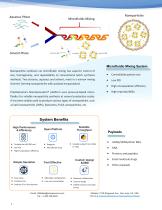
Microfluidic Mixing System Nanoparticle synthesis via microfluidic mixing has superior control of size, homogeneity, and repeatability to conventional batch synthesis methods. Two streams, aqueous and solvent, meet in a narrow mixing channel, forming nanoparticles with payload encapsulated. PreciGenome’s NanoGenerator® platform uses pressure-based microfluidics for reliable nanoparticle synthesis at several production scales. It has been widely used to produce various types of nanoparticles, such as lipid nanoparticles (LNPs), liposomes, PLGA nanoparticles, etc. Controllable particle size High...
Open the catalog to page 2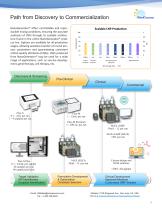
Path from Discovery to Commercialization NanoGenerator® offers controllable and reproducible mixing conditions, ensuring the accurate synthesis of LNPs through its scalable architecture found in the entire NanoGenerator® product line. Options are available for all production stages, allowing seamless transfer of crucial process parameters and guaranteeing consistent critical quality attributes (CQAs). LNPs produced from NanoGenerator® may be used for a wide range of applications, such as vaccine development, gene therapy, cell therapy, etc. Discovery & Screening Flex-M 1 - 12mL per run Flex-M...
Open the catalog to page 3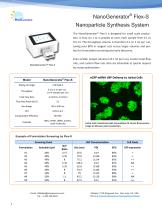
NanoGenerator® Flex-S Nanoparticle Synthesis System The NanoGenerator® Flex-S is designed for small scale production. It may run 1 to 4 samples at once, each sample from 0.1 to 0.5 ml. The throughput volume is therefore 0.1 to 2 ml per run, saving over 80% in reagent cost versus larger volumes and perfect for formulation screening and early discovery. Even smaller output volumes (<0.1 ml per run), custom total flow rate, and custom flow rate ratio are attainable at special request by recipe optimization. eGFP mRNA LNP Delivery to Jurkat Cells Example of Formulation Screening by Flex-S Screening...
Open the catalog to page 4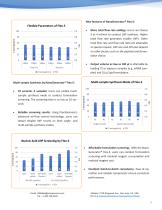
Flexible Parameters of Flex-S 100 New features of NanoGenerator® Flex-S: • More total flow rate settings. Users can choose 3 or 4 ml/min to conduct LNP synthesis. Higher total flow rate generates smaller LNPs. Other total flow rate and flow rate ratio are attainable at special request. LNP size and PDI also depend on other factors such as the payload and formulation choice. • Output volume as low as 100 ^l is attainable by loading 75 ^l aqueous samples (e.g. mRNA samples) and 25 ^l lipid formulation. Multi-sample Synthesis by NanoGenerator® Flex-S: • 10 seconds, 4 samples! Users can enable multisample...
Open the catalog to page 5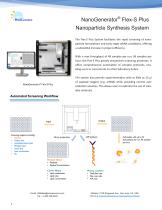
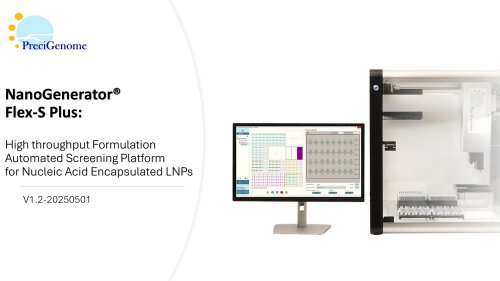
NanoGenerator® Flex-S Plus Nanoparticle Synthesis System The Flex-S Plus System facilitates the rapid screening of nanoparticle formulations and early-stage mRNA candidates, offering a substantial increase in project efficiency. With a max throughput of 48 samples per run, 96 samples per hour, the Flex-S Plus greatly streamlines screening processes. It offers comprehensive automation of complex protocols, enabling users to concentrate on other laboratory duties. NanoGenerator® Flex-S Plus The system also permits experimentation with as little as 25 µl of payload reagent (e.g. mRNA) while providing...
Open the catalog to page 6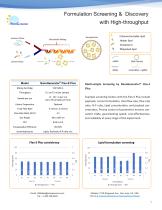
Formulation Screening & Discovery PreciGenome with High-throughput Aqueous Phase Microfluidic Mixing Cationic/ionizable lipid Helper lipid Cholesterol PEGylated lipid Solvent Phase Multi-sample Screening by NanoGenerator® Flex-S Plus: Example screening factors with the Flex-S Plus include payloads, carrier formulation, total flow rate, flow rate ratio, N:P ratio, Lipid concentration, and payload concentration. Precise control of parameters ensures consistent CQAs, guaranteeing speed, cost-effectiveness, and reliability at every stage of the experiment. Lipid formulation screening Address: 2176...
Open the catalog to page 7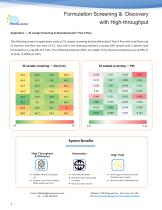
Formulation Screening & Discovery with High-throughput Application — 32 sample Screening by NanoGenerator® Flex-S Plus: The following shows an application study of 32 sample screening by NanoGenerator® Flex-S Plus with total flow rate of 3ml/min and flow rate ratio of 3:1. Each cell in the heatmap indicates a unique LNP sample with a specific lipid formulation or a specific N:P ratio. The following heatmap offers an insight of the physical properties (size & PDI) of 32 kinds of different LNPs 32 sample screening — Size (nm) System Benefits High Throughput & Efficiency run. Runtime <5 min for...
Open the catalog to page 8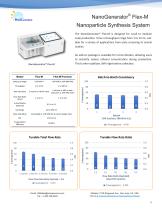
NanoGenerator® Flex-M Nanoparticle Synthesis System The NanoGenerator® Flex-M is designed for small to medium scale production. It has a throughput range from 1 to 12 ml, suitable for a variety of applications from early screening to animal studies. An add-on package is available for in-line dilution, allowing users to instantly reduce ethanol concentration during production. This further stabilizes LNPs right before collection. Tunable Flow Rate Ratio 100 Flow Rate Ratio {Aq:Lipld) Fxied TFR 5ml/min Address: 2176 Ringwood Ave., San Jose, CA, USA Visit us at www.preciaenome.com/nanoparticle-svnthesis...
Open the catalog to page 9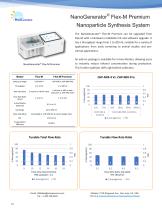
„ NanoGenerator® Flex-M Premium • PreciGenome The NanoGenerator® Flex-M Premium can be upgraded from Flex-M with a hardware installation kit and software upgrade. It has a throughput range from 1 to 200 ml, suitable for a variety of applications from early screening to animal studies and pre-clinical applications. An add-on package is available for in-line dilution, allowing users to instantly reduce ethanol concentration during production. This further stabilizes LNPs right before collection. Address: 2176 Ringwood Ave., San Jose, CA, USA Visit us at www.preciaenome.com/nanoparticle-svnthesis...
Open the catalog to page 10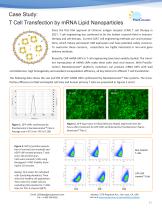
Case Study: T Cell Transfection by mRNA Lipid Nanoparticles Since the first FDA approval of chimeric antigen receptor (CAR) T cell therapy in 2017, T cell engineering has continued to be the hottest research field in immunotherapy and cell therapy. Current CAR T cell engineering methods use viral transductions, which induce permanent CAR expression and have potential safety concerns. To overcome these concerns, researchers are highly interested in non-viral gene delivery methods. Recently, CAR mRNA LNPs in T cell engineering have been widely studied. The transient transduction of mRNA LNPs make...
Open the catalog to page 11All PreciGenome LLC catalogs and technical brochures
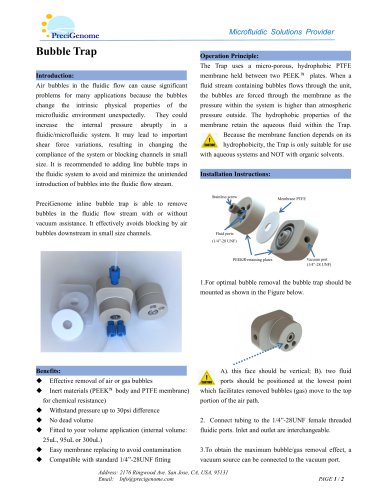 PreciGenome bubble trap
2 Pages
 NanoGenerator brochure
24 Pages
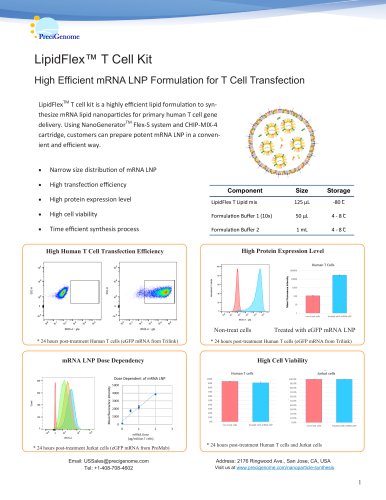 LipidFlex™ T cell kit
1 Page
 PreciGenome iFlow™
16 Pages
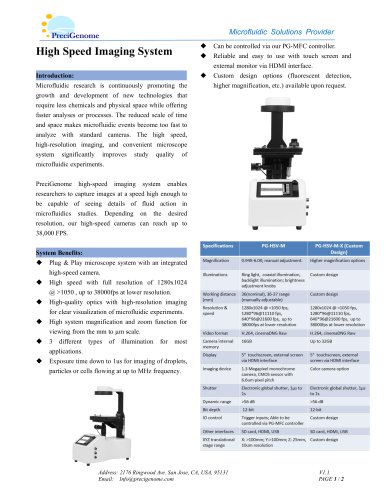 High Speed Imaging System
2 Pages
- Detection kit
- Microscopy
- Respiratory disease assay kit
- Compound microscope
- Laboratory microscope
- Laboratory testing system
- COVID-19 assay kit
- PCR system
- Solenoid valve
- Real-time assay kit
- Throat detection kit
- Nasal detection kit
- Pressure sensor
- Laboratory pump
- Laboratory sensor
- Digital microscope
- Flow sensor
- High-resolution microscope
- Zoom microscope
- Digital thermal cycler