
- Catalogs
- pritidenta GmbH
- VENEERS

VENEERS

VENEERS
Zirconia veneers, such as those made from priti®multidisc ZrO2, are used to rectify dental defects like discoloration, chipping, or missing teeth. These veneers offer a long-term solution with minimal abrasion to healthy dental substance compared to crowns.
Zirconia veneers are highly translucent and have color gradients that make them indistinguishable from natural teeth. They offer high strength and stability, allowing for thinner wall thicknesses, particularly in anterior teeth.
Traditional etching methods are ineffective on zirconia due to its lack of a vitreous phase. Instead, the recommended procedure involves blasting the interior surfaces with 50 µm Al2O3 at 1 bar pressure, which improves bonding strength without the need for hydrofluoric acid etching.
Studies suggest that enamel preparation enhances bonding with high-strength ceramics. Blasting with Al2O3 has shown improved bond strengths compared to traditional methods involving lithium disilicate and hydrofluoric acid.
For adhesive cement, clean and dry the stump, apply a dentine adhesive, and blast the adhesive surface with Al2O3. For self-adhesive cement, similar steps are followed. When bonding to enamel, etching with 37% phosphoric acid is necessary.
priti®multidisc ZrO2 multicolor High Translucent veneers provide an aesthetic and durable alternative to conventional ceramics, ensuring a perfect smile.
Catalog excerpts
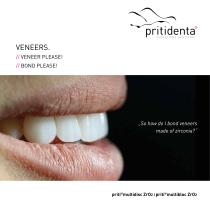
VENEERS. // VENEER PLEASE! // BOND PLEASE! „So how do I bond veneers made of zirconia?“
Open the catalog to page 1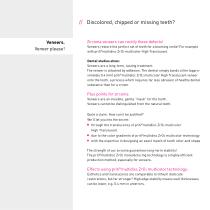
Veneers. Veneer please! Zirconia veneers can rectify these defects! Veneers restore the perfect set of teeth for a beaming smile! For example with priti®multidisc ZrO2 multicolor High Translucent. Dental studies show: Veneers are a long-term, lasting treatment. The veneer is attached by adhesion. The dentist simply bonds a thin (approximately 0.4 mm) priti®multidisc ZrO2 multicolor High Translucent veneer onto the tooth, a process which requires far less abrasion of healthy dental substance than for a crown. Plus points for zirconia Veneers are an invisible, gentle "mask" for the tooth. Veneers...
Open the catalog to page 2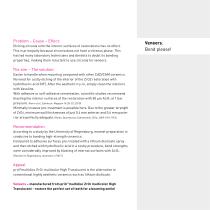
Problem – Cause – Effect: Etching zirconia onto the interior surfaces of restorations has no effect. This is principally because zirconia does not have a vitreous phase. This has led many laboratory technicians and dentists to doubt its bonding properties, making them reluctant to use zirconia for veneers. Easier to handle when mounting compared with other CAD/CAM ceramics. No need for costly etching of the interior of the ZrO2 restoration with hydrofluoric acid (HF). After the aesthetic try-in, simply clean the interiors with Vaseline. With adhesive or self-adhesive cementation, scientific studies...
Open the catalog to page 3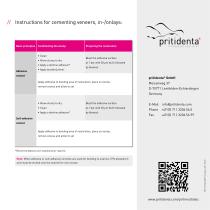
// Instructions for cementing veneers, in-/ontays: Basic principles Note: When adhesive or self-adhesive cements are used for bonding to enamel, 37% phosphoric acid must be etched onto the enamel for one minute. pritidenta’ * PIONEERING DENTISTRY
Open the catalog to page 4All Pritidenta GmbH catalogs and technical brochures
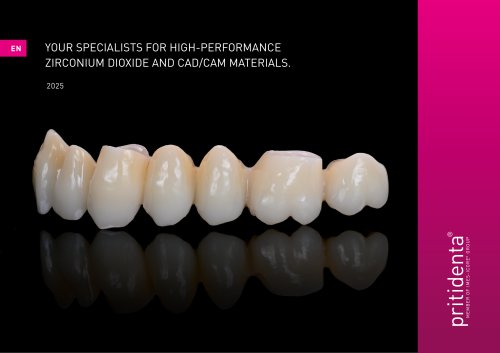 pritidenta_Product catalog 2025
32 Pages
 new product catalog
15 Pages
 CORiTEC
5 Pages
 BONDING
4 Pages
 priti®multidisc ZrO₂
4 Pages
 priti face
8 Pages
 priticrown
8 Pages
 priti multidisc
8 Pages
 flyer pritimirror
2 Pages
 flyer priticrown
2 Pages
 brochure dentist
16 Pages
 brochure dental lab
16 Pages


- Dental material
- Dental restoration material
- Resin dental material
- Dental prosthesis dental material
- Dental crown material
- Biocompatible dental material
- Dental bridge material
- Translucent dental material
- Dental CAD/CAM material
- Orthodontic material
- Milling dental material
- White dental material
- ZrO2 dental material
- Temporary dental material
- Transparent dental material
- Dental inlay material
- Alloy dental material
- Matériau pour onlays dentaires
- Denture making dental material
- Posterior teeth dental material