

I - CATALOG COMPONENTS & MATERIALS

I - CATALOG COMPONENTS & MATERIALS
- Introduction: The catalog is updated in real-time and accessible online. It provides guidance on navigating the catalog and accessing product information and support.
- Product Testing and Standards: Products are tested according to NF. EN. ISO 10328 and NF. EN. ISO 22523 standards, ensuring they can withstand user weight and activity levels.
- Activity Levels: Defined from K1 to K4, indicating the user's potential for prosthetic ambulation, from basic to high-impact activities.
- SYNSYS System: A mechatronic system offering kinematic coupling of ankle and knee movements, enhancing user comfort and safety in everyday activities. Features include programmable heel heights and water resistance.
- Product Categories: Detailed listings of knees, ankles, feet, components, liners, sockets, orthosis, and materials. Each category includes specific products with technical specifications.
- Highlighted Products:
- Freedom QUATTRO: A microprocessor knee with H.A.R.T. Control Technology, offering customizable gait patterns and water resistance.
- Plié 3: Designed for low to high activity users, fully submersible, and lightweight.
- ALLUX 2: A 4-Bar MPK with dual safety systems, suitable for various activity levels.
- Easy Ride: A knee designed for high-impact sports, featuring a pneumatic shock absorber and seaproof capabilities.
- HYTREK: A single-axis knee with hydraulic regulation, suitable for dynamic transfemoral patients.
- Features a re-engineered hydraulic unit for smooth swing initiation.
- Polycentric 4-bar design enhances stance phase stability and safety.
- Suitable for moderate to high activity levels (K3-K4).
- Adjustable flexion and extension resistance.
- Supports sports activities like bike riding.
- Available in different colors and weights, with a maximum patient weight of 125 kg.
- Affordable 4-axis pneumatic knee for patients up to 275 lbs.
- Lightweight design with high toe clearance for safety.
- Flexion and extension adjustments to reduce terminal impact.
- Compact and suitable for activity levels 2-3.
- 6-bar hydraulic knee with adjustable stance flexion.
- High stability due to geometric locking and unique hydraulic cylinder design.
- Features a mechanical sensor for gait status detection.
- Available with or without a manual lock, supporting a maximum weight of 125 kg.
- Includes various models with different features like socket rotation adjustment, friction adjustment, and extension assist.
- Designed for safety during stance phase with unique alignment and axis geometry.
- Supports different patient weights and activity levels.
- Kinnex 2.0 microprocessor ankle offers stability and natural walking experience.
- IP67 certified for water and dust resistance.
- Adjustable heel height and energy return features.
- Kinterra 2.0 combines hydraulics and carbon fiber for a normal gait.
- Multi-axis ankle allows for various motions, suitable for uneven grounds.
- Includes energy return carbon and glass fiber feet for different activity levels.
- Features like lateral stability, dynamic effect, and split plantar keel for uneven grounds.
The document outlines various prosthetic foot models, each designed for different user needs and activities. Key specifications include maximum patient weight, build height, and materials used. The prosthetic feet are categorized based on weight and activity level, with specific models tailored for low to very high impact activities.
Product Models:
- EASY RUN: Designed for everyday users, featuring a curved fiberglass blade and anti-slip sole. It supports a maximum weight of 125 kg and is suitable for various terrains.
- RUSH HiPro: Offers realistic foot and ankle motion with high energy return, suitable for aggressive terrains and waterproof environments.
- RUSH RAMPAGE: Combines cosmetic appeal with high performance, featuring smooth roll-through and energy return.
- RUSH RAMPAGE LP: Low-profile design with superior ground compliance and high energy return.
- RUSH Rogue 2: Provides dynamic foot and ankle motion with vertical shock relief and rotational torsion relief.
- RUSH EVAQ8: Features an elevated vacuum system for maximum vacuum efficiency without mechanical pumps.
- RUSH H2O: Ideal for water activities, offering superior traction on slippery surfaces.
- RUSH ROVER: Designed for extreme low or high clearance patients, offering dynamic toe-off and energy return.
- RUSH KID: Pediatric foot designed for dynamic energy return and smooth roll-through.
Technical Features:
Each model includes specific technical features such as build height, weight, heel rise, and foot shell options. The document also provides guidelines for selecting the appropriate category based on patient weight and activity level.
Recommendations:
For bilateral patients, it is recommended to increase the category by one for added stability. The document emphasizes the importance of selecting the correct category to ensure optimal performance and user comfort.
- STEPLINE HD Liners: Made of copolymer gel with a biocompatible coating for hygiene and durability. Designed for pressure distribution and comfort, especially for sensitive residual limbs. Recommended for trans-tibial patients.
- STEPLINE Socks: Composed of 80% cotton and 20% nylon, these socks help manage moisture and skin irritation. They are machine washable.
- Sealing Ring: Silicone rings available in various sizes to create a vacuum for prosthesis suspension without a locking device.
- Sockets: Adjustable temporary sockets for recent transfemoral amputations, available in adult and child sizes. A suspension system is necessary.
- Temporary Fitting System: Includes splints and a multipurpose cup for rapid fitting of temporary or trial sockets, allowing easy alignment and cost efficiency.
- Locks for Distal Attachment: Various locking kits are available, including those with cords, notched pins, and smooth pins, designed for different types of residual limbs and patient needs.
- Valves: Includes depressurizing valves for transtibial and transfemoral sockets, designed for firm suspension and ease of use.
- Includes centring tools, forming tools, and adapting kits for assembly and installation of locks and valves.
- Transfemoral 2-part cosmetic covers that do not interfere with knee unit settings and allow clothing to slip on easily.
1. Various components such as rollers, loops, buckles, rivets, and nuts are detailed with specifications including dimensions, shapes, colors, and item numbers.
2. Sublimation papers are listed with dimensions and item numbers, featuring various designs.
Warranty and Product Life:
1. Warranty and product life are distinct; the lifetime is indicated in the device's Instruction For Use (IFU).
2. The warranty covers replacement or repair of defective parts but excludes normal wear and tear.
3. Specific warranty durations and conditions are outlined for different prosthetic components, such as microprocessor knees and ankles, mechanical knees, and feet.
Commercial Warranty Terms:
1. Orders must be confirmed in writing, and delivery dates are indicative, not binding.
2. Prices exclude taxes, transport, and packaging costs, and are subject to change based on raw material costs and exchange rates.
3. Payment terms include settlement at thirty days end-of-month, with penalties for late payment.
4. Delivery terms vary for domestic and export orders, with risks transferred to the customer upon dispatch.
5. The seller retains ownership of goods until full payment is received.
General Warranty Conditions:
1. Products must be used as intended; misuse voids the warranty.
2. The warranty covers defects but not normal wear and tear or damage from negligence.
3. Transportation costs for warranty claims are borne by the purchaser.
Catalog excerpts

I - CATALOG COMPONENTS & MATERIALS SYNSYS Discover the unique integral mechatronic system
Open the catalog to page 1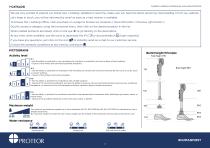
We are very excited to present our brand new I-Catalog. Updated in real time, make sure you have the latest version by downloading it from our website. Let's keep in touch, you will be informed by email as soon as a new version is available. To browse this I-Catalog offline, click anywhere on a page to browse our products ( Next left button / Previous right button ) Quickly access a category using the horizontal menu, then click on the desired product in the list. When related products are linked, click on the eye At any time, when available, use the icons to download the IFU If you have any...
Open the catalog to page 2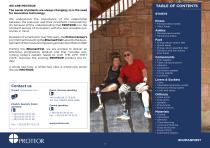
The needs of patients are always changing; so is the need for innovative technology. We understand the importance of the relationship between the end-user and their prosthetic componentry. It’s because of this understanding that PROTEOR is in the constant pursuit of innovation with the best possible outcomes in mind. • Microprocessor knees • Other knees • Microprocessor ankle • Mechanical ankles Rooted in it’s mantra for over 100 years, the Proteor Group’s commitment to putting the #HumanFirst has led to the development of the most encompassing product portfolio in O&P. Putting the #HumanFirst,...
Open the catalog to page 3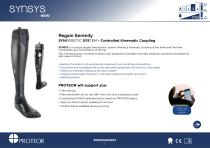
Regain Serenity SYNERGETIC SYSTEM - Controlled Kinematic Coupling SYNSYS is a unique integral mechatronic system offering a kinematic coupling of the ankle and the knee movements, as a continuation of the hip. This microprocessor-controlled solution was designed to facilitate everyday situations and allow the patient to gain peace of mind. • Bending the ankle for all everyday life movements such as sitting and squatting • Putting the foot completely flat on the step when going down the stairs for more safety • Feeling comfortable walking up and down slopes • Changing shoes easily (barefoot +...
Open the catalog to page 4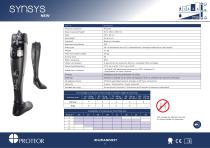
Proximal connector Knee-to-ground height Heel height Maximum knee flexion Ankle joint 20° in dorsiflexion and 22° in plantarflexion (Average amplitude by heel height). Maximum patient weight Activity level Water resistance Lithium-ion battery 4 days minimum autonomy (6h for a complete 100% recharge) Operating temperature Adjustment softwares • SYNSYS Soft adjustment software for CPOs: Windows 10 • Application for users: Android Mandatory and free certification for CPOs SYNSYS is ordered via an online configurator which is presented during the certification. Packaging content SYNSYS assembled...
Open the catalog to page 5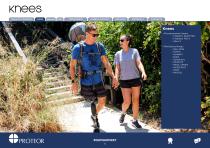
KNEES TABLE OF CONTENTS LINERS & SOCKETS Knees • Microprocessor knees – Freedom QUATTRO – Freedom Plié 3 – Allux 2 • Mechanical knees – Easy Ride – Hytrek – Hydeal II – Matik – Symphony – 1M112/113 – 1M115 / 1M149 – 1M102/102V
Open the catalog to page 6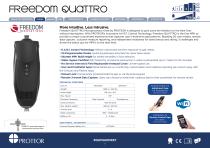
FREEDOM QUATTRO TABLE OF CONTENTS LINERS & SOCKETS More Intuitive. Less Intrusive. Freedom QUATTRO Microprocessor Knee by PROTEOR is designed to give users the freedom to live their lives without interruption. With PROTEOR’s innovative H.A.R.T. Control Technology, Freedom QUATTRO is the first MPK to provide a unique customized experience that captures user’s distinctive gait patterns. Boasting 20 user modes, remote data capture, outcome measure reporting, and independent resistance for stairs/ramps and sitting, it challenges and drives the status quo for MPK’s to the next level. • H.A.R.T. Control...
Open the catalog to page 7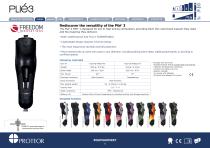
LINERS & SOCKETS Rediscover the versatility of the Plié® 3 The Plié® 3 MPK is designed for low to high activity ambulators, providing them the customized support they need and the response they demand. • Both weatherproof and FULLY SUBMERSIBLE • Lightweight design requires minimal energy • The most responsive stumble and fall protection • Move instinctively at users own pace in any direction, including taking short steps, walking backwards, or pivoting in confined spaces TECHNICAL FEATURES Item N°. Build Height Included with the knee: • Standard black shell if colored shell not desired. • USB...
Open the catalog to page 8
LINERS & SOCKETS In pursuit of the world’s safest knee. ALLUX 2 is the first (and only) 4-Bar MPK that controls both stance, and swing phase. It's unique design boasts a dual safety system based on inherent stability factors and microprocessor control. ALLUX 2 heightens safety and security while providing exceptional functionality to the user. • PC and/or remote control no longer required. ALLUX 2 is fully programmable via a Bluetooth enabled device. • Using a Bluetooth enable device, the user can choose from 5 different modes as needed. • New needle bearings used in the 4-Bar linkage provide...
Open the catalog to page 9
EASY RIDE TABLE OF CONTENTS LINERS & SOCKETS High impact multisport knee. The EasyRide knee was created in collaboration with adaptive athletes from around the world to ensure optimal performance capabilities for extreme, high impact, all-terrain sports such as surfing, snowboarding, skateboarding, cycling, skiing, and more. The EasyRide lets you get back to the activities you LOVE without limitations. • Easy Ride knee is appropriate for patients involved in sports. Developed with handisport athletes, it has been designed while keeping constantly in mind specific needs of these patients. • Thanks...
Open the catalog to page 10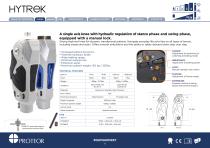
HYTREK TABLE OF CONTENTS LINERS & SOCKETS A single axis knee with hydraulic regulation of stance phase and swing phase, equipped with a manual lock. Strong high-end knee for dynamic transfemoral patients. Navigate everyday life activities on all types of terrain; including slopes and stairs. Offers smooth ambulation and the ability to safely descend stairs step over step. STANCE: Adjustment of sensitivity for switching to braking mode. • Increased patient dynamics. • Powerful hydraulic brake. • Wide braking range. • Optional manual lock. • Extension assist. • Maximum patient weight: 150 kg /...
Open the catalog to page 11All Proteor catalogs and technical brochures
 I - CATALOG
128 Pages
 Proteor & you
20 Pages
 Materials
100 Pages
 Orthosis
84 Pages
 Prosthesis
122 Pages
 INFO news n°4
8 Pages
- Orthopedic immobilization
- Articulated orthopedic immobilization
- Open knee orthopedic immobilization
- Neck brace
- Adult cervical collar
- Forearm support
- Walker boot
- Ankle and foot orthosis
- Lower extremity prosthesis
- Spinal orthosis
- Extension orthopedic immobilization
- Knee sleeve
- Dynamic orthopedic immobilization
- Adult lower extremity prosthesis
- Knee splint
- Walking prosthetic foot