

Materials

Materials
PROTEOR is a family-owned company based in Burgundy, specializing in the development of over 4500 items for Certified Prosthetists and Orthotists (CPO) to create custom orthopedic appliances. The company has been in operation for nearly a century.
The manufacturing unit in Seurre works with materials such as steel, aluminum, titanium, stainless steel, polyurethane, carbon, glass fibers, and silicone. The logistics platform ensures global delivery with packaging designed for safety and environmental sustainability.
PROTEOR invests in innovation and maintains partnerships in the medical and scientific fields, enhancing its expertise in the European external orthopedics market. The company provides customized workshops, custom-made appliances, after-sales support, and technical training.
Research focuses on biomechanics in collaboration with European laboratories, utilizing digital simulations to enhance prosthetic components. New testing methods complement standard tests like ISO 22523 and ISO 10328.
All products comply with European directives and EC marking requirements. PROTEOR is certified to ISO 9001 and ISO 13485 standards.
- Casting: Includes plaster bandages, alginate powder, and materials for positive models.
- Lamination: Features acrylic resins, carbon lamination, and various textiles.
- Foam: Offers expanded polyurethane foam bases and CAD/CAM blocks.
- Adhesive & Varnish: Comprises various adhesives, resins, thinners, and varnishes.
- Thermoforming: Includes thermoplastic sheets and accessories.
- Lining & Finishing: Provides foam lining materials, special fabrics, and hides.
- Straps & Buckles: Contains self-gripping straps, fixing straps, and various buckles.
The document details specifications for thermoplastic sheets and materials used in orthotic and prosthetic manufacturing, including their properties and applications. Materials such as copolymer, PETG, and polyethylene are described with specifications like thickness, color, and heating temperature.
Guidelines are provided for heating and shaping materials using heat guns or hot water, with specific temperatures and times for thermoforming.
Materials are recommended for applications like temporary sockets, orthosis, and test sockets, suitable for various patient needs including geriatric and neonatal fittings.
Key properties include impact resistance, transparency, flexibility, and skin-friendliness, ensuring comfort and durability in orthotic applications.
Accessories such as adhesive bands and lining materials enhance the functionality and aesthetics of orthotic devices.
Specific materials are recommended for different applications based on their properties, with best practices for thermoforming and finishing to achieve optimal results.
Details are provided for materials like leather, rubber profiles, and cork, specified by reference number, thickness, and application.
Information on the use of straps and buckles, including dimensions and packaging, emphasizing resistance and ease of cleaning.
Recommendations for using straps and buckles in orthopedic applications, highlighting flexibility and comfort.
Tables list components like rivets and screws with details on dimensions and materials.
- Importance of selecting the right material for durability and comfort.
- Availability of components in various colors and sizes.
- Ease of installation and adjustment for effective orthopedic support.
Catalog excerpts
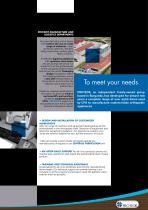
EFFICIENT MANUFACTURE AND LOGISTICS DEPARTMENTS Our manufacturing unit in Seurre (21) masters the use of a wide range of materials : steel, aluminum, titanium, stainless steel, polyurethan, carbon, glass fibers, silicone… An efficient logistics plateform with optimum stock levels ensures prompt delivery of our products to all the professionals in the orthopedic field in France and all over the world. Packaging design is studied to match the shipping methods, ensure a very safe transportation of the products and minimize the material used to take care of environment. Thanks to ongoing investments...
Open the catalog to page 3
We also conduct research works about biomechanics of human being movements, in cooperation with European laboratories. The collected data enable us to make digital simulations to improve the design of our prosthetic components To build the future Our Research and Development department has its own test laboratory. It works on today’s and tomorrow’s products to provide innovations and components that meet the needs of the patients and CPOs. We can also reproduce the functions and stresses applied to the components and carry out new testing methods in addition to standard tests (ISO 22523, ISO...
Open the catalog to page 4
SCREW FITTINGS STRAPS & BUCKLES LINING & FINISHING ADHESIVE & VARNISH
Open the catalog to page 5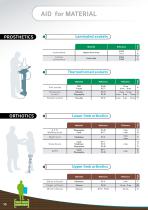
Nyglass tubular jersey Carbon Lamination Carbon sheat Thermoformed sockets Trial socket PETG Transpet Temporary socket Orthochoc Polypropylene Double socket Lower limb orthotics Polypropylene Copok Night boot Knee brace Copok Polyethylene Polypropylene Copok Polypropylene Elbow orthosis Finger orthosis Wrist orthosis Upper limb orthotics
Open the catalog to page 12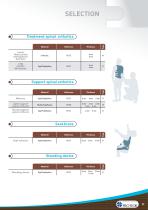
Treatment spinal orthotics Lyons Three points Anticyphosis Garchois Rigid Polyethylene Support spinal orthotics Rigid Polyethylene Light support spinal orthosis Flexible Polyethylene Strong support spinal orthosis Rigid Polyéthylene Seat orthosis Rigid Polyethylene Standing device Standing device Rigid Polyethylene
Open the catalog to page 13
PLASTER BANDAGES plaster bandage High resistance. Optimal molding and drying times. Soaking time Drying time > Biplatrix Soaking time Drying time alginate POWDER Allows quick molding to reproduce any detail with great accuracy. Hypoallergenic, very well tolerated by the skin. Particularly adapted to make a cast without damaging the original mold.
Open the catalog to page 15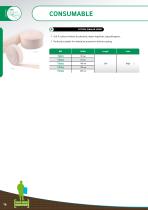
CONSUMABLE cotTon tubular jersey 100 % cotton knitted stockinette, water-repellent, hypoallergenic. Perfectly suitable for individual protection before casting.
Open the catalog to page 16
MATERIAL USED TO MAKE POSITIVE MODEL CASTING PLASTER Used to make positive models. Its very fine texture allows it to reproduce any detail with great accuracy. Multipurpose, it is suitable for most of the uses of plaster in the orthopedic field. REF. Drying time Very fine powder. Used as an absorbent or a lubricant. CASTING BALLOONS LATEX Prevent from sticking. Extremely stretchable in all direction. Perfectly matches the shapes of the positive model. No need to use talc or similar product before thermoforming on positive cast. REF.
Open the catalog to page 17
ACRYLIC RESIN proacryl Allows for rigid lamination with all fibers except carbon fibers. Well tolerated by the skin. REF. Mixing ratio proacryl FOR HOT CLIMATE COUNTRIES Allows for rigid lamination. Well tolerated by the skin. Withstands high storage temperatures. REF. Mixing ratio FLEXIBLE proacryl Allows for soft lamination. Tough, lightweight and flexible. Well tolerated by the skin. REF. Mixing ratio Its fluidity makes it particularly suitable for laminations with carbon fibers. Allows for rigid lamination. Well tolerated by the skin. REF. Mixing ratio
Open the catalog to page 19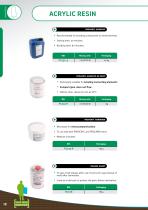
ACRYLIC RESIN proacryl ADHESIVE Recommended for bonding components or reinforcements. Setting time: 30 minutes. Bonding time: 90 minutes. Mixing ratio proacryl ADHESIVE IN PASTE Particularly suitable for bonding connecting elements. Compact glue, does not flow. Settine time : about 20 min at 20°C. REF. Mixing ratio PROACRYL HARDENER Necessary for resins polymerization. To use only with PROACRYL and PROCARB resins. RELEASE AGENT To ease mold release after use of resins for easy release of mold after lamination. Used as a lubricant to protect the parts before lamination. REF.
Open the catalog to page 20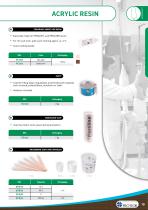
ACRYLIC RESIN COLORING AGENT FOR RESIN Especially made for PROACRYL and PROCARB resins. For 100 g of resin, add 3 g of coloring agent, i.e. 3 %. Good coating quality. Skin color Dark brown Used for filling deep irregularities and finishing of materials such as wood, polyurethane, duralumin or steel. Hardener included. MODELLING CLAY Used to protect some areas during lamination. REF. MEASURING CUPS AND SPATULAS
Open the catalog to page 21
FABRICS FOR LAMINATION NYGLASS TUBULAR JERSEY Made of 75 % polyamide and 25 % glass fibers. POLYAMIDE TUBULAR JERSEY GLASS FIBER JERSEY Used to make laminated reinforcements. REF. STRETCHABLE FINISHING SHEATH Ideal as finishing layer for laminations. REF. ACRYLIC FELT Allows the inside of the socket to have a very smooth touch. REF.
Open the catalog to page 22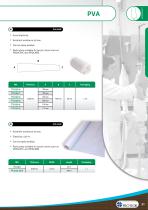
Good elasticity. Excellent resistance to tear. Particularly suitable for acrylic resins such as PROACRYL and PROCARB. B A Excellent resistance to tear. Particularly suitable for acrylic resins such as PROACRYL and PROCARB.
Open the catalog to page 23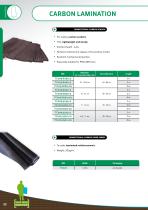
CARBON LAMINATION BIDIRECTIONAL CARBON SHEATH For making carbon sockets. Thin, lightweight and sturdy. Perfectly matches the shapes of the positive model. Excellent mechanical properties. Especially suitable for PROCARB resin. 45° orientation fiber, flat BIDIRECTIONAL CARBON FIBER FABRIC To make laminated reinforcements.
Open the catalog to page 24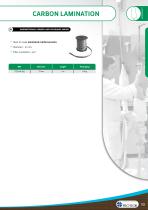
CARBON LAMINATION UNIDIRECTIONAL CARBON AND POLYAMIDE SHEATH Ideal to make laminated reinforcements.
Open the catalog to page 25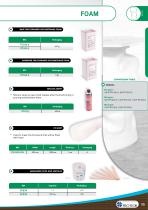
FOAM BASE FOR EXPANDED POLYURETHANE FOAM HARDENER FOR EXPANDED POLYURETHANE FOAM CONVERSION table Density : RELEASE AGENT Silicone spray to ease mold release after thermoforming or pouring polyurethane foam. Used to make the formwork that will be filled with foam. MEASURING CUPS AND SPATULAS
Open the catalog to page 27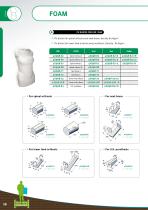
PU blocks for spinal orthosis and seat-brace: density 64 Kg/m3. PU blocks for lower limb orthosis and prosthesis. Density : 84 Kg/m3.. REF. Lower limb orthosis Lower limb orthosis > For lower limb orthosis
Open the catalog to page 28All Proteor catalogs and technical brochures
 I - CATALOG COMPONENTS & MATERIALS
128 Pages
 I - CATALOG
128 Pages
 Proteor & you
20 Pages
 Orthosis
84 Pages
 Prosthesis
122 Pages
 INFO news n°4
8 Pages
- Orthopedic immobilization
- Splint
- Articulated orthopedic immobilization
- Knee orthosis
- Open knee orthopedic immobilization
- Neck brace
- Adult cervical collar
- Forearm support
- Walker boot
- Lower extremity prosthesis
- Spinal orthosis
- Ankle and foot orthosis
- Extension orthopedic immobilization
- Knee sleeve
- Adult lower extremity prosthesis
- Dynamic orthopedic immobilization
- Prosthetic foot
- Walking prosthetic foot
- Knee splint