
- Catalogs
- QT Medical
- Home Use PCA 500 12-lead ECG

Home Use PCA 500 12-lead ECG
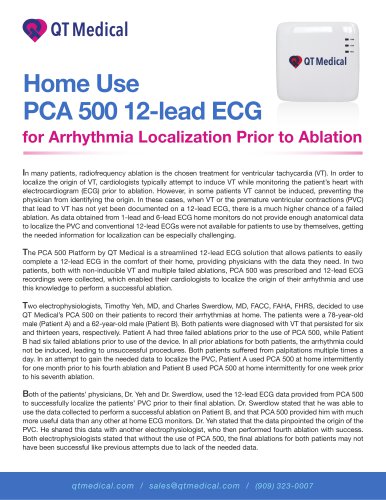
Home Use PCA 500 12-lead ECG
Introduction: The document discusses the use of the PCA 500, a 12-lead ECG platform by QT Medical, designed for home use to aid in the localization of arrhythmias prior to ablation procedures. This is particularly useful for patients with ventricular tachycardia (VT) where traditional methods of inducing VT for localization have failed.
Problem Statement: In cases where VT cannot be induced, identifying the origin of the arrhythmia is challenging, leading to a higher chance of failed ablation. Conventional 12-lead ECGs are not typically available for home use, and 1-lead or 6-lead monitors do not provide sufficient anatomical data.
Solution: The PCA 500 allows patients to perform a 12-lead ECG at home, providing critical data for physicians. This device was used successfully in two case studies where patients had non-inducible VT and multiple failed ablations.
Case Studies: Two patients, a 78-year-old male (Patient A) and a 62-year-old male (Patient B), both with persistent VT and multiple failed ablations, used the PCA 500. Patient A had three failed ablations and used the device for one month before a successful fourth ablation. Patient B had six failed ablations and used the device for one week before a successful seventh ablation.
Outcomes: The data from PCA 500 enabled the cardiologists, Dr. Yeh and Dr. Swerdlow, to localize the origin of the patients' PVCs, leading to successful ablations. Both physicians noted that the PCA 500 provided more useful data than other home ECG monitors, which was crucial for the success of the procedures.
Conclusion: The PCA 500 is a valuable tool for patients with VT, providing essential data for arrhythmia localization and increasing the success rate of ablation procedures.
Catalog excerpts
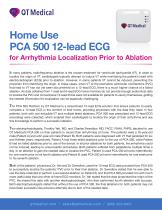
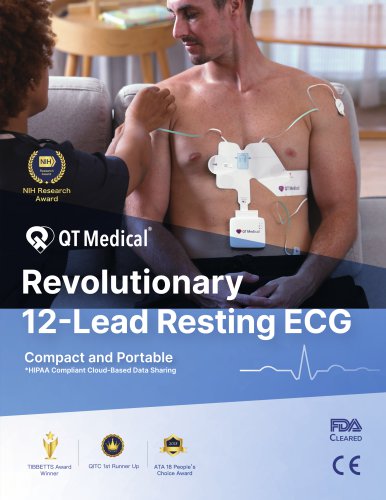
for Arrhythmia Localization Prior to Ablation In many patients, radiofrequency ablation is the chosen treatment for ventricular tachycardia (VT). In order to localize the origin of VT, cardiologists typically attempt to induce VT while monitoring the patient’s heart with electrocardiogram (ECG) prior to ablation. However, in some patients VT cannot be induced, preventing the physician from identifying the origin. In these cases, when VT or the premature ventricular contractions (PVC) that lead to VT has not yet been documented on a 12-lead ECG, there is a much higher chance of a failed ablation. As data obtained from 1-lead and 6-lead ECG home monitors do not provide enough anatomical data to localize the PVC and conventional 12-lead ECGs were not available for patients to use by themselves, getting the needed information for localization can be especially challenging. The PCA 500 Platform by QT Medical is a streamlined 12-lead ECG solution that allows patients to easily complete a 12-lead ECG in the comfort of their home, providing physicians with the data they need. In two patients, both with non-inducible VT and multiple failed ablations, PCA 500 was prescribed and 12-lead ECG recordings were collected, which enabled their cardiologists to localize the origin of their arrhythmia and use this knowledge to perform a successful ablation. Two electrophysiologists, Timothy Yeh, MD, and Charles Swerdlow, MD, FACC, FAHA, FHRS, decided to use QT Medical’s PCA 500 on their patients to record their arrhythmias at home. The patients were a 78-year-old male (Patient A) and a 62-year-old male (Patient B). Both patients were diagnosed with VT that persisted for six and thirteen years, respectively. Patient A had three failed ablations prior to the use of PCA 500, while Patient B had six failed ablations prior to use of the device. In all prior ablations for both patients, the arrhythmia could not be induced, leading to unsuccessful procedures. Both patients suffered from palpitations multiple times a day. In an attempt to gain the needed data to localize the PVC, Patient A used PCA 500 at home intermittently for one month prior to his fourth ablation and Patient B used PCA 500 at home intermittently for one week prior to his seventh ablation. Both of the patients’ physicians, Dr. Yeh and Dr. Swerdlow, used the 12-lead ECG data provided from PCA 500 to successfully localize the patients’ PVC prior to their final ablation. Dr. Swerdlow stated that he was able to use the data collected to perform a successful ablation on Patient B, and that PCA 500 provided him with much more useful data than any other at home ECG monitors. Dr. Yeh stated that the data pinpointed the origin of the PVC. He shared this data with another electrophysiologist, who then performed fourth ablation with success. Both electrophysiologists stated that without the use of PCA 500, the final ablations for both patients may not have been successful like previous attempts due to lack of the needed data.
Open the catalog to page 1All QT Medical catalogs and technical brochures
 QT ECG RECORDER USER’S MANUAL
42 Pages
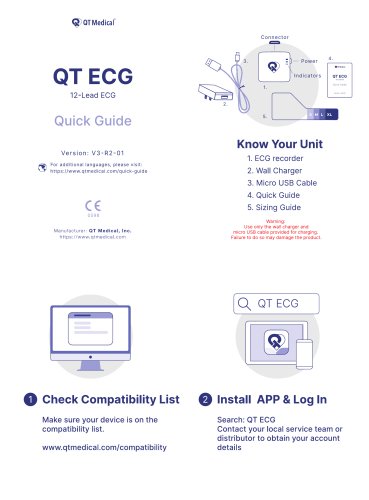 QT ECG
2 Pages
 QT ECG RECORDER USER’S MANUAL
42 Pages
 QT ECG Troubleshooting
29 Pages
 QT ECG APP USER’S MANUAL
29 Pages

- ECG cable
- EKG
- Digital electrocardiograph
- 12-channel electrocardiograph
- ECG electrode
- Monitoring ECG electrode
- Wireless electrocardiograph
- Mobile application
- Disposable ECG electrode
- Pad ECG electrode
- Medical ECG cable
- 10-wire ECG cable
- Smartphone mobile application
- Chest ECG electrode
- Reusable ECG cable
- IOS mobile application
- Android mobile application
- Bluetooth electrocardiograph
- Tablet-based electrocardiograph
- Upper limb ECG electrode