
- Catalogs
- RADWAG Balances & Scales
- DETECTION OF VIBRATIONS AT THE ELECTRONIC BALANCES WORKSTATION


DETECTION OF VIBRATIONS AT THE ELECTRONIC BALANCES WORKSTATION

DETECTION OF VIBRATIONS AT THE ELECTRONIC BALANCES WORKSTATION
Mechanical vibrations are movements of particles in elastic mediums, affecting both liquid and solid states. In industrial settings, vibrations are common but can also occur randomly due to machinery operation. These vibrations can negatively impact both humans and precision measuring equipment like electronic balances. While standards exist for human exposure to vibrations, such as PN-EN ISO 5349-2:2004/A1:2015-11, there are no specific standards for electronic balances. Manufacturers like RADWAG provide their own guidelines based on internal research.
Measurement Challenges
Temperature and humidity measurements are straightforward, involving single values and their changes over time. However, vibration measurement is complex, involving three axes (X, Y, Z) with varying amplitude and frequency. Proper mathematical analysis is required to interpret these measurements accurately. RADWAG's 4Y series balances include an ambient conditions module with a vibration sensor to monitor these factors.
Principle of Operation
Balances and mass comparators operate by maintaining equilibrium through electromagnetic compensation. Ground vibrations can disrupt this equilibrium, affecting measurement precision. RADWAG's devices are designed to account for this, with sensors measuring vibrations on all three axes. A permissible vibration value is set at 100%, with visual indicators (green or red) showing whether the current vibrations are within acceptable limits.
Vibrations in the Weighing Process
Analyzing vibrations requires considering free vibration values, resolution, and permissible errors. Instruments measuring vibrations must have configurable metrological parameters to ensure reliable comparisons. RADWAG's devices use filters tailored to the frequencies affecting weighing devices, rather than those affecting human exposure. The ambient conditions module provides both graphical and numerical displays of current vibration, temperature, and humidity values.
Catalog excerpts

DETECTION OF VIBRATIONS AT THE ELECTRONIC BALANCES WORKSTATION
Open the catalog to page 1
INTRODUCTION Mechanical vibrations are defined as movement of particles of elastic medium in relation to equilibrium point. The particles can spread in both liquid and solid mediums. In industry, it is known that the mechanical vibrations are a co-existing element of a technological process. However the vibrations can also be a phenomenon of random nature, i.e. they can be an effect of exploitation of various machines and devices (e.g. press, saw, means of transport etc.). Vibrations negatively influence human beings and measuring equipment such as balances, scales and mass comparators. Permissible...
Open the catalog to page 2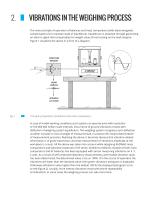
VIBRATIONS IN THE WEIGHING PROCESS The main principle of operation of balances and mass comparators (with electromagnetic compensation) is to maintain state of equilibrium. Equilibrium is obtained through generating an electric signal that compensates for weight value of load resting on the load receptor. Figure 1 visualizes the above in a form of a diagram. Principle of operation of balances and mass comparators. In case of model working conditions such system can operate even with resolution of 100 000 000 million scale intervals. Occurrence of ground vibrations results with deflection of weighing...
Open the catalog to page 3
Vibrations at mas comparators and balances’ workplace. Apart from graphic visualization the ambient conditions module of 4Y series balances displays numeric value of currently measured vibrations. The value is presented in the information box along with temperature and humidity values. MYA 4.Y microbalance – ambient conditions module, numeric values. Due to the following 3 factors: specified values of free vibrations, resolution, and permissible weighing instrument errors, the analysis of vibrations must be carried out with regard to the right effective value (rms value) and bandwidth. Unfortunately...
Open the catalog to page 4All RADWAG Balances & Scales catalogs and technical brochures
 ELLIPSIS, 5Y Laboratory Balances
36 Pages
 AS-X2
AS-X24 Pages
 AS-R2
AS-R24 Pages
 THBR 2.0 System
4 Pages
 Micro scale measurement
58 Pages
 4Y series balances leaflet
2 Pages
 SQC in laboratory
9 Pages
 4Y SERIES BALANCES
16 Pages
 MOISTURE ANALYZERS
2 Pages
 DEFINED WEIGHING PROFILES
2 Pages
 USB FREE LINK
2 Pages
 PIPETTES
4 Pages
 Mass Comparators
20 Pages
 Album Radwag
242 Pages
 WEIGHING MODULES MW
2 Pages
 WEIGHING MODULES MAS, MPS
2 Pages
 PUE5 TERMINAL
2 Pages
 PUE HX5.EX TERMINAL
2 Pages
 PUE C32 TERMINAL
2 Pages
 PUE 7.1 TERMINAL
2 Pages
 PREPACKAGED GOODS CONTROL
4 Pages
 HY10 TERMINAL
2 Pages
 HRP PLATFORMS
2 Pages
 DWM SORTING CHECKWEIGHER
2 Pages
 CHECKWEIGHERS
16 Pages
 X2 SERIES BALANCES
12 Pages
 X2 MOISTURE ANALYZERS
2 Pages
 R SERIES BALANCES
12 Pages
 4Y SERIES BALANCES
16 Pages
 4Y SERIES BALANCES
2 Pages
 RADWAG PRODUCT CATALOGUE
160 Pages
 Checkweigher
16 Pages


- Rectangular table
- Stainless steel table
- Automatic balance
- Laboratory balance
- Electronic laboratory balance
- Benchtop laboratory balance
- Laboratory software
- Patient scale
- Laboratory rack
- Electronic patient scale
- USB laboratory balance
- Precision laboratory balance
- Platform patient weighing scale
- Laboratory tube rack
- Automatic laboratory balance
- Measurement software
- Patient weighing scale with digital display
- Laboratory balance with digital display
- Scientific research laboratory balance
- Platform scale