
- Catalogs
- RADWAG Balances & Scales
- Micro scale measurement


Micro scale measurement

Micro scale measurement
The document addresses the challenges in achieving accurate measurements with high-resolution electronic balances, emphasizing the impact of ambient conditions and measurement methods on accuracy.
Proper installation requires optimizing balance operation parameters and working conditions, considering ambient conditions and collaborating with manufacturers for optimization.
Temperature, moisture, air flow, vibrations, and electrostatic charges significantly affect balance performance. Maintaining stable conditions is crucial for accurate measurements.
Understanding the balance's capacity and ambient conditions is essential for precise measurements. The document provides guidance on optimizing these factors.
Environmental factors like temperature, humidity, and air flow affect measurement accuracy. Recommendations are provided to mitigate these effects.
Optimization involves balancing metrological performance with speed and other factors, with strategies outlined to enhance measurement accuracy.
Standard Operating Procedures are crucial for monitoring parameters like repeatability, eccentricity, and linearity to ensure consistent measurement accuracy.
Various diagnostic measures, including adjustment and autotests, are described to maintain balance accuracy and reliability.
Different applications require specific considerations for accurate results, with guidance provided for applications like filter weight measurement and liquids checkweighing.
Compliance with legal metrology, GMP, and pharmacy regulations is essential for ensuring measurement accuracy and reliability.
Features such as speed, touch-free operation, and customization enhance the usability and performance of electronic balances.
The document discusses the influence of ambient conditions on measurement accuracy, emphasizing standard deviation tests for repeatability and the necessity of multiple measurement series for comprehensive data.
Measuring capacity is influenced by balance adjustment and mass standards, with procedures outlined for verifying balance accuracy and economic considerations discussed.
The impact of ambient conditions on microbalance performance is stressed, with guidance on optimizing the workplace environment to minimize errors.
Advice is given on optimal microbalance workstation setup, considering room size, employee presence, and air conditioning effects.
The significance of maintaining stable laboratory temperature is outlined, with recommendations for achieving thermal equilibrium.
Specifications for balances like the XA 52.3Y Semi Micro-Analytical Balance and MYA 5.3Y Microbalance are provided, detailing capacity, readability, repeatability, and linearity.
Maintaining stable temperature is crucial, with solutions like draft shields recommended to counteract air conditioning disruptions.
Temperature changes can affect weighing device components, leading to measurement drift. Automatic adjustments can mitigate these effects.
Humidity affects weighing accuracy, with stable humidity levels recommended to prevent electrostatic charges.
Humidity can alter sample weight, with guidelines provided for acclimatizing samples and using appropriate packaging.
Air flow can disturb weight measurements, with preventative measures like draft shields suggested.
Electrostatic charges can affect gravitational force measurement, with diagnosis involving mass standards and antistatic measures.
Vibrations can cause measurement instability, with solutions like anti-vibration tables recommended.
Workstations should minimize vibrations, with anti-vibration tables and electronic optimization methods suggested.
Optimization involves adjusting factors like temperature and moisture to minimize errors, requiring comprehensive knowledge and support.
Balance settings should suit stable external conditions, with adjustments made through service and user menus.
Solutions for various scenarios include adjusting filter values and using ionizers for electrostatic charges.
Measurement speed can be optimized by adjusting parameters, though faster measurements may compromise repeatability.
Regular monitoring of parameters like repeatability and linearity is crucial, with specific standards and procedures outlined.
Linearity tests require minimal mass standard deviations, with procedures outlined for verifying balance accuracy.
Procedures for testing balance weighing range and adjustment are detailed, with emphasis on balance stabilization and stable conditions.
Diagnostics involve temporary balance control, with adjustment procedures ensuring correct balance sensitivity.
Autotest procedures provide data for optimizing balance settings, with checks for repeatability and filter settings.
Linearity testing is stable and usually determined during validation, with repeatability crucial for accuracy.
Microbalances control ambient parameters with internal sensors, allowing for limit setting and visualization.
Microbalances require specific methodologies for precision, with recommendations for sample stability and filter weight stability.
For light samples, stability of indication is crucial, with autozero function adjustments recommended.
Minimizing evaporation is essential, with specific vessels and quick processes recommended.
Comparative weighing involves quick processes with attention to balance sensitivity and sample stability.
Heavy samples require proper adjustments and conditions for accuracy, considering factors like sensitivity variation.
Balances must comply with industry-specific regulations, dictating design and metrological parameters.
WELMEC and OIML guidelines define Maximum Permissible Errors for balances, crucial for compliance with legal regulations.
Industrial metrology focuses on measurement reliability, with quick tests and Warning and Critical Limits emphasized.
Pharmaceutical metrology is governed by stringent requirements, with procedures for determining minimal sample weight outlined.
Balances in environmental processes must comply with regional regulations, requiring periodic verification.
Modern balances feature speed, touch-free operation, wireless connectivity, safety, customization, and multi-functional environments.
Catalog excerpts

R/A\D W/A\G RADWAG BALANCES AND SCALES ADVANCED WEIGHING TECHNOLOGIES Micro Scale Measurement
Open the catalog to page 1
Sławomir Janas MICRO SCALE MEASUREMENT Installation at the workstation • Usage precautions • The best measuring capacity Ambient conditions effect • Optimization as a balanced process SOP – monitoring of metrologically important parameters • Diagnostics measures Weighing applications (filter weight measurement, light loads measurement, measuring liquids) Conformity with regulations (legal metrology and practice, GMP, pharm
Open the catalog to page 2
© Copyright by RADWAG Balances and Scales RADWAG Wagi Elektroniczne 26-600 Radom, ul. Bracka 28 VAT ID: 796-000-03-27
Open the catalog to page 3
Author’s note Contemporarily manufactured equipment provides intuitive operation holding the users back from thorough analysis of its operation. This phenomenon is evident and at the same time desired, owing to rapid and dynamic technological development. New inventions and PC software stand for ergonomics of use and simplicity, both of which are a result of advanced know-how involving group of engineers. When it comes to determination of sample weight by means of high resolution balance, the case is likewise. The balance seems to be unsophisticated measuring device, whereas in practice it comprises...
Open the catalog to page 4
1. Introduction Measurement usually lacks accuracy which is mainly caused by imprecision of measuring equipment and applied methods. Such situation concerns electronic balances too, regardless of their design or resolution. Satisfying results do not depend on the construction exclusively, the ambient conditions and used methods are of the great importance here as well. The users practically do not notice any problems while using low resolution balances (< 2 000 000 d). In contrast, for measurement performed by means of high resolution equipment, it happens that user expectations collide reality,...
Open the catalog to page 7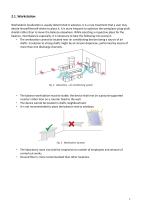
2.1. Workstation Workstation localization is usually determined in advance, it is a rare treatment that a user may decide himself/herself where to place it. It is more frequent to optimize the workplace using draft shields rather than to move the balance elsewhere. While selecting a respective place for the balance, microbalance especially, it is necessary to take the following into account: The workstation cannot be located near air conditioning devices being a source of air drafts. A solution to strong drafts might be air stream dispersion, performed by means of more than one discharge channels....
Open the catalog to page 8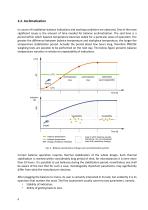
In course of installation balance indications and working conditions are observed. One of the most significant issues is the amount of time needed for balance acclimatization. The said time is a period within which balance temperature becomes stable for a particular place of operation. The greater the difference between balance temperature and workplace temperature, the longer the temperature stabilization period. Actually the period about few hours long, therefore PRECISE weighing tests are possible to be performed on the next day. The below figure presents balance temperature variation in relation...
Open the catalog to page 9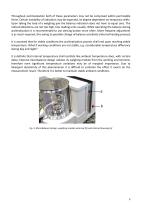
Throughout acclimatization both of these parameters may not be comprised within permissible limits. Certain instability of indication may be expected, its degree dependent on temporary drifts. Upon taking the load of a weighing pan the balance indication does not have to equal zero. The noticed deviations are not too high, few reading units usually. While operating the balance during acclimatization it is recommended to use zeroing button more often. More frequent adjustment is as much required, this owing to possible change of balance sensitivity (internal heating process). It is assumed that...
Open the catalog to page 10
3. Operating Conditions By operating conditions one shall understand any factors relating to the balance working environment, these are: Temperature variation dynamics, Moisture content variation dynamics, Speed and direction of air flow, Possibility of vibrations occurrence, Unbalanced electrostatic charges around balance and a sample. Some technical documents contain information on the above listed factors, unfortunately not many users are able to record dynamics of their variations. Such detailed control is not necessary for most measuring devices. This influences the adopted approach....
Open the catalog to page 11
4. Measuring Capacity – how to obtain precise measurement This seemingly simple issue turns out to be a bit sophisticated problem in reality. It is due to the fact that measuring capacity, understood as “ACCURATE” and “PRECISE” measurement, is a sum of many factors. Fig. 7. Accuracy and precision in metrology In order to determine sample weight, one has to assume that the obtained result is both, real and accurate. In order to provide confirmation for the above mentioned, it is necessary to check balance indications by means of mass standards. The procedure is quite simple. First, balance adjustment...
Open the catalog to page 12
New design of Q.C Test Report
Open the catalog to page 13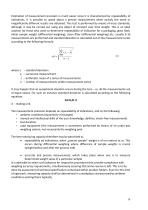
Estimation of measurement precision is much easier since it is characterized by repeatability of indications. It is possible to speak about a precise measurement when exactly the same or insignificantly different results are obtained. This test is performed by means of mass standards, although it may be carried out using any object of constant over time weight. This is an ideal solution for those who want to determine repeatability of indication for a packaging, glass flask, initial sample weight (differential weighing), clean filter (differential weighing) etc. usually 6-10 measurements are...
Open the catalog to page 14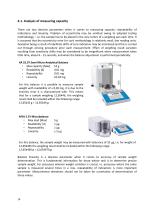
There are two decisive parameters when it comes to measuring capacity: repeatability of indications and linearity. Problem of eccentricity may be omitted owing to adopted testing methodology - i.e. the sample has to be placed in the very centre of a weighing pan each time. It is assumed that the eccentricity error for such methodology is relatively small, few reading units. Deviation being a result of indefinite drifts of zero indication may be minimized and this is carried out through zeroing procedure prior each measurement. Effect of weighing result variation resulting from sensitivity drifts...
Open the catalog to page 15All RADWAG Balances & Scales catalogs and technical brochures
 ELLIPSIS, 5Y Laboratory Balances
36 Pages
 AS-X2
AS-X24 Pages
 AS-R2
AS-R24 Pages
 THBR 2.0 System
4 Pages
 4Y series balances leaflet
2 Pages
 SQC in laboratory
9 Pages
 4Y SERIES BALANCES
16 Pages
 MOISTURE ANALYZERS
2 Pages
 DEFINED WEIGHING PROFILES
2 Pages
 USB FREE LINK
2 Pages
 PIPETTES
4 Pages
 Mass Comparators
20 Pages
 Album Radwag
242 Pages
 WEIGHING MODULES MW
2 Pages
 WEIGHING MODULES MAS, MPS
2 Pages
 PUE5 TERMINAL
2 Pages
 PUE HX5.EX TERMINAL
2 Pages
 PUE C32 TERMINAL
2 Pages
 PUE 7.1 TERMINAL
2 Pages
 PREPACKAGED GOODS CONTROL
4 Pages
 HY10 TERMINAL
2 Pages
 HRP PLATFORMS
2 Pages
 DWM SORTING CHECKWEIGHER
2 Pages
 CHECKWEIGHERS
16 Pages
 X2 SERIES BALANCES
12 Pages
 X2 MOISTURE ANALYZERS
2 Pages
 R SERIES BALANCES
12 Pages
 4Y SERIES BALANCES
16 Pages
 4Y SERIES BALANCES
2 Pages
 RADWAG PRODUCT CATALOGUE
160 Pages
 Checkweigher
16 Pages


- Rectangular table
- Stainless steel table
- Automatic balance
- Laboratory balance
- Electronic laboratory balance
- Benchtop laboratory balance
- Laboratory software
- Patient scale
- Laboratory rack
- Electronic patient scale
- USB laboratory balance
- Precision laboratory balance
- Platform patient weighing scale
- Laboratory tube rack
- Automatic laboratory balance
- Measurement software
- Patient weighing scale with digital display
- Laboratory balance with digital display
- Scientific research laboratory balance
- Platform scale