
- Catalogs
- Randox Laboratories
- How often is right for QC


- Products
- Catalogs
- News & Trends
- Exhibitions
How often is right for QC

How often is right for QC
Determining the appropriate frequency for quality control (QC) in laboratories is crucial for ensuring accurate and reliable test results. While daily QC is a common practice, it may not be sufficient for all assays or laboratories. ISO 15189 suggests that QC frequency should be based on the stability of the procedure and the risk of harm from erroneous results.
Key Considerations for QC Frequency
- Assay Stability: Identify assays that are less stable and require more frequent QC to detect errors.
- Patient Sample Volume: The number of samples tested between QC evaluations affects the frequency. High-volume labs may need more frequent QC.
- Risk Level of Tests: High-risk tests, which could significantly impact patient care if erroneous, should have more frequent QC.
- Time Between Evaluations: Ensure the time between QC checks is shorter than the time needed for corrective actions.
Recommendations
To optimize QC frequency, labs should:
- Run QC more frequently for high-risk and unstable tests.
- Start and end patient testing with a QC evaluation.
- Conduct QC checks before and after events that might affect testing, such as reagent changes or instrument maintenance.
Acusera Advisor Tool
The Acusera Advisor tool helps labs determine optimal QC frequency and multi-rules for each test, reducing false rejections and unnecessary troubleshooting.
Conclusion
There is no one-size-fits-all answer for QC frequency. By asking the right questions and considering all relevant factors, laboratories can determine the most appropriate QC schedule to ensure patient safety and test accuracy.
Catalog excerpts

QUALITY CONTROL Improving Laboratory Performance Through Quality Control Five simple steps for QC success Ask the Right Questions to get the Right Answers Complete QC solutions for results you can trust
Open the catalog to page 1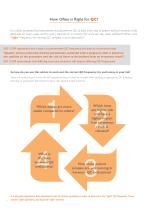
How Often is Right for QC? It is widely accepted that laboratories should perform QC at least every day of patient testing. However, is this adequate for every assay and for every laboratory? Is running QC once per day really sufficient? What is the “right” frequency for running QC samples in your laboratory? ISO 15189 regulations don’t state a recommended QC frequency but they do recommend that “Quality Control materials shall be periodically examined with a frequency that is based on the stability of the procedure and the risk of harm to the patient from an erroneous result”. ISO 15189 understands...
Open the catalog to page 2
1. Which assays are more stable compared to others? Some assays naturally perform better than others, giving consistently better results and rarely producing any errors. On the other hand, some assays perform inconsistently, having a higher rate of error and much lower stability. It’s important that laboratories can recognise which assays are more stable and consistent in comparison to others and ensure that they are running QC at an appropriate frequency, in order to detect any clinically significant errors. By utilising an EQA scheme and/or peer group reporting programme, method validation...
Open the catalog to page 3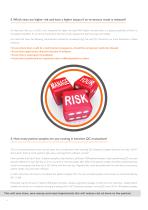
2. Which tests are higher risk and have a higher impact if an erroneous result is released? It’s important that you run QC more frequently for higher risk tests. With higher risk tests there is a greater possibility of harm to the patient, therefore it’s of utmost importance that the results released are both accurate and reliable. Any tests that have the following characteristics should be considered high risk and QC should be run more frequently in these instances. • A test where there could be a detrimental consequence, should the wrong test results be released • A test that supports the clinician’s...
Open the catalog to page 4
4. What is the time between QC evaluations? Let’s consider another scenario, both Lab A and Lab B now decide to change their QC strategy. Instead of running QC once per day, they now decide to run it every 100 patient samples. Great news, correct? This perhaps is good news for Lab B, as they will now be running QC more frequently, reducing risk for their patients. However, this is not so good for Lab A. Let’s say that an error occurs after 50 patient samples have been run. For Lab B, they will detect the problem straight away on day 1 and will be able to investigate the problem preventing the...
Open the catalog to page 5
QUALITY CONTROL Randox Laboratories Ltd, 55 Diamond Road, Crumlin, County Antrim, BT29 4QY, United Kingdom +44 (0) 28 9442 2413 True third party controls offering complete test menu consolidation Uniquely combining more than 100 parameters conveniently in a single control, laboratories can significantly reduce costs and consolidate without compromising on quality. As true third party controls, unbiased performance assessment with any instrument or method is guaranteed. Online QC software with real-time peer group statistics Compatible for use with the Acusera range of third party controls, the...
Open the catalog to page 6All Randox Laboratories catalogs and technical brochures
 LT735 Vivalytic Overview
32 Pages
 Acusera New Controls
8 Pages
 Acusera 24.7
24 Pages
 Acusera Third Party Controls
108 Pages
 Acusera SMART Controls
12 Pages
 Company Overview
40 Pages
 Reagents Brochure
64 Pages
 sdLDL-C
8 Pages
 RX SERIES ANALYSER OVERVIEW
24 Pages
 RX modena
20 Pages
 RX misano
20 Pages
 RX Daytona Plus
20 Pages
 Rx Imola
20 Pages
 RX Monaco
20 Pages
 2024 Product List
64 Pages
 LT107 Evidence Investigator
32 Pages
 VeraSTAT-V
16 Pages
 LT033 RIQAS Explained
64 Pages
 VERASTAT
16 Pages
 Endocrine Array
4 Pages
 Cerebral Arrays
4 Pages
 Thyroid Arrays
4 Pages
 Respiratory Multiplex Array
8 Pages
 LT253 Molecular Diagnostics
20 Pages
 LT367 FH Array Brochure
4 Pages
 The role of EQA in QC
8 Pages
 Basic QC Stastics
8 Pages
 Commutability Guide
4 Pages
 How to measure uncertainty
8 Pages
 ISO 15189 Educational Guide
8 Pages
 Troubleshooting QC Errors
8 Pages
 Qnostics
52 Pages
 Adiponectin LT519
28 Pages
 Specific Proteins
40 Pages
 Linearity sets
12 Pages
 Antioxidants
16 Pages
 Cardiology & Lipid Testing
28 Pages
 Diabetes Portfolio
28 Pages
 Total Bile Acids
4 Pages
 VIVALYTIC
30 Pages
 RANDOX DISCOVERY
36 Pages


Archived catalogs
 HbA1c
HbA1c2 Pages
 Which QC is the Right QC
8 Pages
 Custom Arrays for Biochip
12 Pages
 KRAS / BRAF / PIK3CA Array*
4 Pages
 LT241 Metabolic Array MAY15
8 Pages
 Cardiac Risk Multiplex Array
4 Pages
 Tumour Marker Arrays
4 Pages
 Guide to running QC
1 Page
 Preparing QC
1 Page
 Point of Care Testing
12 Pages
 LT169 Cardiac Array
4 Pages
 ACUSERA
108 Pages
 Rx Daytona
16 Pages
 Evidence Evolution
28 Pages
 Evidence
16 Pages
 Evidence Investigator
20 Pages
 Molecular Testing
16 Pages
 STI Multiplex Array
8 Pages
 Metabolic Syndrome Arrays
8 Pages
 Fertility Array
4 Pages
 Evidence Investigator
16 Pages
 Evidence
16 Pages


- RANDOX test kit
- RANDOX solution reagent
- RANDOX molecular biology reagent
- Cassette rapid test
- RANDOX research reagent
- RANDOX laboratory reagent
- Infectious disease detection kit
- RANDOX diagnostic reagent
- RANDOX protein reagent
- RANDOX rapid virus test
- RANDOX molecular biology test kit
- RANDOX enzyme reagent
- Histology reagent
- Respiratory disease assay kit
- RANDOX rapid infectious disease test
- Cytology reagent
- Cassette detection kit
- RANDOX biochemistry reagent
- Clinical chemistry analyzer
- Real-time PCR assay kit