
- Catalogs
- Randox Laboratories
- LT241 Metabolic Array MAY15


- Products
- Catalogs
- News & Trends
- Exhibitions
LT241 Metabolic Array MAY15

LT241 Metabolic Array MAY15
Metabolic Syndrome (MetS) is a cluster of cardiovascular risk factors including diabetes, abdominal obesity, high cholesterol, and high blood pressure. It affects 20-25% of adults and significantly increases the risk of stroke, heart attack, and diabetes. The International Diabetes Foundation defines MetS as central obesity plus at least two of the following: raised triglycerides, reduced HDL cholesterol, raised blood pressure, or raised fasting plasma glucose.
MetS is associated with various conditions such as cardiomyopathy, coronary heart disease, type 2 diabetes, and more. Risk factors include abdominal obesity, insulin resistance, physical inactivity, aging, and hormonal imbalance.
Adipose tissue secretes adipokines linking obesity with cardiovascular disorders. Key biomarkers include NEFA, glucose, adiponectin, resistin, TNFα, IL-6, and insulin, which are involved in insulin resistance, pro-inflammatory, and pro-thrombotic states.
Array I includes assays for Interleukin-6, TNFα, Ferritin, Insulin, Leptin, PAI-I, and Resistin. Array II includes Adiponectin, Cystatin C, and C-reactive Protein. These arrays allow for the simultaneous determination of multiple analytes related to MetS.
The arrays demonstrate high precision and sensitivity across various analytes, with intra-assay and inter-assay precision detailed for each biomarker.
The technology allows multiplexing from a single sample, is validated for serum and plasma, and requires a small sample volume. It offers efficient use of samples, ready-to-use biochips, and excellent assay performance without non-specific aggregation.
The Evidence Investigator and Evidence analysers provide comprehensive test menus, high throughput, and cost-effective testing. They support extensive QC data generation and retrospective reporting.
Metabolic Syndrome Arrays provide a robust tool for clinical research, enabling detailed profiling of MetS-related biomarkers and facilitating the investigation of associated conditions and risk factors.
Catalog excerpts

Metabolic Syndrome Arrays Simultaneous determination of multiple analytes related to metabolic syndrome
Open the catalog to page 1
Metabolic Syndrome in Clinical Research What is Metabolic Syndrome? Metabolic syndrome (MetS) is a group of cardiovascular risk factors (i.e. diabetes and prediabetes, abdominal obesity, high cholesterol and high blood pressure). It is highly prevalent, with approximately 20-25% of adults affected. It is estimated that having metabolic syndrome results in a person being three times more likely to have a stroke or heart attack, and five times more likely to develop diabetes. Underlying risk factors for MetS include: abdominal obesity, insulin resistance, physical inactivity, aging and hormonal...
Open the catalog to page 2
Metabolic Syndrome pathways Endothelial dysfunction Vascular inflammation (atherogenesis) Astherogenic dyslipidaemia Pro-thrombotic state Pro-inflammatory state Insulin resistance Vascular dysfunction Adipose tissue Adiponectin TNFα IL-6 Resistin Adipose tissue secretes cytokines, chemokines and hormones, which are collectively known as adipokines and can link obesity with cardiovascular disorders. Obesity-related disorders such as MetS, diabetes, atherosclerosis, hypertension and coronary artery disease are linked with dysregulated adipokine expression.
Open the catalog to page 3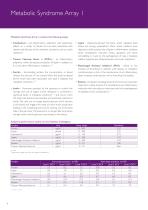
Metabolic Syndrome Array 1 Metabolic Syndrome Array I contains the following assays • Interleukin-6 - pro-inflammatory adipokine with pleiotropic effects on a variety of tissues. Il-6 has been associated with obesity and features of the metabolic syndrome such as insulin resistance.2 • Tumour Necrosis Factor α (TNFα) - an inflammatory adipokine, which stimulates production of leptin in addition to IL-6 and other inflammatory mediators.3-6 • Ferritin - Iron-binding protein, the concentration in blood reflects the amount of iron stored within the body. Increased ferritin levels have been associated...
Open the catalog to page 4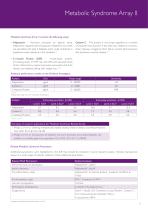
Metabolic Syndrome Array II Metabolic Syndrome Array II contains the following assays • Adiponectin - Hormone produced by adipose tissue. Adiponectin regulates lipid and glucose metabolism, low levels are associated with type 2 diabetes, which could contribute to peripheral insulin resistance in this condition.15 Cystatin C – This protein is not simply regarded as a marker of impaired renal function. It has been also related to coronary artery disease, congestive heart failure, carotid atherosclerosis and peripheral vascular disease.19 • C-reactive Protein (CRP) Acute-phase protein. Circulating...
Open the catalog to page 5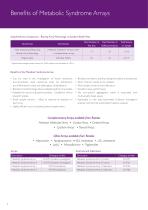
Benefits of Metabolic Syndrome Arrays Sample Volume Comparison - Biochip Array Technology vs Standard ELISA Tests Total Number of Multi-analytical profiling using Single analyte Different Analytes Metabolic Syndrome Arrays I and II Biochip Array Technology Total Volume Test Details Test Kits Test Format Individual ELISAs Approximate average sample volume for ELISA analysis was estimated at 100 μl Benefits of the Metabolic Syndrome Arrays C • an be used in the investigation of insulin resistance, pro-thrombotic state, abnormal body fat distribution, pro-inflammatory state and atherogenic dyslipidaemia...
Open the catalog to page 6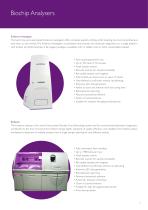
Biochip Analysers Evidence Investigator The bench top semi-automated Evidence Investigator offers complete patient profiling whilst boasting the most comprehensive test menu on the market. The Evidence Investigator consolidates immunoassay and molecular diagnostics on a single platform with protein and DNA biochips. A full reagent package is available, with no hidden costs or extra consumables needed. • Semi-automated, bench top • Up to 702 tests in 70 minutes • Small sample volume • Barcode scanner for sample traceability • Bar-coded samples and reagents • Internal back-up stores over six years...
Open the catalog to page 7
1. Hu, G. et al. for the DECODE study group. Prevalence of the metabolic syndrome and its relation to all-cause and cardiovascular mortality in nondiabetic European men and women. Arch. Intern. Med. 2004, 164: 1066-1076. 2. Qatanani, M. and Lazar M.A. Mechanisms of obesity-associated insulin resistance: many choices on the menu. Genes Dev. 2007, 21: 1443-1455. 3. Stephens, J.M. and Pekala P.H. Transcriptional repression of the C/EBP-alpha and GLUT4 genes in 3T3-L1 adipocytes by tumor necrosis factor-alpha: regulation is coordinate and independent of protein systhesis. J. Biol. Chem. 1992, 267:...
Open the catalog to page 8All Randox Laboratories catalogs and technical brochures
 LT735 Vivalytic Overview
32 Pages
 Acusera New Controls
8 Pages
 Acusera 24.7
24 Pages
 Acusera Third Party Controls
108 Pages
 Acusera SMART Controls
12 Pages
 Company Overview
40 Pages
 Reagents Brochure
64 Pages
 sdLDL-C
8 Pages
 RX SERIES ANALYSER OVERVIEW
24 Pages
 RX modena
20 Pages
 RX misano
20 Pages
 RX Daytona Plus
20 Pages
 Rx Imola
20 Pages
 RX Monaco
20 Pages
 2024 Product List
64 Pages
 LT107 Evidence Investigator
32 Pages
 VeraSTAT-V
16 Pages
 LT033 RIQAS Explained
64 Pages
 VERASTAT
16 Pages
 Endocrine Array
4 Pages
 Cerebral Arrays
4 Pages
 Thyroid Arrays
4 Pages
 Respiratory Multiplex Array
8 Pages
 LT253 Molecular Diagnostics
20 Pages
 LT367 FH Array Brochure
4 Pages
 The role of EQA in QC
8 Pages
 Basic QC Stastics
8 Pages
 Commutability Guide
4 Pages
 How to measure uncertainty
8 Pages
 ISO 15189 Educational Guide
8 Pages
 Troubleshooting QC Errors
8 Pages
 Qnostics
52 Pages
 Adiponectin LT519
28 Pages
 Specific Proteins
40 Pages
 Linearity sets
12 Pages
 Antioxidants
16 Pages
 Cardiology & Lipid Testing
28 Pages
 Diabetes Portfolio
28 Pages
 Total Bile Acids
4 Pages
 VIVALYTIC
30 Pages
 RANDOX DISCOVERY
36 Pages


Archived catalogs
 HbA1c
HbA1c2 Pages
 Which QC is the Right QC
8 Pages
 Custom Arrays for Biochip
12 Pages
 KRAS / BRAF / PIK3CA Array*
4 Pages
 Cardiac Risk Multiplex Array
4 Pages
 How often is right for QC
6 Pages
 Tumour Marker Arrays
4 Pages
 Guide to running QC
1 Page
 Preparing QC
1 Page
 Point of Care Testing
12 Pages
 LT169 Cardiac Array
4 Pages
 ACUSERA
108 Pages
 Rx Daytona
16 Pages
 Evidence Evolution
28 Pages
 Evidence
16 Pages
 Evidence Investigator
20 Pages
 Molecular Testing
16 Pages
 STI Multiplex Array
8 Pages
 Metabolic Syndrome Arrays
8 Pages
 Fertility Array
4 Pages
 Evidence Investigator
16 Pages
 Evidence
16 Pages


- RANDOX solution reagent
- RANDOX molecular biology reagent
- Cassette rapid test
- RANDOX research reagent
- RANDOX laboratory reagent
- Infectious disease detection kit
- RANDOX diagnostic reagent
- RANDOX protein reagent
- RANDOX rapid virus test
- RANDOX molecular biology test kit
- RANDOX enzyme reagent
- Histology reagent
- Respiratory disease assay kit
- RANDOX rapid infectious disease test
- Cytology reagent
- Cassette detection kit
- RANDOX biochemistry reagent
- Clinical chemistry analyzer
- Real-time PCR assay kit