
- Catalogs
- Randox Laboratories
- LT630 Monitoring EQA Performance


- Products
- Catalogs
- News & Trends
- Exhibitions
LT630 Monitoring EQA Performance

LT630 Monitoring EQA Performance
- Performance Review: Regularly review performance over the cycle to ensure reported results and units are accurate. Correct any transcription errors and submit corrected results to RIQAS with supporting documentation.
- Verification: Ensure that instruments, methods, and units are correctly registered for each parameter, especially during initial submissions or after registration changes.
- Result Analysis: Examine summary pages for flagged results and review Levey-Jennings charts for any points outside +/- 1SD, indicating potential issues.
- Sample Issues: Investigate specific sample problems such as incorrect sample testing, reconstitution errors, or storage issues.
- Instrument and Calibration Review: Check instrument parameters and calibration, especially if reagent batches have changed.
- Corrective Actions: If issues are identified, take corrective actions and look for trends such as positive/negative bias, poor precision, or performance changes due to reagent or calibrator changes.
- Acceptable Performance Limits: Ensure parameter results are within acceptable limits, with a target score >50, SDI <2SDPA, and % deviation within acceptable limits.
- Common Causes of Poor EQA Performance: Errors can occur at any testing stage, but EQA focuses on analytical errors, which are categorized into clerical, systematic, and random errors.
Catalog excerpts
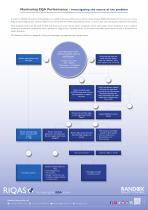
Monitoring EQA Performance : Investigating the source of the problem In order to identify the source of the problem it is useful to be aware of the most common causes of poor EQA performance. Errors can occur at any stage of the testing process however EQA is most concerned with detecting analytical errors i.e. errors that occur during the analysis of the sample. Most analytical errors can be easily divided into three main areas; clerical errors, systematic errors and random errors. Systematic errors result in inaccurate results that consistently show a positive or negative bias. Random errors on the other hand affect precision and result in fluctuations in either direction. The flowchart (below) is designed to help you investigate any apparent poor performance. Is the parameter result within acceptable limits of performance? YES • Target Score >50 • SDI <2SDPA • % Deviation < acceptable limits of performance Send corrected result to RIQAS along with relevant documentation to support the case. Verify instrument, method and units are registered correctly for each parameter. Especially important for initial submission and when registration changes have been made. Review the summary page. Are the majority of results flagged? Advise RIQAS of correct details Review Levey-Jennings charts. Are any points outside +/- 1SD? Review instrument parameters and calibration. Has the reagent batch been changed? Review IQC results from the time the EQA sample was tested. Look for trends within the data • Positive/Negative bias • Poor precision • Changes in performance due to change in reagent, calibrator or standardisation There may be a problem specific to that sample • Incorrect sample tested • Reconstitution error • Sample storage Look for shifts or trends Investigate and take corrective action The largest global EQA scheme QUALITY CONTROL Information correct at time of print. Randox Laboratories Ltd is a subsidiary of Randox Holdings Limited a company registered within Northern Ireland with company number N.I. 614690. VAT Registered Number: GB 151 6827 08. Product availability may vary from country to country. Please contact your local Randox representative for information. Products may be for Research Use Only and not for use in diagnostic procedures in the USA. Review performance over the cycle Verify that the reported result and units reflect what was obtained. Has a transcription
Open the catalog to page 1All Randox Laboratories catalogs and technical brochures
 LT735 Vivalytic Overview
32 Pages
 Acusera New Controls
8 Pages
 Acusera 24.7
24 Pages
 Acusera Third Party Controls
108 Pages
 Acusera SMART Controls
12 Pages
 Company Overview
40 Pages
 Reagents Brochure
64 Pages
 sdLDL-C
8 Pages
 RX SERIES ANALYSER OVERVIEW
24 Pages
 RX modena
20 Pages
 RX misano
20 Pages
 RX Daytona Plus
20 Pages
 Rx Imola
20 Pages
 RX Monaco
20 Pages
 2024 Product List
64 Pages
 LT107 Evidence Investigator
32 Pages
 VeraSTAT-V
16 Pages
 LT033 RIQAS Explained
64 Pages
 VERASTAT
16 Pages
 Endocrine Array
4 Pages
 Cerebral Arrays
4 Pages
 Thyroid Arrays
4 Pages
 Respiratory Multiplex Array
8 Pages
 LT253 Molecular Diagnostics
20 Pages
 LT367 FH Array Brochure
4 Pages
 The role of EQA in QC
8 Pages
 Basic QC Stastics
8 Pages
 Commutability Guide
4 Pages
 How to measure uncertainty
8 Pages
 ISO 15189 Educational Guide
8 Pages
 Troubleshooting QC Errors
8 Pages
 Qnostics
52 Pages
 Adiponectin LT519
28 Pages
 Specific Proteins
40 Pages
 Linearity sets
12 Pages
 Antioxidants
16 Pages
 Cardiology & Lipid Testing
28 Pages
 Diabetes Portfolio
28 Pages
 Total Bile Acids
4 Pages
 VIVALYTIC
30 Pages
 RANDOX DISCOVERY
36 Pages


Archived catalogs
 HbA1c
HbA1c2 Pages
 Which QC is the Right QC
8 Pages
 Custom Arrays for Biochip
12 Pages
 KRAS / BRAF / PIK3CA Array*
4 Pages
 LT241 Metabolic Array MAY15
8 Pages
 Cardiac Risk Multiplex Array
4 Pages
 How often is right for QC
6 Pages
 Tumour Marker Arrays
4 Pages
 Guide to running QC
1 Page
 Preparing QC
1 Page
 Point of Care Testing
12 Pages
 LT169 Cardiac Array
4 Pages
 ACUSERA
108 Pages
 Rx Daytona
16 Pages
 Evidence Evolution
28 Pages
 Evidence
16 Pages
 Evidence Investigator
20 Pages
 Molecular Testing
16 Pages
 STI Multiplex Array
8 Pages
 Metabolic Syndrome Arrays
8 Pages
 Fertility Array
4 Pages
 Evidence Investigator
16 Pages
 Evidence
16 Pages


- RANDOX test kit
- RANDOX solution reagent
- RANDOX molecular biology reagent
- Cassette rapid test
- RANDOX research reagent
- RANDOX laboratory reagent
- Infectious disease detection kit
- RANDOX diagnostic reagent
- RANDOX protein reagent
- RANDOX rapid virus test
- RANDOX molecular biology test kit
- RANDOX enzyme reagent
- Histology reagent
- Respiratory disease assay kit
- RANDOX rapid infectious disease test
- Cytology reagent
- Cassette detection kit
- RANDOX biochemistry reagent
- Clinical chemistry analyzer
- Real-time PCR assay kit