
- Catalogs
- Randox Laboratories
- Point of Care Testing


- Products
- Catalogs
- News & Trends
- Exhibitions
Point of Care Testing

Point of Care Testing
Point of Care Testing (POCT) is performed near the patient, providing immediate results that can influence patient care. The demand for POCT is rising due to its convenience and speed, but accuracy and reliability are critical, ensured through Quality Control (QC), which includes Internal Quality Control (IQC) and External Quality Assessment (EQA).
QC is essential for POCT devices to prevent errors that could lead to misdiagnosis or inappropriate treatments. POCT is more error-prone than laboratory testing, necessitating strict QC procedures. ISO standards like ISO 15189 and ISO 22870 guide effective QC implementation.
ISO 22870:2006 suggests forming a POCT management group for QC management and staff training. Regular users of the devices should perform QC tests to ensure reliability.
QC procedures should match the POCT device type, considering risk factors like test impact and specimen collection difficulty. Devices are categorized into High Throughput Analysers, Cartridge Based Instruments, Strip Based Instruments, and Manually Read Tests, each needing specific QC strategies.
These require QC similar to laboratory standards, with daily multi-level third-party controls.
Daily third-party controls are crucial for performance and accuracy, especially for devices lacking built-in QC functions.
Due to the absence of built-in QC features, daily third-party QC checks are recommended.
Both IQC and EQA are vital due to the high potential for human error.
IQC materials should be user-friendly, similar to patient samples, and clinically relevant. EQA schemes should provide frequent reporting and quality materials suitable for POCT devices.
The document discusses the importance of QC in POCT and the role of QC management software in ensuring accurate and reliable results.
The document emphasizes the need for QC management software to address errors in POCT due to staff responsibility issues. Key features include:
- Up-to-date Peer Group: Real-time comparison with other labs using the same control, method, and instrument.
- Multiple Instrument Registrations: Essential for monitoring numerous POCT devices.
- Online Access: Allows remote entry and access of results, aiding lab managers.
- Multiple User Levels: Provides different account levels for tracking results and ensuring device maintenance and operator training.
- User-defined Acceptable Limits: Automatically accepts or rejects QC results based on predefined criteria.
The document concludes that the benefits of POCT devices depend on accurate and reliable results. It recommends following the guidelines and adhering to ISO 15189 and ISO 22870:2006 standards for high-quality management and results.
The document cites ISO standards and studies on POCT error rates and quality.
Catalog excerpts
QC Explained 1. 0 - Quality Control for Point of Care Testing QUALITY CONTROL QC Explained 1.0 - Quality Control for Point of Care Testing QC Explained 1.0 - Quality Control for Kee, Sarah., Adams, Lynsey., Whyte, Carla J., McVicker, Louise. Point of Care Testing QC Explained 1. 0 - Quality Control for Point of Care Testing Kee, Sarah., Adams, Lynsey., Whyte, Carla J., McVicker, Louise. Background Point of care testing (POCT) refers to testing that is performed near or at the site of a patient with the result leading to a possible change in the care of the patient. Over the past few years, the Point of care testing (POCT) refers to popularity and demand of POCT has been testing that is performed near or at the growing rapidly. This should come as no site of a patient with the result leading surprise as there are many advantages to to a possible change in the care of the POCT, for example, the added patient. Over the past few years, the convenience of being able to obtain a popularity and demand of POCT has been rapid result at the patient’s bedside, thus growing rapidly. This should come as no allowing immediate action, saving time surprise as there are many advantages to and improving the potential outcome for POCT, for example, the added the patient. convenience of being able to obtain a Although there the patient’s bedside,using rapid result at are many benefits of thus POCT devices in action, saving their terms of time allowing immediate convenience, these benefits are only true if and improving the potential outcome for the patient. produced are both accurate results and reliable. Ensuring accuracy and Although there are many benefits of using POCT devices in terms of their convenience, these benefits are only true if 1 the results produced are both accurate and reliable. Ensuring accuracy and reliability is the primary responsibility of Quality Control. Quality control is composed of two key elements; internal quality control (IQC) and external quality assessment (EQA). IQC reliability is the primary responsibility of involvesControl. quality control material Quality running that contains analytes of known Quality control is composed of two key concentration to monitor the precision of elements; internal quality control (IQC) the analytical process over time. Whereas and external quality assessment (EQA). IQC EQA involves running blind patient-like involves running quality control material samples, comparing your results to peer that contains analytes of known results, in order to retrospectively monitor concentration to monitor the precision of the accuracy of reporting. EQA samples the analytical process over time. Whereas should be treated as if they were a patient EQA involves running blind patient-like sample and therefore must be run by samples, comparing your results to peer personnel who would be using the device. results, in order to retrospectively monitor This provides confidence in the reliability the accuracy of reporting. EQA samples of patient test results. should be treated as if they were a patient sample and therefore must be run by personnel who would be using the device. This provides confidence in the reliability of patient test results
Open the catalog to page 1
QC Explained 1. 0 - Quality Control for Point of Care Testing QUALITY CONTROL Section Title Page 1.0 Importance of Quality Control for POCT Devices 3 3.0 Choosing an Appropriate QC Procedure for your POCT Device 4 3.1 Balancing risk with the stringency of your POCT quality 4 control procedure 3.1.1 Choosing a QC procedure for High Throughput Analyser 5 Type POCT Instruments 3.1.2 Choosing a QC procedure for Cartridge Based Instruments 5 3.1.3 Choosing a QC procedure for Strip Based Instruments 6 3.1.4 Choosing a QC procedure for manually read POC...
Open the catalog to page 2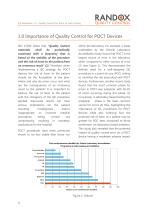
QC Explained 1. 0 - Quality Control for Point of Care Testing QUALITY CONTROL ISO 15189 states that "Quality Control materials shall be periodically examined with a frequency that is based on the stability of the procedure and the risk of harm to the patient from an erroneous result" (1). Therefore, when implementing a QC strategy for POCT devices the risk of harm to the patient should be the foundation of the plan: where and why do errors occur and what are the consequences of an erroneous result to the patient? It is important to balance the risk of harm to the patient with the stringency...
Open the catalog to page 3
QC Explained 1. 0 - Quality Control for Point of Care Testing QUALITY CONTROL on patient outcome was 14.7% (3), demonstrating that for POCT devices there is larger room for error and a greater need for quality control. Some POCT device manufacturers advise that QC procedures similar to those found in the laboratory are unnecessary for POCT devices. However, this is not the opinion of the majority of laboratory professionals who believe a place undoubtedly remains for traditional IQC and EQA practices for POCT. This view is supported by the introduction of the new ISO POC specific regulations....
Open the catalog to page 4
QC Explained 1. 0 - Quality Control for Point of Care Testing QUALITY CONTROL • tests used to support the clinician's decision in isolation, • tests acted upon immediately, and • tests performed on specimens that are difficult to collect. The POCT strategy will depend on the POC device that is being used as POCT devices can be broadly split into three categories: 1. "High Throughput Analyser"- Full size instruments used at the point of care, e.g.: blood gas analysers. 2. "Cartridge Based Instruments"- For example HbA1c and INR analysers. 3. "Strip Based Instruments" e.g.: electrochemical or...
Open the catalog to page 5
QC Explained 1. 0 - Quality Control for Point of Care Testing QUALITY CONTROL Each time the laboratory receives a new batch of cartridges they should be evaluated using multi-level, third party controls to ensure that the cartridges have not been damaged during transport. It is also a good idea to periodically test quality control samples over the shelf life of a particular batch. Ideally a third party control should be used every day of patient testing to ensure the stability of the on-board reagents and the accuracy of the results obtained, as recommended by ISO 15189. However, it's important...
Open the catalog to page 6All Randox Laboratories catalogs and technical brochures
 LT735 Vivalytic Overview
32 Pages
 Acusera New Controls
8 Pages
 Acusera 24.7
24 Pages
 Acusera Third Party Controls
108 Pages
 Acusera SMART Controls
12 Pages
 Company Overview
40 Pages
 Reagents Brochure
64 Pages
 sdLDL-C
8 Pages
 RX SERIES ANALYSER OVERVIEW
24 Pages
 RX modena
20 Pages
 RX misano
20 Pages
 RX Daytona Plus
20 Pages
 Rx Imola
20 Pages
 RX Monaco
20 Pages
 2024 Product List
64 Pages
 LT107 Evidence Investigator
32 Pages
 VeraSTAT-V
16 Pages
 LT033 RIQAS Explained
64 Pages
 VERASTAT
16 Pages
 Endocrine Array
4 Pages
 Cerebral Arrays
4 Pages
 Thyroid Arrays
4 Pages
 Respiratory Multiplex Array
8 Pages
 LT253 Molecular Diagnostics
20 Pages
 LT367 FH Array Brochure
4 Pages
 The role of EQA in QC
8 Pages
 Basic QC Stastics
8 Pages
 Commutability Guide
4 Pages
 How to measure uncertainty
8 Pages
 ISO 15189 Educational Guide
8 Pages
 Troubleshooting QC Errors
8 Pages
 Qnostics
52 Pages
 Adiponectin LT519
28 Pages
 Specific Proteins
40 Pages
 Linearity sets
12 Pages
 Antioxidants
16 Pages
 Cardiology & Lipid Testing
28 Pages
 Diabetes Portfolio
28 Pages
 Total Bile Acids
4 Pages
 VIVALYTIC
30 Pages
 RANDOX DISCOVERY
36 Pages


Archived catalogs
 HbA1c
HbA1c2 Pages
 Which QC is the Right QC
8 Pages
 Custom Arrays for Biochip
12 Pages
 KRAS / BRAF / PIK3CA Array*
4 Pages
 LT241 Metabolic Array MAY15
8 Pages
 Cardiac Risk Multiplex Array
4 Pages
 How often is right for QC
6 Pages
 Tumour Marker Arrays
4 Pages
 Guide to running QC
1 Page
 Preparing QC
1 Page
 LT169 Cardiac Array
4 Pages
 ACUSERA
108 Pages
 Rx Daytona
16 Pages
 Evidence Evolution
28 Pages
 Evidence
16 Pages
 Evidence Investigator
20 Pages
 Molecular Testing
16 Pages
 STI Multiplex Array
8 Pages
 Metabolic Syndrome Arrays
8 Pages
 Fertility Array
4 Pages
 Evidence Investigator
16 Pages
 Evidence
16 Pages


- RANDOX test kit
- RANDOX solution reagent
- RANDOX molecular biology reagent
- Cassette rapid test
- RANDOX research reagent
- RANDOX laboratory reagent
- Infectious disease detection kit
- RANDOX diagnostic reagent
- RANDOX protein reagent
- RANDOX rapid virus test
- RANDOX molecular biology test kit
- RANDOX enzyme reagent
- Histology reagent
- Respiratory disease assay kit
- RANDOX rapid infectious disease test
- Cytology reagent
- Cassette detection kit
- RANDOX biochemistry reagent
- Clinical chemistry analyzer
- Real-time PCR assay kit