
- Catalogs
- Randox Laboratories
- The role of EQA in QC


- Products
- Catalogs
- News & Trends
- Exhibitions
The role of EQA in QC

The role of EQA in QC
Quality Control is essential for laboratories to ensure the accuracy and precision of patient sample testing. Without QC, errors could lead to misdiagnosis and inappropriate treatment, posing life-threatening risks to patients.
Internal Quality Control (IQC) is crucial but limited as it does not address calibration issues or systematic errors. External Quality Assessment (EQA), also known as Proficiency Testing (PT), complements IQC by providing an objective check of laboratory results through an external agency, as recommended by ISO 15189.
EQA is vital for verifying the reliability of laboratory results. It helps identify biases and inaccuracies that IQC might miss. Participation in an ISO 17043 accredited EQA scheme is recommended to ensure laboratory quality and prevent incorrect patient results.
A laboratory using only IQC showed excellent precision and accuracy. However, participation in an EQA scheme revealed erratic performance due to an instrument fault, highlighting the importance of EQA.
Laboratories register their instruments and methods, receive samples, analyze them, and submit results for statistical evaluation. Reports compare their performance with other participants, facilitating interlaboratory performance comparison and standardization.
- Compares different analytical methods
- Initiates corrective actions
- Improves interlaboratory agreement
- Detects equipment failures and reagent problems
Ensure the scheme is accredited to ISO/IEC 17043:2010. Frequent reporting is crucial for timely error identification. A good scheme should offer clinically relevant challenges and have a large number of international participants for statistical validity.
Supplementing existing EQA schemes with additional programs can enhance frequency and coverage, increasing productivity and saving time and money.
Randox Laboratories provides comprehensive EQA solutions with a wide range of analytes and flexible formats, helping laboratories meet ISO 15189:2012 requirements and ensuring unbiased performance assessment.
Catalog excerpts

EDUCATIONAL GUIDE The Role of EQA in Quality Control QUALITY CONTROL
Open the catalog to page 1
The Role of EQA in Quality Control Quality Control (QC) is a vital process for laboratories to monitor the accuracy and precision of patient sample testing. Without QC, laboratory errors could go undetected potentially resulting in misdiagnosis and inappropriate or delayed treatment, all of which could be life threatening for the patient. Taking An Holistic View While Internal Quality Control (IQC) does a vital job it is only part of the overall quality management picture. For example, IQC doesn’t address calibration issues, instrument systematic errors or wide ‘acceptable’ limits. Equally, while...
Open the catalog to page 2
How Does EQA Work? EQA provides a means of periodically assessing laboratory performance in comparison with other laboratories using the same method and instrument. Unlike IQC, EQA provides an effective method of monitoring a laboratory’s bias or accuracy through the analysis of samples of unknown concentrations otherwise known as ‘blind samples’. It also enables assessment of the complete testing process including pre-analytical, analytical and post analytical phases. After analysis, results are submitted to the scheme organiser for statistical evaluation. Laboratories will subsequently receive...
Open the catalog to page 3
Benefits Of EQA EQA plays an essential role in assuring laboratory quality by supporting daily IQC. It facilitates interlaboratory performance comparison, bringing greater standardisation in diagnostic testing. EQA has a number of functions: • It compares different analytical methods • Initiates and evaluates corrective actions • Provides an objective view of test system performance that IQC alone cannot provide • It improves interlaboratory agreement and helps raise standards • It maintains and improves the analytical quality of laboratory tests • It helps laboratories detect equipment failures,...
Open the catalog to page 4
As part of your EQA scheme you will be provided with ‘blind’ samples to be analysed as if they were patient samples. Analytes should be provided in a realistic range of concentrations, allowing assessment of normal and abnormal ranges, both analytical and clinical decision levels should be covered. It’s important that samples should be stable, but free from interfering preservatives or stabilisers, and offer a matrix consistent with a human sample. Labs should be confident that EQA material mirrors that of patient samples. EQA programmes should offer flexibility to customise the programme to...
Open the catalog to page 5
ACUSERA True third party quality controls As a world leading manufacturer of multi-analyte true third party controls, thousands of laboratories rely on Randox to accurately assess test system performance and ultimately empower them with the confidence required to release patient test results. With more than 390 analytes available, the number of individual controls required to cover your test menu is significantly reduced while simultaneously reducing costs, time and storage space. A choice of formats is available, including liquid or lyophilised, which ensures flexibility and suitability for...
Open the catalog to page 6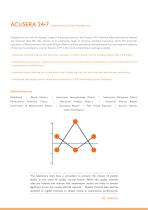
ACUSERA 24•7 Interlaboratory Data Management Designed for use with the Acusera range of third party controls, the Acusera 24•7 software helps laboratories monitor and interpret their QC data. Access to an impressive range of features, including interactive charts, the automatic calculation of Measurement Uncertainty & Sigma Metrics and live peer group data generated from our extensive database of laboratory participants, ensures Acusera 24•7 is the most comprehensive package available. • Advanced statistical analysis with automatic calculation of performance metrics including; Sigma, UM, TE &...
Open the catalog to page 7
Copyright © 2019 Randox Laboratories Ltd. All rights Reserved. VAT number: GB 151682708. Product availability may vary from country to country. Some products may be for Research Use Only. For more information on product application and availability, please contact your local Randox Representative.
Open the catalog to page 8All Randox Laboratories catalogs and technical brochures
 LT735 Vivalytic Overview
32 Pages
 Acusera New Controls
8 Pages
 Acusera 24.7
24 Pages
 Acusera Third Party Controls
108 Pages
 Acusera SMART Controls
12 Pages
 Company Overview
40 Pages
 Reagents Brochure
64 Pages
 sdLDL-C
8 Pages
 RX SERIES ANALYSER OVERVIEW
24 Pages
 RX modena
20 Pages
 RX misano
20 Pages
 RX Daytona Plus
20 Pages
 Rx Imola
20 Pages
 RX Monaco
20 Pages
 2024 Product List
64 Pages
 LT107 Evidence Investigator
32 Pages
 VeraSTAT-V
16 Pages
 LT033 RIQAS Explained
64 Pages
 VERASTAT
16 Pages
 Endocrine Array
4 Pages
 Cerebral Arrays
4 Pages
 Thyroid Arrays
4 Pages
 Respiratory Multiplex Array
8 Pages
 LT253 Molecular Diagnostics
20 Pages
 LT367 FH Array Brochure
4 Pages
 Basic QC Stastics
8 Pages
 Commutability Guide
4 Pages
 How to measure uncertainty
8 Pages
 ISO 15189 Educational Guide
8 Pages
 Troubleshooting QC Errors
8 Pages
 Qnostics
52 Pages
 Adiponectin LT519
28 Pages
 Specific Proteins
40 Pages
 Linearity sets
12 Pages
 Antioxidants
16 Pages
 Cardiology & Lipid Testing
28 Pages
 Diabetes Portfolio
28 Pages
 Total Bile Acids
4 Pages
 VIVALYTIC
30 Pages
 RANDOX DISCOVERY
36 Pages


Archived catalogs
 HbA1c
HbA1c2 Pages
 Which QC is the Right QC
8 Pages
 Custom Arrays for Biochip
12 Pages
 KRAS / BRAF / PIK3CA Array*
4 Pages
 LT241 Metabolic Array MAY15
8 Pages
 Cardiac Risk Multiplex Array
4 Pages
 How often is right for QC
6 Pages
 Tumour Marker Arrays
4 Pages
 Guide to running QC
1 Page
 Preparing QC
1 Page
 Point of Care Testing
12 Pages
 LT169 Cardiac Array
4 Pages
 ACUSERA
108 Pages
 Rx Daytona
16 Pages
 Evidence Evolution
28 Pages
 Evidence
16 Pages
 Evidence Investigator
20 Pages
 Molecular Testing
16 Pages
 STI Multiplex Array
8 Pages
 Metabolic Syndrome Arrays
8 Pages
 Fertility Array
4 Pages
 Evidence Investigator
16 Pages
 Evidence
16 Pages


- RANDOX test kit
- RANDOX solution reagent
- RANDOX molecular biology reagent
- Cassette rapid test
- RANDOX research reagent
- RANDOX laboratory reagent
- Infectious disease detection kit
- RANDOX diagnostic reagent
- RANDOX protein reagent
- RANDOX rapid virus test
- RANDOX molecular biology test kit
- RANDOX enzyme reagent
- Histology reagent
- Respiratory disease assay kit
- RANDOX rapid infectious disease test
- Cytology reagent
- Cassette detection kit
- RANDOX biochemistry reagent
- Clinical chemistry analyzer
- Real-time PCR assay kit