


- Company
- Products
- Catalogs
- News & Trends
- Exhibitions
BENCHTOP AUTOCLAVES WITHOUT DRYING - AHS-N SERIES

BENCHTOP AUTOCLAVES WITHOUT DRYING - AHS-N SERIES
The AHS-N Series benchtop autoclaves by RAYPA are compact and efficient devices designed for general laboratory sterilization needs, excluding drying capabilities. They are suitable for sterilizing a variety of items such as liquids, culture media, glassware, plastics, metal objects, and laboratory waste.
RAYPA is a global leader in laboratory autoclave manufacturing, exporting 85% of its products to over 100 countries. With over 45 years of experience, RAYPA is known for its innovation, quality, and efficient technical service. The company provides comprehensive consultancy, guidance, and training to ensure optimal operation and extended product lifespan.
The autoclaves feature a high-quality stainless steel chamber and door, comply with EU quality and safety standards, and include powerful Incoloy® 825 heating elements. They are equipped with a PID microprocessor control offering 4 predefined and 6 editable programs, and optional software and printer for data management. The plug-and-play design requires no plumbing.
The autoclaves utilize a PID microprocessor to manage sterilization cycles, which include heating, sterilization, and cooling phases. Rapid steam release is available for faster cooling.
The AHS-50-N and AHS-75-N models offer 10 programs, with 4 pre-set and 6 customizable options. The digital screen displays sterilization parameters and alerts in multiple languages.
Models offer varying capacities for ISO bottles and Erlenmeyer flasks, with detailed tables provided for selection guidance.
Each model includes specific components such as stainless steel trays, clamps, and auxiliary trays for water collection.
Optional accessories include thermal printers, flexible temperature probes, cable glands, and software for enhanced functionality and data management.
The document provides detailed technical specifications and features of the AHS-N Series autoclaves, including information on accessories, services, technical drawings, safety features, regulations, and general specifications.
Services offered include consumables and spare parts, stability mapping, maintenance contracts, extended warranty, IQ-OQ documentation, calibration certificates, and both on-site and remote commissioning and training.
Detailed diagrams are provided for different models, highlighting key components like drain filters, water tank outlets, and safety valves.
The document describes three models: AH-21-N2, AHS-50-N, and AHS-75-N, detailing specifications on chamber volume, materials, pressure, and user interface features.
Safety mechanisms include a safety valve, thermostat, pneumatic door blocking, open door sensor, and various alarms to ensure safe operation under pressure.
The autoclaves comply with international standards such as EN-61010-1, EN-61010-2-040, EN-61326, AD 2000 Merkblatt, and EU directives on low voltage, electromagnetic compatibility, and pressure equipment.
The autoclaves offer adjustable sterilization temperatures and times, automatic control systems, gravity displacement air purge, and RS-232 connections for data transfer, designed for small facilities and general laboratories.
Detailed specifications include chamber dimensions, water tank volume, power requirements, and weight, along with information on tray sizes, net weight, and electrical configurations.
Catalog excerpts

Benchtop autoclaves without drying AHS-N Series CLASSIC LINE Technical information
Open the catalog to page 1
AHS-N Series Why choose RAYPA? Expert manufacturer, original design, global brand GLOBAL REACH With half a century of experience, we have a long list of satisfied customers around the world. Currently, we export 85% of our annual turnover and have a stable network of distributors with presence in over 100 countries. EXPERT MANUFACTURER After more than 45 years in the industry, RAYPA is a global leader in the manufacture of laboratory autoclaves. Each of our autoclaves is designed and manufactured entirely within our modern facility equipped with the latest technology. INNOVATION AND QUALITY Our...
Open the catalog to page 2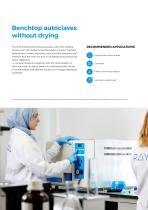
Benchtop autoclaves without drying The AHS-N Series benchtop autoclaves with front-loading access cover the fundamental sterilization needs of general laboratories in many industries, educational institutions and research facilities with the aim of increasing the productivity of the laboratory. A compact footprint together with the optimization of resources such as water, power and operating time results in an affordable and efficient solution to manage laboratory workload. RECOMMENDED APPLICATIONS Liquids and culture media Plastics and metal objects Laboratory waste bags* *For this application,...
Open the catalog to page 3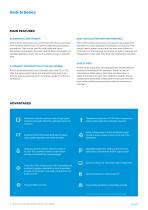
AHS-N Series MAIN FEATURES ECONOMICAL AND ROBUST EASY INSTALLATION AND MAINTENANCE AHS-N Series autoclaves are economical and robust autoclaves with excellent performance for general laboratory sterilization procedures. They can be used for both solid and liquid sterilization procedures. They also have limited consumption of valuable laboratory resources such as water, power or operator time. Every AHS-N Series autoclave is a plug and play equipment that does not need dedicated installation connections. They simply need a power source and can work even without a connection to the drainage. All...
Open the catalog to page 4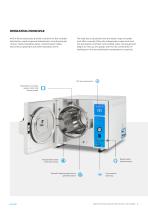
OPERATING PRINCIPLE AHS-N Series autoclaves provide a solution for the multiple sterilization needs of general laboratories, including liquids, culture media, biological waste, contaminated media, instruments, glassware and other laboratory items. The load has to be placed into the vessel’s trays or basket and, after manually filling the independent water tank and the sterilization chamber with purified water, the equipment begins to heat up and purge until the set combination of sterilization time and sterilization temperature is reached. PID microprocessor Sterilization chamber made of AISI-316L...
Open the catalog to page 5
AHS-N Series OPERATION OF A STERILIZATION CYCLE FOR SOLIDS HEATING PHASE COOLING PHASE • In this initial step, the powerful heating elements assembled at the bottom of the sterilization chamber heat up dramatically, transferring energy to water to produce saturated steam throughout the chamber. • Once the sterilization phase is complete, natural cooling begins, and the steam and water located inside the chamber around the electric heating elements will automatically return to the independent water tank. An acoustic beep will sound when a safe temperature is reached, allowing the chamber to be...
Open the catalog to page 6
• Sterilization cycle is ongoing. • Delay start function is ongoing. • Preprogrammed sterilization time is ongoing. • Safety thermostat is activated. • Indefinitely at a set temperature after an initial delay. • During a finite period of time at a set temperature. • During a finite period of time at a set temperature after an initial delay. • The screen shows current chamber temperature, sterilization parameters and error messages. • Digital microprocessor and several intuitive push-buttons to set up the sterilization cycle parameters. • A manual valve is used to supply water to the sterilization...
Open the catalog to page 7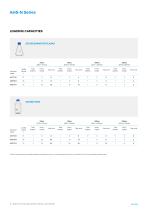
LOADING CAPACITIES ISO ERLENMEYER FLASKS Usable Total volume baskets Units / basket Total units Units / basket Total units Units / basket Total units Units / basket Total units Usable Total volume baskets Units / basket Total units Units / basket Total units Units / basket Total units Units / basket Total units The data contained within these tables, regarding load capacities, serves as a non-binding guide to assist you in the selection of the most appropriate autoclave model. 8 BENCHTOP AUTOCLAVES WITHOUT DRYING - AHS-N SERIES
Open the catalog to page 8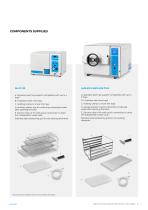
A. Stainless steel tray support compatible with up to 4 trays1. B. 3 stainless steel wire trays. C. Holding clamp to move the trays. D. Auxiliary plastic tray for collecting condensed water after opening the door. E. Silicone tube of 1m with quick connection to drain the independent water tank. Stainless steel protecting grid for the heating elements. A. Stainless steel tray support compatible with up to 5 trays. B. 2 stainless steel wire trays. C. Holding clamp to move the trays. D. Auxiliary plastic tray for collecting condensed water after opening the door. E. Silicone tube of 1m with quick...
Open the catalog to page 9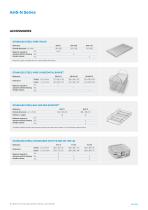
AHS-N Series ACCESSORIES STAINLESS STEEL WIRE TRAYS References External dimensions L x D mm Maximum capacity for autoclaves with the following chamber volumes *Special tray support compatible with up to 5 trays available under request. STAINLESS STEEL WIRE HORIZONTAL BASKET References Dimensions Maximum capacity for autoclaves with the following chamber volumes STAINLESS STEEL BAG HOLDER SUPPORT* References External dimensions L x D x H mm Positions / support Maximum capacity for autoclaves with the following chamber volumes *Possibility of adapting the size of this accessory according to the...
Open the catalog to page 10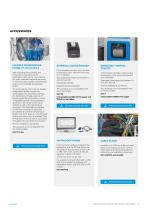
FLEXIBLE TEMPERATURE PROBE PT-100 CLASS A After installing this accessory, the temperature regulation of the sterilization cycle can be controlled by the main chamber temperature probe or both the main chamber temperature probe and the flexible temperature probe. The temperature control by the flexible temperature probe is especially advantageous for processes involving the sterilization of large volumes of liquids, where the sterilization process is regulated by both the temperature achieved in the center of the liquid sample as well as the temperature achieved in the sterilization chamber....
Open the catalog to page 11All RAYPA catalogs and technical brochures
 Media preparators
19 Pages
 2023 FULL CATALOGUE
102 Pages
 COLD FAT EXTRACTOR EF-6P
5 Pages
 RANDALL EXTRACTOR - SX-6
9 Pages
 FIBRE EXTRACTOR - F-6P SERIES
10 Pages
 OENOLOGIC DISTILLER - ENODEST
10 Pages
 KJELDAHL DIGESTER - MBC SERIES
12 Pages
 KJELDAHL DISTILLER - DNP SERIES
16 Pages



- Sterilizer
- Steam sterilizer
- Benchtop sterilizer
- Automatic sterilizer
- Stainless steel sterilizer
- Laboratory sterilizer
- Floor-standing sterilizer
- Front-loading autoclave
- Sterilizer with touchscreen
- Dental sterilizer
- Top-loading sterilizer
- Programmable sterilizer
- Microprocessor-controlled sterilizer
- Sterilizer with vacuum cycle
- Compact sterilizer
- Sterilizer with steam generator
- Sterilizer on casters
- Sterilizer with dryer
- Electric autoclave
- Sterilizer for the pharmaceutical industry