


Variable Pathlength Slope Spectroscopy

Variable Pathlength Slope Spectroscopy
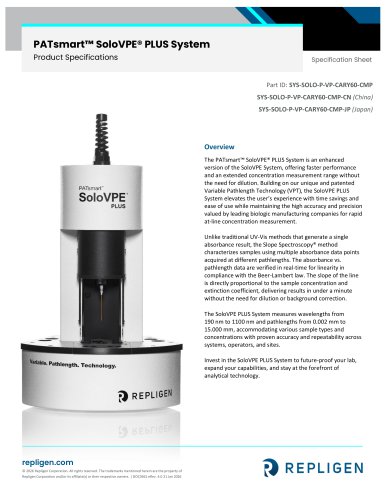
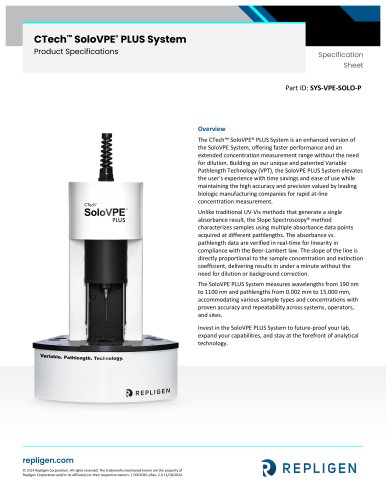
The SoloVPE System introduces a novel approach to spectroscopy through Variable Pathlength Slope Spectroscopy. Unlike traditional UV-Vis methods that rely on a single absolute absorbance value, this technique uses absorbance versus pathlength data to determine a slope value for quantifying sample concentration. This method is based on the Slope Spectroscopy Equation (m = ec), derived from the Beer-Lambert Law.
The SoloVPE's variable pathlength technology allows for the measurement of highly concentrated samples without the need for dilution or baseline correction. This patented technology is globally deployed, enhancing accuracy and efficiency in sample analysis.
- Eliminates the need for buffer correction when the slope is zero, as the buffer does not contribute to the sample.
- Ensures accuracy through linear regression, confirming proportional changes in absorbance with pathlength as per the Beer-Lambert Law.
- No dilution or baseline correction required.
- Proven linearity with an R2 value of 0.999534, indicating high accuracy.
- Measurement repeatability within ±2%.
- Sample reading time is less than one minute.
- Antibody concentration range from 0.01 mg/ml to 300 mg/ml.
- Minimum sample volume is less than 20 μl, depending on concentration.
- Pathlength range from 0.005 mm to 15 mm, with a resolution of 0.005 mm (5 μm).
- Wavelength range from 190 nm to 1100 nm.
- Compliant with 21 CFR Part 11 software standards.
The SoloVPE System offers a reliable and efficient method for sample analysis, providing accurate results without the need for traditional sample preparation methods. Its compliance with industry standards and broad application range make it a valuable tool in spectroscopy.
Catalog excerpts
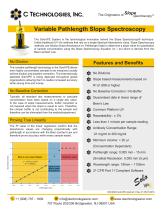
The Originators of Slope spectroscopy Variable Pathlength Slope Spectroscopy The SoloVPE System is the technological innovation behind the Slope Spectroscopy® technique. Unlike traditional UV-Vis methods that rely on a single Absolute Absorbance value, Slope Spectroscopy methods use Section Data (Absorbance vs. Pathlength Data) to determine a slope value for quantitation of sample concentration using the Slope Spectroscopy Equation (m = ec) which is derived from the Beer-Lambert Law. The variable pathlength technology in the SoloVPE allows even highly concentrated samples to be measured usually without dilution and baseline correction. The internationally patented SoloVPE is being deployed throughout global organizations allowing them to realize increased accuracy while saving time and money. Slope based measurements based on R2 of .999 or higher No Baseline Correction / No Buffer Typically, all standard abs measurements to calculate concentration have been based on a single abs value. In the case of slope measurements, buffer correction is not required when the slope is equal to zero. Therefore, the chosen buffer is not contributing to the sample and therefore can be eliminated from the method/experiment. Guaranteed data in linear range of Beer’s Law The R value of the linear regression confirm that the absorbance values are changing proportionally with pathlength in accordance with the Beer-Lambert Law and therefore prove accuracy within every sample tested. Proving True Linearity Less than 1 minute per sample reading Antibody Concentration Range: .01 mg/ml to 300 mg/ml Beer’s Law Linear Region Detection Limit Beer’s Law Non-Linear Breakdown 21 CFR Part 11 Compliant Software [email protected] www.ctechnologiesinc.com 757 Route
Open the catalog to page 1All Repligen catalogs and technical brochures
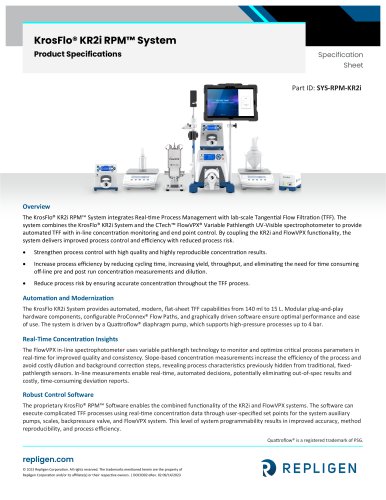
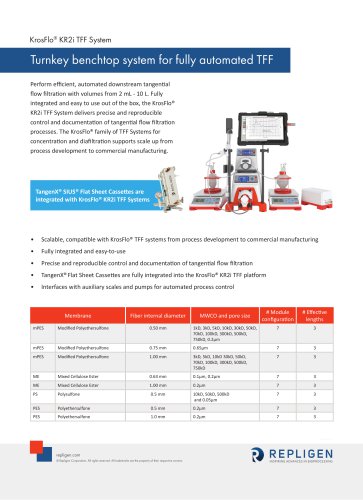 KrosFlo® KR2i TFF System
1 Page
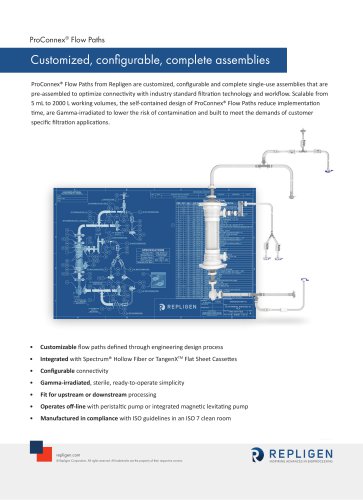 ProConnex® Flow Paths
1 Page
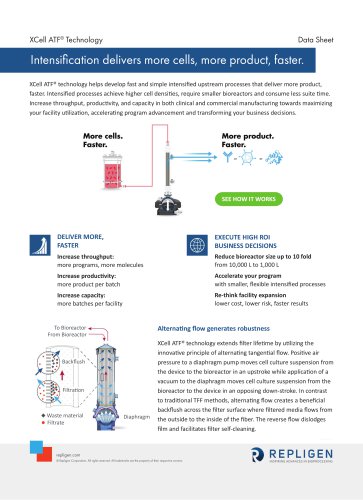 XCell ATF® Technology
2 Pages
Archived catalogs


- Analysis software
- Control software
- Laboratory testing system
- Reporting software
- Windows software
- Monitoring software
- Cloud-based software
- Medical device testing system
- Control analyser
- Data management software
- Measurement software
- Spectrophotometer
- Web-based software
- Test software
- Real-time software
- Data analysis software
- Testing system with touchscreen
- Benchtop spectrophotometer
- Continuous testing system
- Security software